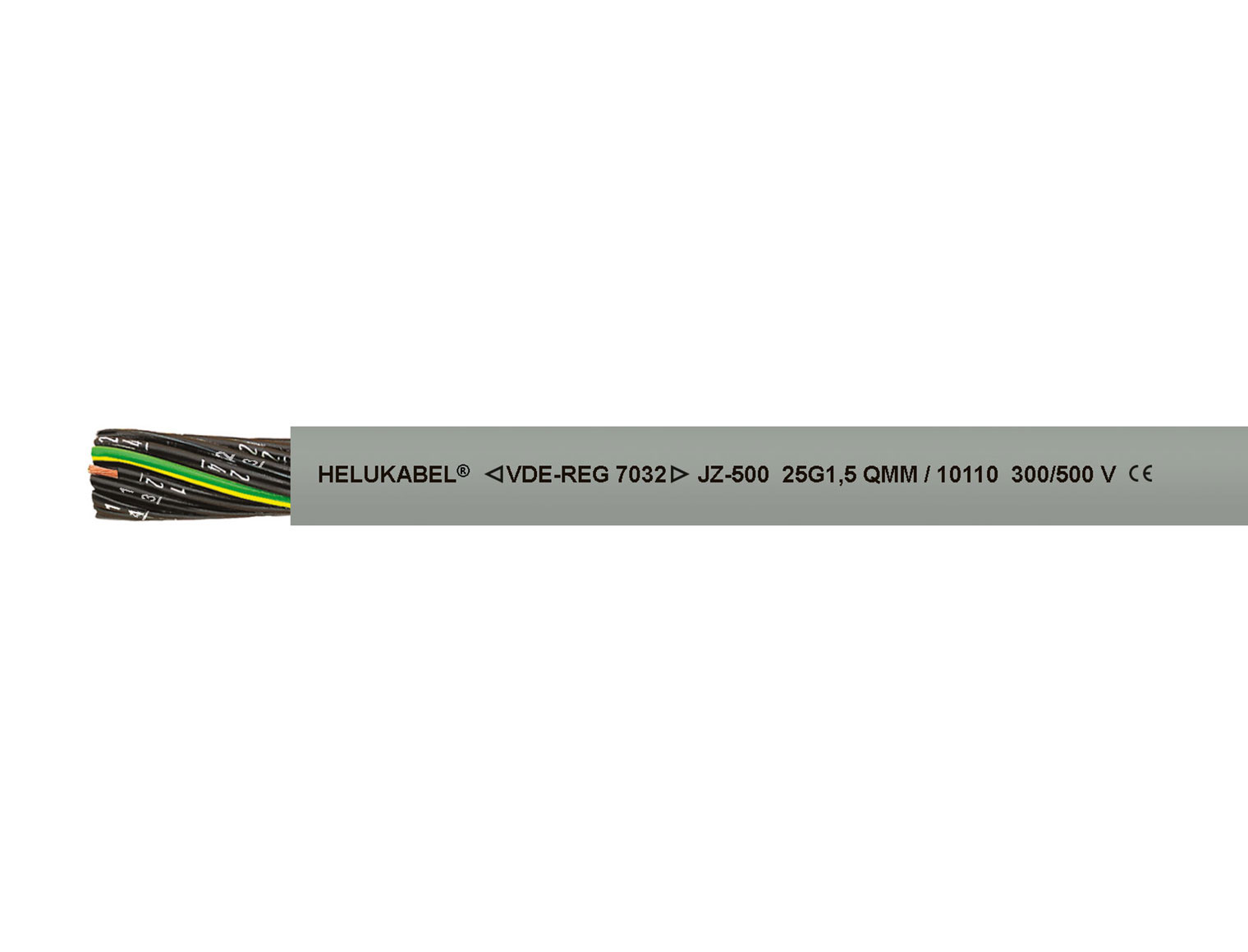
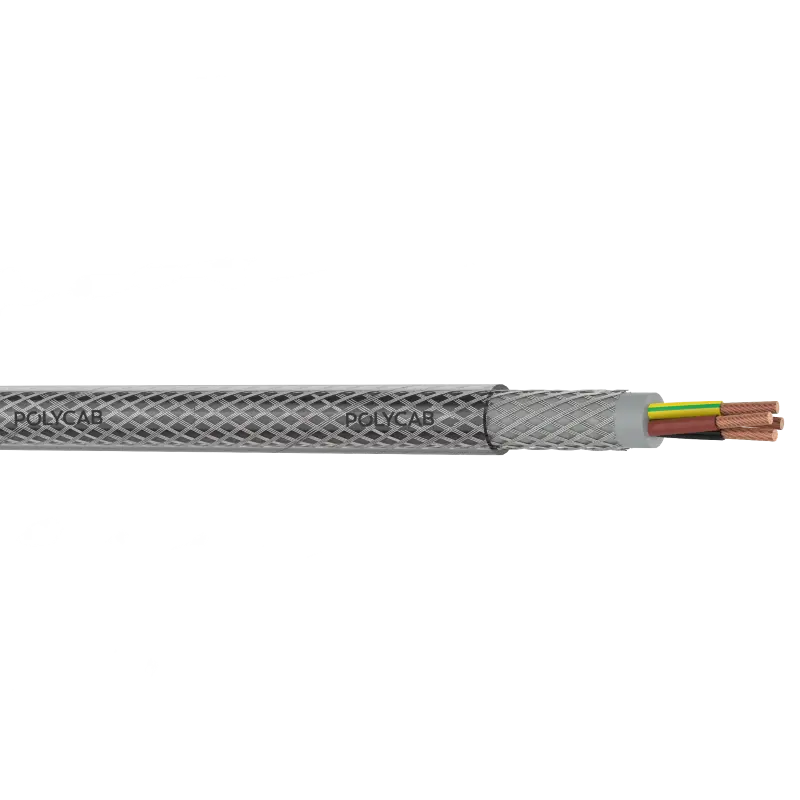
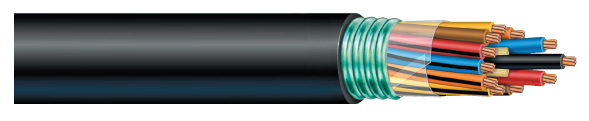
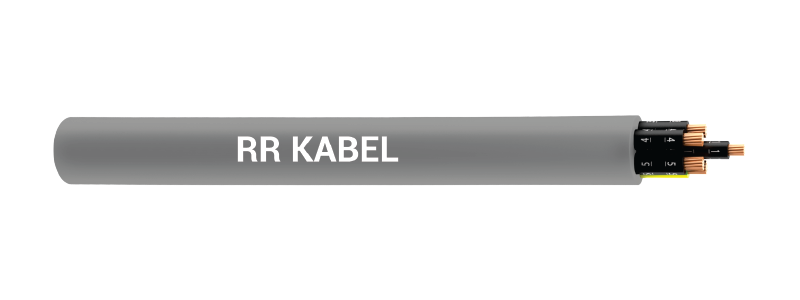
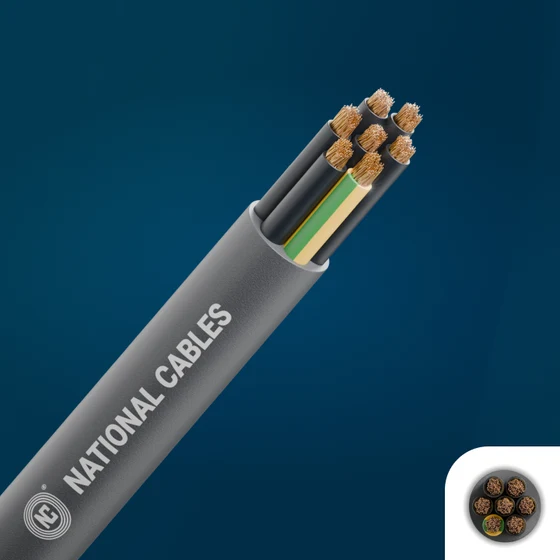
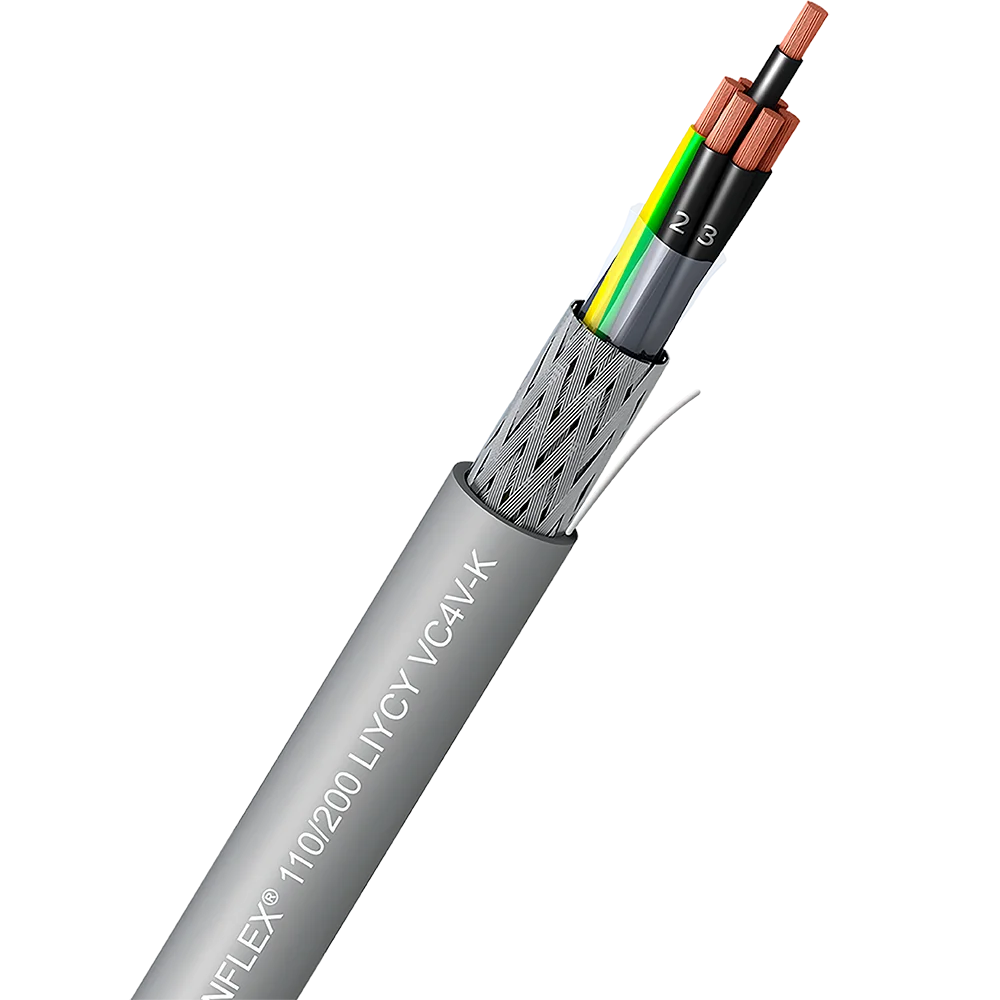
A control cable is a multi-core flexible or installation cable that carries command, signal, and feedback circuits between controllers and field devices: PLCs, contactors, relays, sensors, drives, and actuators. Unlike a power cable, which is sized for load current, a control cable is built for many cores, small cross-sections, clear core identification, and where needed, electromagnetic shielding. It is the connective tissue of any automated machine or process line.
This guide treats control cable as an engineering selection problem. It covers construction, the main cable families used in IEC and North American markets, insulation and sheath grades, shielding, the standards that govern them, how to read a datasheet, and the decision sequence that turns process requirements into a verified part number.
Photo: Adamantios, CC BY-SA 3.0, via Wikimedia Commons
This guide is written for industrial purchasing engineers and design engineers. It covers 6 chapters from construction and cable families through insulation grades, shielding, spec-sheet decoding, to the selection decision, with 7 selection FAQs and verified manufacturer comparisons. All parameters reference public standards including IEC 60227, IEC 60502-1, IEC 60228, UL 1277, UL 2250, and DIN VDE 0293-308, plus published manufacturer datasheets.
Chapter 1 / 06
What is a Control Cable
A control cable is a multi-conductor cable whose purpose is to transmit control and signal currents rather than the main power that drives a load. In a typical automated machine, the power cable feeds the motor, and the control cable carries the dozens of low-current circuits that tell the machine what to do: contactor coil commands, limit-switch returns, sensor signals, enable lines, and feedback to the PLC. Because each of these circuits is an independent conductor, a control cable is defined first by its core count and second by the cross-section of each core.
Structurally, a control cable consists of four layers from the inside out: (1) the conductors, usually annealed bare or tinned copper, stranded to a flexibility class defined by IEC 60228; (2) the core insulation, most often PVC for general duty, with XLPE, EPR, silicone, or PUR for higher temperature or harsher environments; (3) an optional shield, a tinned-copper braid, an aluminium-polyester foil, or a combination of both, for electromagnetic compatibility; and (4) the outer sheath, typically PVC, polyurethane (PUR), or a halogen-free compound, which provides mechanical, chemical, and abrasion protection.
The defining feature against a power cable is the trade space. A power cable optimises ampacity: few large conductors sized so the temperature rise and voltage drop stay within limits. A control cable optimises core count, flexibility, and signal integrity: many small conductors, each carrying a fraction of an ampere, with numbered or color-coded identification so an electrician can land them correctly at a terminal block. Cross-sections commonly run from 0.5 to 2.5 square millimetres (about 20 to 14 AWG), and core counts from 2 up to 100 in catalog builds, though 3 to 25 covers most machine wiring.
The industrial history of control cabling tracks the rise of the control panel. Early relay logic in the mid-twentieth century used individual single-core wires bundled in trunking. As machines grew more complex, pre-assembled multi-core cables with numbered cores replaced loose wiring, cutting installation labour and wiring errors. The European flexible control cable, exemplified by the Lapp OLFLEX family first produced in 1957, made fine-stranded, oil-resistant, numbered-core cable a standard machine-building component. In North America, the tray-cable concept under UL 1277 and NEC Article 336 standardised multi-conductor power and control cable for industrial plant.
In application scale, control cables span an enormous range of environments: from a dry, temperature-controlled electrical cabinet, to a robot arm flexing millions of cycles in a drag chain, to an outdoor oil field where the cable sees sunlight, hydrocarbons, and -40 degrees Celsius winters. No single cable spans that range. The essence of selection, as with any field component, is mapping the real environment and circuit duty onto a specific construction, insulation grade, shield, and approval set.
Chapter 2 / 06
Control Cable Families
Control cables divide into families that reflect two different regulatory and market traditions: the IEC and European flexible-cable world, and the North American tray-cable world under the National Electrical Code. Naming a cable by its family is the fastest way to communicate construction, voltage class, and intended installation. The table below compares the most common families a buyer encounters.
Flexible control cable (YY) is the workhorse of European machine building. It uses fine-stranded Class 5 copper conductors per IEC 60228, PVC core insulation, numbered cores, and a PVC outer sheath, rated 300/500 V. The reference product is the Lapp OLFLEX CLASSIC 110, an oil-resistant, VDE-registered cable used inside cabinets and across moving but non-continuous-flex machine parts. Helukabel JZ-500 is a comparable cable. YY suits the great majority of contactor, relay, and command wiring where electromagnetic noise is not a concern.
Screened control cable (CY) adds a tinned-copper braid, commonly around 85 percent coverage, between the cores and the outer sheath. The CLASSIC 110 CY is the screened counterpart of the 110. The braid is bonded to earth and drains capacitively and inductively coupled noise, which makes CY the default choice for analog signals, encoder feedback, and any cable routed near a variable frequency drive. Steel-braid cable (SY) instead uses a galvanised-steel wire braid: its purpose is mechanical, providing crush and impact resistance for cables run on a factory floor, not primarily electromagnetic screening.
Installation control cable to IEC 60502-1 is the heavier 0.6/1 kV family used for fixed control wiring in substations, switchgear, and outdoor plant. It uses Class 1 solid or Class 2 stranded conductors, PVC or XLPE insulation, and is often armoured (steel-wire or steel-tape) for direct burial or mechanical protection. North American tray cable covers the same ground under a different code: Type TC and TC-ER (UL 1277) at 600 V for power and control, PLTC for power-limited circuits, and ITC (UL 2250) for instrumentation at 150 V and 5 A or less. The ER suffix marks the crush and impact rating that allows exposed runs outside a tray per NEC Article 336.
Chapter 3 / 06
Insulation and Sheath Grades
The polymer chosen for core insulation and for the outer sheath sets the temperature rating, chemical resistance, flexibility, and fire behaviour of a control cable. Most selection failures in the field trace back to a polymer mismatch: PVC embrittled by cold, polyurethane swollen by an aggressive solvent, or a standard PVC cable that fails a fire-spread requirement. The table below compares the mainstream insulation and sheath compounds.
Compound
Max Conductor Temp
Strengths
Weaknesses
PVC
70 °C
Low cost, oil-resistant grades, flexible
Halogenated smoke, stiffens in cold
XLPE
90 °C
Higher temp, moisture and aging resistance
Less flexible than PVC, costs more
EPR
90 °C
Flexible at temperature, ozone resistant
Higher cost, larger diameter
PUR sheath
80 to 90 °C
Abrasion, oil, and notch resistance
Hydrolysis risk in hot wet service
LSZH / HFFR
70 to 90 °C
Low smoke, zero halogen, low toxicity
Lower mechanical and moisture margin
Silicone
180 °C
Extreme heat, fire-survival circuits
Soft, needs protective braid or sheath
PVC (polyvinyl chloride) is the default insulation and sheath for general control cable, rated to a 70 degrees Celsius maximum conductor temperature. It is inexpensive, available in oil-resistant grades, and flexible enough for machine wiring. Its limitations are a stiffening point in cold weather (standard PVC is rated to about -15 degrees Celsius when flexing) and the corrosive, dense smoke it releases in a fire, which is why PVC is restricted in tunnels, ships, and crowded public buildings.
XLPE (cross-linked polyethylene) raises the conductor temperature rating to 90 degrees Celsius and adds moisture and thermal-aging resistance, which is why IEC 60502-1 installation cables and many North American tray cables use XLP cores. It is stiffer than PVC, so it appears more often in fixed installation control cable than in continuous-flex machine cable. EPR (ethylene propylene rubber) reaches the same 90 degrees Celsius but stays flexible at temperature and resists ozone, making it common in flexible mining and rubber control cables.
Polyurethane (PUR) is used mainly as an outer sheath, not core insulation. It outperforms PVC on abrasion, notch propagation, and oil resistance, which makes it the standard sheath for drag-chain and robotic control cables that flex millions of cycles. Its one caution is hydrolysis: in hot, permanently wet service, ester-based PUR can degrade, so ether-based PUR grades are specified there. LSZH or HFFR (low-smoke zero-halogen, halogen-free flame-retardant) compounds replace PVC where smoke toxicity matters: rail, marine, data centres, and public infrastructure. They emit little smoke and no corrosive halogen gas, at some cost in mechanical and moisture margin.
Silicone rubber serves the extreme-heat and fire-survival niche, rated to about 180 degrees Celsius continuous and able to form an insulating ash that maintains circuit integrity in a fire. It is soft and easily damaged, so silicone control cable is always protected by a braid or tough outer sheath. Fire-resistant control cables for emergency and safety circuits typically combine silicone or mica-glass tape barriers with an LSZH sheath.
Chapter 4 / 06
Shielding, Standards and Core Identification
Three construction details separate a well-specified control cable from a generic one: the shield, the governing standards, and the core identification scheme. Each addresses a different risk: signal corruption, regulatory conformity, and wiring error. This chapter covers all three.
Shielding protects low-level signals from electromagnetic interference. There are two practical shield types. A braid shield, usually tinned copper at around 80 to 85 percent optical coverage, gives mechanical strength and effective low-frequency magnetic protection in the roughly 1 kHz to 15 MHz band, and survives flexing well, so it is preferred for drag-chain and robotic cables. A foil shield, aluminium-polyester tape, gives near 100 percent coverage and better high-frequency RFI protection, but is fragile and cannot flex repeatedly. A combined foil plus braid construction layers both for maximum broadband screening, common in instrumentation and drive cables. A shield only performs if it is terminated to earth correctly, ideally 360 degrees around the cable through an EMC gland at the cabinet entry; a single thin pigtail wire to ground undoes much of the benefit at high frequency.
Standards define the rating, test regime, and approvals that make a cable specifiable and legal to install. The table below maps the principal control-cable standards by region.
Standard
Scope
Key Content
IEC 60227 / HD 21
PVC cables to 450/750 V
300/500 V flexible control grades
IEC 60502-1
Extruded cables 1 kV class
0.6/1 kV PVC and XLPE
IEC 60228
Conductors of insulated cables
Class 1, 2, 5, 6 stranding
DIN VDE 0293-308
Core colour identification
GN-YE earth, BN, BU, BK, GY
VDE 0293-334
Numbered core identification
Black cores, white numbers
UL 1277 / NEC 336
Tray cable (TC, TC-ER)
600 V power and control
UL 2250 / NEC 727
Instrumentation tray (ITC)
150 V, 5 A max
The voltage designation deserves a note. A 300/500 V rating from IEC 60227 means 300 V conductor-to-earth and 500 V conductor-to-conductor; 0.6/1 kV from IEC 60502-1 means 600 V to earth and 1,000 V between conductors. The cable must be rated for the highest voltage any of its cores can see, including the case where a control cable runs alongside, or shares a multicore with, circuits at a higher potential. Mixing a 300/500 V control cable into a 0.6/1 kV system is a common and dangerous specification error.
Conductor class per IEC 60228 governs flexibility and is chosen by installation type. Class 1 is solid wire for fixed installation. Class 2 is stranded wire for general fixed and lightly handled cable. Class 5 is fine-stranded for flexible cable that is routed and occasionally moved, the norm for OLFLEX-type machine cable. Class 6 is extra-fine-stranded for continuous-flex and drag-chain duty. A higher class number means more, finer strands, more flex life, and slightly higher cost and resistance.
Core identification prevents the most common installation error: landing the wrong conductor. Two schemes dominate in Europe. Colour coding per DIN VDE 0293-308 (harmonised as HD 308 S2) assigns green-yellow to the protective earth, then brown, blue, black, and grey in defined sequences for 3, 4, and 5 core cables. For cables with more cores, numbered identification per VDE 0293-334 prints sequential white numbers on black cores, with the green-yellow earth as an optional outer core. Numbered cores scale cleanly to 25, 50, or more conductors where colour combinations run out.
Chapter 5 / 06
Key Specification Parameters
Reading a control-cable datasheet is a core skill for a purchasing engineer. A single datasheet may list twenty lines, but only nine truly drive selection: number of cores, conductor cross-section and class, rated voltage, insulation and sheath compound, temperature range, minimum bending radius, shield type, outer diameter, and approvals. Each is explained below.
Number of cores and cross-section are the primary identity of the cable, written as a build such as 4G1.5 (four cores of 1.5 square millimetres including a green-yellow earth, the G) or 7X1.0 (seven cores of 1.0 square millimetres, no dedicated earth, the X). Cross-section is given in square millimetres in the IEC world and as AWG in North America; as a rough guide 0.5 mm-squared is about 20 AWG, 1.5 mm-squared about 16 AWG, and 2.5 mm-squared about 14 AWG. Always reserve spare cores: a 10 to 20 percent allowance avoids re-pulling the whole cable when the circuit count grows.
Rated voltage appears as U0/U, for example 300/500 V or 0.6/1 kV, and must cover the highest potential present, as covered in Chapter 4. Insulation and sheath compound set temperature and chemical limits per Chapter 3; the datasheet states both separately, since cores and sheath can use different polymers (for example PVC cores in a PUR sheath for a drag-chain cable).
Temperature range is given in two figures: a fixed-installation range and a flexing range, because cold makes PVC brittle and flexing it at low temperature cracks the insulation. A typical PVC flexible control cable such as OLFLEX CLASSIC 110 specifies roughly -40 to +80 degrees Celsius fixed and -15 to +70 degrees Celsius for occasional flexing, with a 70 degrees Celsius maximum conductor temperature in service. Continuous-flex drag-chain grades narrow the cold limit further, around -5 degrees Celsius, when in motion.
Minimum bending radius is expressed as a multiple of the outer diameter and differs by duty. The table below gives representative figures; tighter bends overstress the insulation and shield.
Installation Type
Min. Bend Radius
Conductor Class
Typical Cable
Fixed installation
4 x OD
Class 2 or 5
Panel and trunking
Occasional flexing
10 x OD
Class 5
OLFLEX CLASSIC 110
Continuous flex (drag chain)
7.5 to 15 x OD
Class 6
PUR drag-chain cable
Torsion (robot)
10 x OD min.
Class 6
Robotic torsion cable
Shield type records whether the cable is unscreened, braid-screened (and at what coverage), foil-screened, or both, per Chapter 4. Outer diameter matters for cable-gland and conduit sizing and for tray fill calculations; a build with more cores or a shield grows in diameter and may force a larger gland. Approvals are the line that makes a cable legal and insurable: VDE registration and CE for Europe, UL listing (TC, TC-ER, ITC) and CSA for North America, plus RoHS and REACH for material compliance, and specialised marks such as oil-resistance ratings, marine (DNV), or rail (EN 45545) where the application demands them.
Chapter 6 / 06
Selection Decision Factors
To convert the knowledge from the preceding chapters into a specific part number, follow the decision sequence below. Most selection mistakes come not from a single wrong line but from deciding the cable family before the environment and circuit duty are understood. These eight steps form a reusable RFQ template.
Circuit duty and voltage: First classify the circuits, command and signal, analog instrument, fieldbus, or short power, then set the rated voltage (300/500 V, 0.6/1 kV, or 600 V) to cover the highest potential present, including any shared higher-voltage cores.
Core count and cross-section: Total the active circuits, add 10 to 20 percent spare cores, round up to a standard build, and size the cross-section for current and voltage drop (0.5 to 0.75 mm-squared for pure signalling, 1.0 to 2.5 mm-squared for control and short power runs).
Installation and flex class: Decide fixed, occasional-flex, continuous drag-chain, or torsion duty, which sets the IEC 60228 conductor class (Class 2 fixed, Class 5 flexible, Class 6 continuous flex) and the minimum bending radius the route must respect.
Insulation and sheath: Match the polymer to temperature, oil and chemical exposure, abrasion, and fire requirements per Chapter 3 (PVC general, XLPE or EPR for heat, PUR sheath for drag chain, LSZH for smoke-sensitive, silicone for fire survival).
Shielding and EMC: Add a braid or foil-plus-braid shield for analog, encoder, and fieldbus signals or any run near a drive; confirm a 360 degree earthing path through an EMC gland exists. Leave unscreened for simple on/off command wiring.
Mechanical and environmental protection: Specify steel-braid (SY) or armour for crush and impact, the outer-sheath compound for chemical and UV exposure, and confirm the cold-temperature limit covers the worst winter ambient at the install site.
Standards and approvals: Select the standard set the project demands, IEC 60227 or IEC 60502-1 plus VDE and CE for Europe, UL 1277 TC-ER or UL 2250 ITC plus CSA for North America, plus RoHS, REACH, and any marine, rail, or oil-resistance marks.
Total cost of ownership: Weigh purchase price against installation labour (numbered cores cut wiring time), flex life (a drag-chain cable that fails early stops the line), and rework risk. A cheaper cable that cracks in cold or fails an EMC test costs far more once it is installed and a machine is down.
One last dimension that buyers often overlook is serviceability and supply continuity: whether the exact part number is held in regional stock, whether the manufacturer publishes a current datasheet with traceable approvals, and whether a drop-in equivalent exists if the line is discontinued. Lapp, Helukabel, Belden, Southwire, Prysmian, and Nexans all maintain regional distribution and published datasheets, which makes them dependable choices for projects that must be maintained for ten years or more. Always verify the live datasheet before release, because voltage rating, temperature class, shielding, and approvals vary within a single product family.
FAQ
What is the difference between a control cable and a power cable?
A power cable carries the main load current that drives a machine, so its conductors are sized for ampacity and voltage drop and it usually has only 1 to 5 cores. A control cable carries low-current command and signal circuits between PLCs, contactors, relays, sensors, and actuators, so it favours many cores (typically 2 to 100), small cross-sections (0.5 to 2.5 square millimetres), numbered or color-coded core identification, and often a shield. Both can share the same 300/500 V or 0.6/1 kV insulation grade, but the design intent differs: a power cable optimises current capacity, a control cable optimises core count, flexibility, and signal integrity.
What do the suffixes YY, CY and SY mean on European control cables?
They describe the outer protection on flexible PVC control cables in the German naming convention used by Lapp OLFLEX and similar brands. YY is an unscreened cable with a plain PVC sheath, for general control inside cabinets and machines. CY adds a tinned-copper braid shield (typically around 85 percent coverage) under the outer sheath for EMI and EMC protection on signal and drive circuits. SY adds a galvanised-steel wire braid for mechanical protection and crush resistance where the cable is exposed to impact, not primarily for screening. The braid in CY is bonded to earth at one or both ends to drain induced noise.
What is the difference between TC-ER, PLTC and ITC tray cable in North America?
All three are multi-conductor tray cables under the US National Electrical Code. Type TC (UL 1277) is a 600 V power and control cable for cable trays and raceways; TC-ER adds crush and impact tests so it can be run exposed outside a tray for short drops, installed per NEC Article 336. PLTC (Power Limited Tray Cable) is for power-limited Class 2 and Class 3 circuits. ITC (Instrumentation Tray Cable, UL 2250) is the most common power-limited type, restricted by NEC Article 727 to instrumentation and control circuits at 150 V or less and 5 A or less. Choose TC or TC-ER for general power and control, ITC or PLTC for low-energy instrument and sensor wiring.
How do I choose the conductor cross-section and core count for a control cable?
For pure signalling at low current, 0.5 to 0.75 square millimetres (about 20 to 18 AWG) is common; for control circuits feeding contactor coils or short power runs, 1.0 to 2.5 square millimetres (18 to 14 AWG) is typical. Size up if the run is long enough that voltage drop matters, or if the conductor must carry more than a few amperes. For core count, total the active circuits, add 10 to 20 percent spare cores for future changes and fault tolerance, then round up to a standard build (for example 5, 7, 12, 18, or 25 cores). Specify Class 5 fine-stranded conductors per IEC 60228 if the cable will flex; Class 2 is adequate for fixed installation.
When does a control cable need to be shielded?
Shield a control cable when it carries low-level analog signals (4-20 mA, thermocouple, 0-10 V), encoder or pulse feedback, or fieldbus data, and when it runs parallel to power cables, near variable frequency drives, or through electrically noisy plant. A tinned-copper braid around 85 percent coverage handles low-frequency magnetic coupling and general EMC; a combined aluminium-foil plus braid construction extends protection to higher-frequency RFI. Unshielded cable is acceptable for simple on/off command circuits and contactor wiring inside a cabinet. The shield only works if it is properly terminated to earth, usually 360 degrees through an EMC gland at the cabinet entry.
What temperature and bending-radius limits apply to flexible control cables?
A typical PVC flexible control cable such as OLFLEX CLASSIC 110 is rated about -40 to +80 degrees Celsius for fixed installation and -15 to +70 degrees Celsius for occasional flexing, with a maximum conductor temperature of 70 degrees Celsius in service. Minimum bending radius is about 4 times the outer diameter for fixed installation and 10 times for occasional flexing. Continuous-flex drag-chain cables need 7.5 to 15 times the outer diameter and fine Class 6 stranding. For service above 90 degrees Celsius or in halogen-free or fire-survival duty, move to XLPE, EPR, or silicone insulation and confirm the rated conductor temperature on the datasheet.
Which manufacturers and series are reliable for industrial control cable?
For flexible machine and panel wiring, Lapp OLFLEX CLASSIC 110 (unscreened) and 110 CY (screened) are de facto references, along with Helukabel JZ-500 and Belden tray and instrumentation cables. For North American tray and instrumentation duty, Southwire, General Cable, and Belden supply UL-listed TC-ER, PLTC, and ITC. For halogen-free and fire-performance circuits, look at LSZH and fire-resistant grades from Lapp, Prysmian, and Nexans. Verify the exact part number against the current datasheet, because voltage rating, temperature class, shielding, and approvals (VDE, UL, CE, RoHS) vary within a single product family.
Control Cable Manufacturers
Source-backed product routes. Open a company dossier for procurement scope and cited evidence.