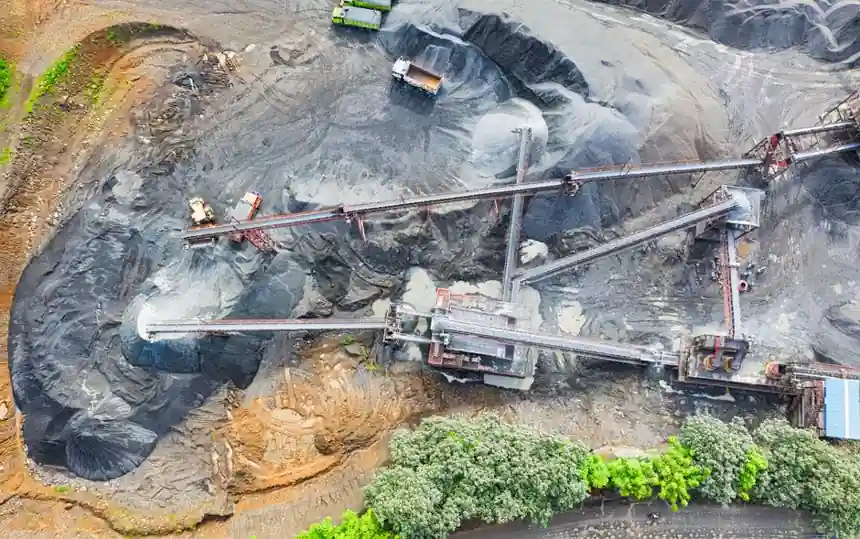
A belt conveyor line bought for an industrial site is rarely accepted on mechanical performance alone; auditors want the certificate stack behind the belt conveyor, the storage handling transfer points, and the integrated weigher before a single pallet moves [S1][S7].
Five evidence blocks appear in nearly every European, North American and Chinese OEM tender: mechanical design rules, electrical safety, fire and anti-static performance of the belt carcass, roller and bearing conformance, and, when the line bills by weight, a legal-for-trade approval on the in-line scale [S7][S10].
Mechanical Design: CEMA, ISO 5048 and the Load Geometry
Conveyor Equipment Manufacturers Association (CEMA) B105.1, ISO 5048 and the Chinese GB/T 10595 all converge on the same calculation: idler pitch, belt width, trough angle and drive power are derived from the lump size, belt speed (typically 0.5–4.0 m/s on heavy-duty lines) and the material bulk density, and a vendor that cannot show the calculation sheet has not finished the design [S1]. EP fabric belts, the dominant carcass for general material handling, are spec'd as EP100, EP150, EP200, EP250, EP300 and EP400, with widths of 300–2000 mm, 1–10 plies, and tensile strength in the 8–25 MPa range for textile-ply belts [S3]. Steel-cord belts (St800–St3500) sit at 24 MPa and above for overland and mining duty where elongation must stay below 0.2% [S3].
Sidewall and cleated belts, used on inclined conveyor sorting lines between 18° and 90°, require their own pull-out and flexing test data; the Made-in-China sidewall offering is published at US$45.60–65.80/m versus US$6.50–28.90/m for a plain EP belt, and that step-change in price is the visible proxy for the extra certification work (flex fatigue, splice pull) the fabricator had to do [S3].
Electrical and Control Safety on the Drive Skid
Every belt conveyor shipped into a CE-marked plant must be wired to IEC 60204-1, with the drive panel carrying a separate EN 61439-1 panelbuilder declaration and the motor running on IEC 60034-1 ratings; the same panel usually has to clear the EU Machinery Directive 2006/42/EC conformity package, which is what the EC Declaration of Incorporation hangs off [S1][S10].
A pull-rope emergency stop, belt misalignment switches, zero-speed sensors and upstream interlocks are listed in CEMA B20.1 as a minimum, and modern skid builders such as Shandong barrick (ISO 9001 management system) put them in the same bill of materials as the drive motor and gearbox [S10]. Hazardous-area lines (grain elevators, chemical transfer) layer ATEX 2014/34/EU on top and the suppression system on the conveyor itself is independently FM-approved for combustible dust [S1].
Fire, Anti-Static and Compound Certificates for the Belt
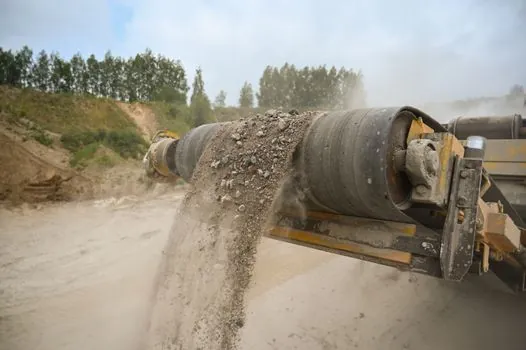
ISO 340 covers belt flame propagation (six standard test lengths and a max-afterflame time that has to be on the data sheet), and anti-static behaviour falls under ISO 284 with a surface resistivity ceiling of 3×10⁸ Ω measured on a conditioned sample; coal-mine and grain applications usually require both, and the test reports have to be from a recognised lab, not a self-declaration [S1][S3].
Compound-level certificates are the second layer: a heat-resistant cover is rated by class (T1 ≤100°C, T2 ≤150°C, T3 ≤180°C, T4 ≤200°C+) and the cover compound, not the carcass, is what carries the class label, so the same EP200 carcass can host four different cover ratings [S4]. Oil-resistant, acid/alkali-resistant, cold-resistant (down to roughly −40°C) and FDA white belts for food are separate compound families, and a single multi-purpose line item on a purchase order usually voids the certificate the buyer thinks they are getting [S3][S4].
Rollers, Bearings and the Quiet Side of the BOM
Idler rollers on heavy-duty lines are CEMA Series C/D/E, with diameters from 89 mm (light duty) to 219 mm (heavy impact) and a typical CEMA rating published for each shell, and the matching bearing is a 6204 / 6205 / 6306 deep-groove ball for a return idler, going up to a 22209 spherical roller for impact zones [S9].
For a material handling line built around a mesh belt conveyor for food or wash-down, the rollers and bearings must carry an IP67 or IP69K ingress rating (IEC 60529) and a 304/316 stainless shell option; buyers should also confirm the supplier holds ISO 9001, because the CEMA dimensional standard is not enforced by any third party on a free-market roller [S9][S10].
Weights-and-Measures Approval for In-Line Weighing
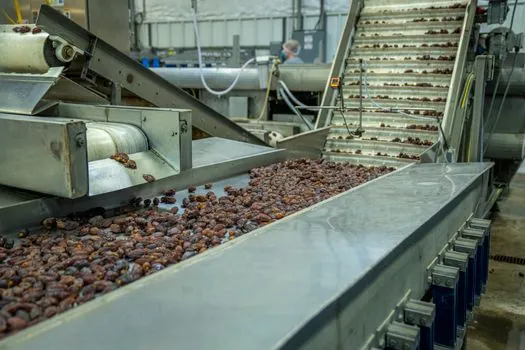
Where the conveyor feeds a billing weigher (aggregates, grain, food, recycling), the scale must be OIML R76 or NTEP Handbook 44 approved and the integrator must hold an ISO/IEC 17025 calibration at the installed location; the JBT Marel Certified Flowscale is a typical OIML R76 / NTEP-integrated belt weigher, 100 t/h class, with a published certified accuracy figure that is traceable to a national metrology institute, not a factory bench [S7].
Two failure modes show up repeatedly in audits: a CEMA-conformant conveyor fitted with a non-OIML scale is treated as a non-legal-for-trade line, and a legal-for-trade scale mounted on a frame that has not been checked for vibration isolation drifts out of accuracy within months; both fail the same W&M inspection [S7].
Document Stack an Auditor Will Ask For
Walk into a tender review with: (1) the CEMA B105.1 or ISO 5048 design calculation, (2) the IEC 60204-1 / EN 61439-1 panel declaration, (3) the ISO 340 and ISO 284 belt test reports, (4) the compound certificate (heat, oil, FDA) for the specific grade ordered, (5) the roller/bearing conformity with the CEMA series code and an IP rating for wash-down, and (6) for any line that sells by weight, an OIML R76 / NTEP certificate with the serial number matching the installed unit [S3][S4][S7][S9][S10].
Two signals worth tracking after the line is running: ISO 3684 (belt splice efficiency) is increasingly referenced in European mining tenders in 2025–2026 specifications, and Chinese flat-belt OEM datasheets now publish GB, DIN, RMA, ISO, AS, SABS and BS compliance side-by-side, which lets a single belt type satisfy multi-region audit packs if the compound certificates are kept current [S3][S5].
For related coverage, see Zinc Die Casting Machine Selection for Energy Equipment: 2026 Spec Map.