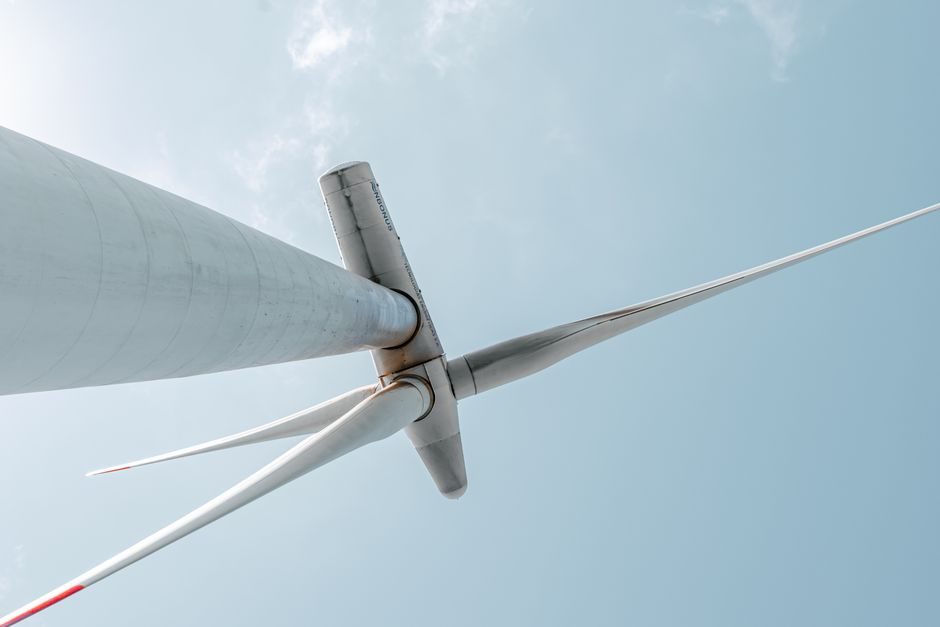
In utility-scale solar tracking and small-wind yaw duty, the right slewing drive is selected on holding torque, tilting moment load, IP class, and backlash band — not on panel area or rotor diameter, which are outputs, not inputs [S2][S3].
Power-generation slewing duty spans concentrated solar power (CSP) heliostats, photovoltaic (PV) single- and dual-axis trackers, and small-wind turbine yaw drives; loading is dominated by wind overturning moment, not by static weight of the structure [S2]. A typical 1-axis PV tracker slewing drive carries a holding torque spec in the 8–40 kN·m range with IP66 sealing and a 24 Vdc or 380 Vac worm-gear motor; a 2-axis CSP heliostat drive is an order of magnitude up the curve, with tilting-moment ratings commonly in the 50–150 kN·m band [S2].
Holding Torque and Tilting Moment: The Two Specs That Decide Everything
Worm-gear slewing drives are the dominant architecture for power-generation tracking because they are self-locking under load — when the worm stops, the gear cannot back-drive, so a tracker holds position without a brake [S3]. Holding torque (the maximum static moment the drive resists without back-driving) and tilting-moment load rating (the off-axis moment from wind acting on the panel or mirror) are the two numbers a specifier must lock first; gear ratio, motor voltage, and IP class follow from those two.
For a single-axis PV tracker with a 2 m × 1 m panel string, designers commonly land in the 8–15 kN·m holding-torque band; a longer 4-panel string typically pushes 20–40 kN·m. CSP heliostat and small-wind yaw units specify 50–150 kN·m with moment loads of 30–80 kN·m because the mirror or rotor area presents a much larger wind sail [S2]. A drive undersized on tilting moment is the classic field-failure mode — the worm wears, backlash opens, and tracking accuracy drifts before the holding torque rating is ever approached.
Gear Architecture: Worm Dual-Axis vs Spur vs Helical
Three gear families compete in power-generation slewing duty: worm-gear dual-axis (the volume leader for PV), enclosed spur-gear slew drives, and helical-bevel precision units for higher-speed tracking. Worm dual-axis is the default because self-locking removes the brake, the sealed housing simplifies IP66/67 washing, and the ratio range of 30:1 to 120:1 covers most tracker slew rates (5–9 °/min typical for PV) without an external gearbox [S3].
Spur-gear slew drives are cheaper and handle higher continuous input speed, but they are not self-locking, so a fail-safe brake is mandatory — that brake becomes the field-failure point in dusty or coastal sites. Helical-bevel units offer better efficiency (commonly 85–92 % vs 30–50 % for worm) and lower noise, used in small-wind yaw and CSP where slew speed exceeds 1 rpm; the trade-off is higher unit cost and the need for a parking brake. Selection logic is therefore: worm dual-axis for self-locking PV duty, helical-bevel for high-speed yaw or heliostat, spur only when cost dominates and a brake is acceptable [S2].
IP Class, Backlash, and Lubrication: Field-Survival Specs

IP66 is the de facto minimum for outdoor power-generation slewing drives; IP67 is specified for coastal or desert sites where sandstorm loading and salt fog are concurrent [S2]. Backlash is the second quality axis — worm dual-axis units typically land in the 0.1°–0.3° band, and anything above 0.5° will produce visible tracking jitter on a long string of panels. Sealed-for-life grease fill is the standard lubrication approach; relube fittings are still offered but are rarely exercised in solar O&M schedules, so the grease choice (typically lithium-based or polyurea) decides service life.
Operating-temperature band matters more than the spec sheet suggests: arctic-rated grease extends the lower limit to roughly -40 °C, and synthetic polyurea pushes the upper limit past 120 °C — both relevant for desert PV or high-altitude CSP. LDB Bearing publishes slewing-drive and slewing-bearing lines covering construction, forestry, port, welding, and CSP-tracking applications, with custom ratio and seal options [S3]. The slewing bearing reference page defines the load-rating families that the drive must match, since the bearing raceway is the structural backbone.
Motor Voltage, Encoder, and Control Interface
Two motor-voltage platforms dominate power-generation slewing drives: 24 Vdc for residential and small-commercial PV trackers, and 380 Vac three-phase for utility-scale single-axis trackers and CSP [S2]. Encoder choice splits along the same line — incremental encoders (typically 1024 or 2048 PPR) on low-voltage DC drives, absolute multi-turn encoders (H multiturn, commonly SSI or CANopen interface) on AC drives where position retention through power-loss matters.
For utility-scale PV plants, CANopen and Modbus RTU are the common fieldbus profiles; PROFINET appears on European utility builds. The drive controller is almost always external to the slew unit — a tracker row controller or SCADA-edge PLC commands position, and the drive executes. Specifiers should confirm the slew-drive input protocol against the tracker controller's profile before locking the part, because protocol mismatch is a common late-stage rework driver. The slewing drive encyclopedia entry covers the full motor and protocol matrix.
Standards, Vendor Map, and Failure-Mode Watch List

No single ISO or IEC standard governs slewing-drive selection for power generation; the load-rating methodology follows slewing-bearing conventions (static and dynamic load ratings, moment load factors), and the motor section falls under IEC 60034 for rotating machines. Site certification (UL, CE) is the typical compliance gate for North American and European utility-scale procurement. [S1]
China is the dominant manufacturing base for worm-gear dual-axis slewing drives, with several hundred suppliers clustered in Jiangsu, Zhejiang, and Shandong; LDB Bearing is one established maker offering custom-tailored slew bearings, slewing drives, and gears since 1999 [S3]. Domestic Chinese makers typically price 30–50 % below European equivalents at the same holding-torque rating, but lead times and quality-consistency variance are wider — procurement teams should require sample destructive test reports on tilting-moment and backlash before releasing volume POs.
Common field failure modes, in order of frequency: (1) seal failure letting water into the worm-gear housing, leading to grease washout and accelerated wear; (2) backlash drift from under-spec tilting-moment rating; (3) motor insulation failure from voltage spike on long cable runs (mitigated with VFD-rated inverter duty cable, not standard power cable); (4) encoder cable damage from UV exposure on tracker booms. The slewing ring bearing reference covers the structural load limits that bound the drive's mechanical envelope. A specifier should also weigh the related decision tree in Slewing Drive Selection: Torque, Moment Load, IP and Backlash Class for the detailed sizing worksheet.
Sizing Workflow and Decision Criteria
For a single-axis PV tracker with a 2 m × 1 m panel string at 30 m above ground, design wind 24 m/s: holding torque ≈ 8 kN·m, tilting-moment load ≈ 5 kN·m, IP66, backlash ≤ 0.3°, 24 Vdc worm dual-axis, ratio 60:1. For a CSP heliostat with 10 m² mirror at 8 m above ground, same wind: holding torque ≈ 80 kN·m, tilting-moment load ≈ 50 kN·m, IP66, backlash ≤ 0.2°, 380 Vac helical-bevel with brake, ratio 120:1. For a small-wind yaw drive (10 kW turbine): holding torque ≈ 30 kN·m, tilting-moment load ≈ 20 kN·m, IP65 minimum (IP66 if coastal), backlash ≤ 0.2°, 380 Vac helical-bevel with parking brake. [S2]
Three decision criteria separate acceptable from optimal in a tender: holding-torque safety factor (≥ 1.5× over calculated wind moment, ≥ 2× in cyclone-prone regions); tilting-moment to holding-torque ratio (target 0.5–0.7 — a drive that rates 100 kN·m holding but only 30 kN·m moment is mis-sized for tracker duty); and grease service life at site temperature (≥ 25,000 h at the 95th-percentile ambient). Power-metering integration on the tracker row is a separate decision governed by power meter selection on the AC side, not by the slewing drive itself.
Two signals worth tracking into the back half of 2026: Chinese makers are pushing 48 Vdc worm dual-axis units aimed at larger string trackers, which would simplify PV combiner architecture if the IP66 and 25,000 h grease claims hold in the field; and European CSP projects are publishing tighter backlash specs (≤ 0.15°) on heliostat slew drives as mirror-area increases push tracking-accuracy budgets down — both are worth a specifier's attention in the next tender cycle.