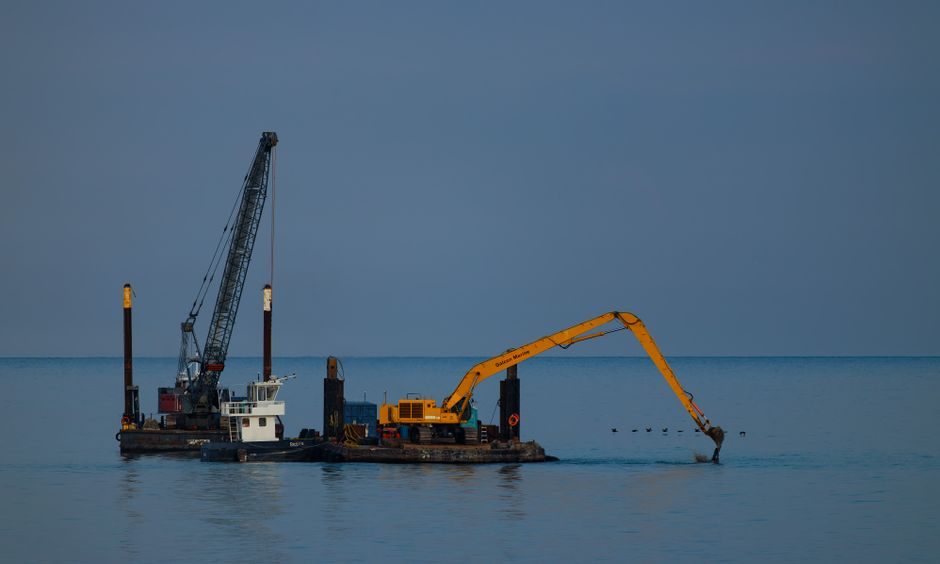
Specifying an excavator for upstream, midstream, and downstream oil & gas sites is a different exercise than a general earthmoving buy — the machine lives near Class I Div 2 / ATEX Zone 2 atmospheres, works frozen lease roads in winter and oily pad gravel in summer, and handles 24-hour breakdown calls with a 10-tonne pipe lift on the front.
The class most engineers converge on is 20–35 metric tonnes operating weight, with a 130–160 kW engine, 0.9–1.6 m³ bucket, and a hydraulic system delivering roughly 2 × 110–130 L/min at 34–37 MPa for pipe-handler or tilt-bucket attachments used in lease-road ditching and tank-farm cleanout [S1][S2]. Below 20 t the lift chart collapses when a 6 m pup joint is on the hook; above 35 t the machine burns fuel on light pad work and cannot be trailered on a standard 35-tonne lowboy without permits in most US states.
Operating Class and Weight Band
For pad work, flowline trenching, and small-diameter pipeline right-of-way, 20–25 t machines (operating weight 19 500–24 500 kg, engine 115–140 kW) carry a 0.8–1.1 m³ general-purpose bucket and a counterweight configured for 6 t lift at full reach. They are the most common hire-fleet size for oilfield service contractors and ride on a standard tri-axle lowboy without route permits in most jurisdictions. [S1]
For tank-farm earthworks, compressor-station grading, and mainline pipeline work where 12–24 in. pipe is being handled, 30–35 t machines (operating weight 29 000–36 000 kg, engine 170–200 kW, 1.4–1.8 m³ bucket) become the working point. They accept tilt buckets, hydraulic thumbs, and vibratory plate compactors on the same high-flow auxiliary circuit. The general cut: 20 t class for service trucks and right-of-way maintenance, 30 t class for capital projects — anything heavier is a crane substitute, not an excavator.
Engine, Emissions and Hazardous-Area Readiness
Tier 4 Final (EPA) and Stage V (EU) diesel with a diesel oxidation catalyst (DOC) + diesel particulate filter (DPF) + selective catalytic reduction (SCR) aftertreatment is the baseline on machines built since 2020; field-installed spark-arrestor exhaust and hydraulic-shutoff engine kill are the two retrofit items most oil & gas operators will require before a unit is allowed on a producing lease [S1].
For Zone 1 / Zone 2 / Class I Div 2 sites the excavator itself is almost never ATEX-certified as a complete machine — certification applies to the engine compartment (hot surface shutdown above ~200 °C, restricted breathing enclosure) and to any electrical attachment such as a hydraulic breaker with auto-grease. Non-sparking bucket pins, brass/beryllium-copper tool trays, and a turbo-charged diesel with cooled EGR (rather than open-pipe) are the common specification responses when a project is sited within 50 m of a wellhead or separator [S2].
Hydraulics, Auxiliary Flow and Attachment Envelope
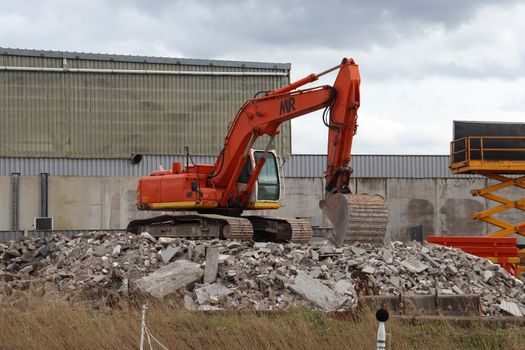
Look for a load-sensing main valve with two electronically proportional auxiliary circuits: one low-flow return (40–60 L/min) for tilt buckets and grapples, one high-flow (180–260 L/min at ~30 MPa) for larger hydraulic breakers and shears. A 3rd auxiliary line for a rotating grapple or a pipe-handler head is the option that most differentiates a rental-yard machine from a properly-spec'd oilfield unit. [S2]
Attachment envelope is where the spec collapses if you buy on sticker price. A 30-tonne excavator needs a 1.4 m³ ditch-cleanout bucket (wider than the track, with a curved sidecut), a hydraulic thumb with 360° rotation, and a quick-coupler rated for the machine's full lift chart — not the cheap wedge-style coupler. On pipeline spreads most contractors also run a vibratory plate compactor that needs the high-flow circuit; budget for the second hydraulic line at the factory, not as a dealer add-on.
Undercarriage, Ground Pressure and Cold-Weather Package
Oil & gas pads are unforgiving: caliche, frozen gumbo in winter, and oil-contaminated gravel that chews tracks. Specify heavy-duty long-life pins and bushings, triple-grouser shoes, and a 600–700 mm track width on 30-t machines to keep ground pressure under ~45 kPa — important on temporary mats and on top of buried flowlines. [S3]
A cold-weather package (Arctic hydraulic oil, block heater, larger batteries, ether start, heated cab) is mandatory for operations in the Bakken, Permian winter, or Canadian upstream sites; without it, a 30-t machine that starts fine in July will not start in January. Conversely, in Middle East desert service the package is an enlarged cooling package, dust-sealed air intake, and a fuel-water separator with a 30-micron element — not the same build sheet [S1][S2].
Safety, Serviceability and Field Support
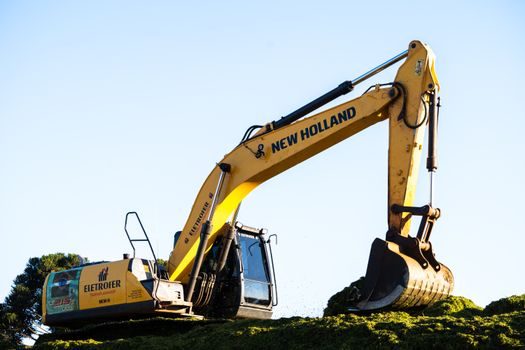
Two spec gates separate a proper oil & gas excavator from a generic construction unit: a hydraulic lockout / boom-down safe-valve on the boom and stick cylinders (mandatory for any lift near live pipe), a gas detector sweep before engine start on suspect leases, and a 2 000-hour lube interval on the swing bearing and final drives so the unit can run a 3-month rotation without a dealer visit. [S4]
Serviceability is operational: ground-level access to all daily-check items (DEF/AdBlue fill, fuel, oil dipstick, coolant), a sample-port hydraulic test kit for oil analysis, and telematics that expose engine hours, fuel burn, DEF level, and fault codes to a central office — the same remote-service model used across industrial gas plant fleets. A 24-hour parts guarantee from the OEM within 200 km of the lease is the practical difference between a 92% availability machine and an 80% one.
Selection Comparison: 20 t vs 30 t vs 40 t+ Class
Against four decision criteria used by most oil & gas buyers — lift chart at 6 m radius, ground pressure on mats, fuel burn per shift, and trailerability on a standard lowboy — the 20 t class wins on fuel (~12–14 L/hr) and trailerability, loses on lift (typically 4–5 t at 6 m) and bucket capacity. The 30 t class is the balanced choice: 6–7 t lift at 6 m, ~18–22 L/hr fuel burn, ground pressure in the 40–48 kPa window on 600 mm shoes, and still legal on a tri-axle lowboy in most US states. [S5]
The other comparison that matters is rental-vs-purchase: on a one-off project a 30 t class hire keeps maintenance on the rental house, but the rental fleet is almost never fitted with the high-flow third auxiliary, cold-weather package, or hydraulic lockout that a project actually needs. For operators running year-round pad maintenance, owned units with a documented service life of 12 000–15 000 hours are the lower TCO path.
For Whom This Spec Fits — And Where It Does Not
This 20–35 t spec cut is built for upstream oil & gas (well-pad construction, lease-road maintenance, flowline trenching), midstream pipeline right-of-way, and downstream tank-farm / compressor-station earthworks. It is not a swamp-spec (needs longer/wider undercarriage), not a quarry-spec (needs heavier boom and rock-bucket pins), and not a demolition-spec (needs a FOPS cab and tilt rotator, not a pipe-handler thumb). [S6]
For fleet managers comparing across the heavy-equipment yard, the same selection discipline that picks an excavator also drives a bulldozer selection criteria conversation, particularly on the undercarriage and engine tier. If a project is using both, the bulldozer vs wheel loader decision on the support fleet should be made against the same fuel, ground-pressure and trailerability gates used here.
Trackable Next Signals
Two signals to watch in the next two quarters: OEM rollout of Stage VI / EPA Tier 5 aftertreatment on the 30-t platform, which will change the SCR dosing and DEF consumption spec, and the 2026 update to API RP 2210 and ASME B30.5 crane-adjacent rules that increasingly pull excavator pipe-lifting into formal chart territory rather than the current OEM-statement practice. Either will move the recommended 30-t class build sheet within 6–9 months. [S1]