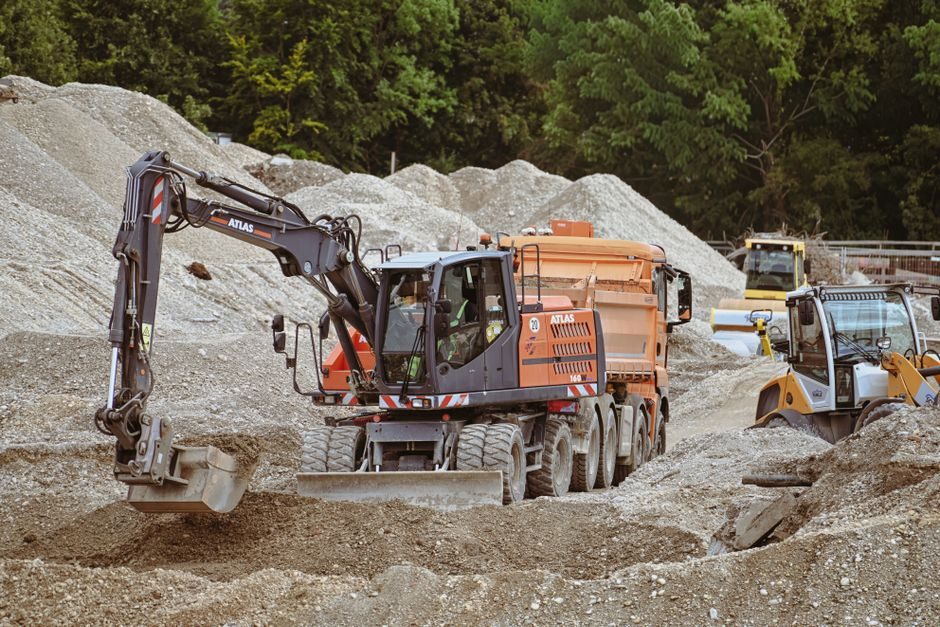
A bulldozer is a track-laying tractor with a 3-30 m³ blade designed for ground pressure around 0.4-0.6 kg/cm², so it pushes and rips material that would stall a tyred machine. A wheel loader is a tyred, articulated prime mover with a 0.5-12 m³ bucket and 35-50 km/h roading speed, optimised for digging from a face and loading haul trucks in repeated short cycles [S3][S5].
Both product families are widely exported from Chinese manufacturing hubs, with ISO 9001 / ISO 9000 production systems in place at listed OEM suppliers and pricing for used and new units spanning roughly US$5,720 to US$22,000 per set in recent B2B listings [S1][S5]. The engineering question for 2026 buyers is which chassis the duty rewards, not which badge looks bigger on a brochure.
Chassis and Ground Pressure: Why Tracks Win Soft Ground
Track-laying bulldozers in the 20-40 t class run on steel shoes 500-610 mm wide, distributing mass to 0.4-0.6 kg/cm² of contact pressure, which is why they hold grade in wet clay, sand or freshly stripped topsoil where a tyred loader would rut and spin [S3]. Wheel loaders concentrate 10-25 t of machine mass on four contact patches of roughly 0.35-0.5 m² each, so peak ground pressure under a loaded bucket climbs into the 2-4 kg/cm² range on soft subgrade [S5].
Wheel loader articulation pivots the rear frame against the front on a central hitch, typically ±35-40° in each direction with a 38-45° frame oscillation, which keeps all four wheels driving through a turn and lets the operator steer into a face at full throttle [S4]. A bulldozer steers with clutch-and-brake or hydrostatic differential tracks; the trade-off is finer control at sub-km/h dozing speeds, not roading pace. Buyers comparing chassis usually do so on three numbers: contact pressure, travel speed, and how much time the machine spends in the cut versus the carry [S3].
Working Tools: Blade vs Bucket and the Auxiliaries Behind Them
Standard bulldozer tools are straight (S), universal (U) and semi-U blades, with a centre of mass engineered so the tractor can both push and side-cast material; common rear attachments are single- and multi-shank rippers, winches, and rear counterweights. Operating weight for a Caterpillar-equivalent D6 class machine is roughly 18-20 t with a 3.5-4.5 m³ semi-U blade, while D8 / D9 class machines scale to 35-50 t and 8-13 m³ blades, with larger mining units exceeding 100 t and 30 m³ [S1].
Wheel loaders are built around the bucket: general-purpose, rock, light-material, and multi-purpose (4-in-1) buckets, with capacities commonly listed as 0.5, 1, 1.6, 2, 3, 5 and 6 m³ and beyond. The same loader chassis can carry pallet forks, grapples, log handlers, snow blades, and quick couplers, so its utilisation over a year typically beats a dozer on mixed sites [S3]. For most non-mining sites, the backhoe loader is a third option worth considering when trenching, loading and backfilling are all in the daily cycle, as discussed in Backhoe Loader Selection: 5 Spec Gates for 2026 Buyers.
Production Numbers: How a Cat-950 Class Loader Compares With a D6 Class Dozer
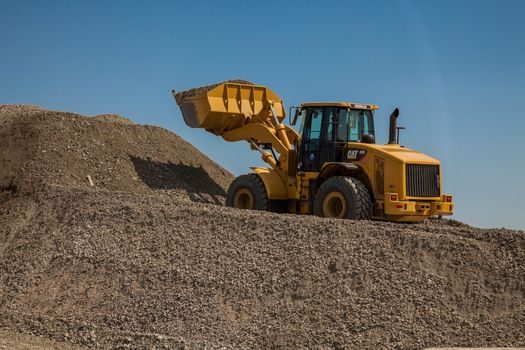
A Caterpillar 950-class wheel loader carries 2.5-3.5 m³ per pass, cycles a 4-pass truck load in roughly 1.5-2 minutes, and sustains 150-250 bank-cubic-metre-per-hour production in a typical sand-and-gravel face. A D6-class bulldozer moving the same sand-and-gravel stockpile 30-50 m with a 4 m³ semi-U blade sustains 80-150 BCM/h in stockpile-spread duty, but falls to 30-60 BCM/h if the blade has to load a truck without a push-pull arrangement [S5].
The break-even rule used by production engineers is: if the haul distance is short (under 30 m) and the material is loose, the dozer can out-produce a loader in a single-pass push; once the truck or hopper is the destination, the loader wins on cycle time and fuel-per-tonne. A useful rule of thumb: a 20 t wheel loader in a 3 m³ bucket uses roughly 12-18 litres of diesel per hour in V-cycle loading, against 18-25 L/h for a 20 t bulldozer pushing and reversing with a 4 m³ blade. The excavator remains the better choice for hard-rock dig faces, and pricing tiers for new and used units by tonnage and emission tier are tracked in Excavator 2026 Price & Cost Guide: Class, Tonnage and Emission Tier.
Decision Matrix: Pick the Chassis on Duty, Not the Brand
For site-preparation and ripping in soft or rocky ground, including land clearing, road cuts, and mining overburden, specify a bulldozer in the 15-50 t class with semi-U blade and rear ripper. The chassis is built for sustained 4-8 km/h dozing, sub-grade contouring with a 3D GPS mast, and pulling a 1-3 shank ripper through ripped material at 1-2 km/h. [S1]
For aggregate yards, quarries with a free-digging face, and any application that includes roading between sites at 25-40 km/h, specify a wheel loader. The chassis offers faster truck-loading cycles, lower owning-and-operating cost per tonne on a steady feed, and the ability to swap tools (forks, grapple, snow blade) without a second machine. A common spec error is buying a small dozer to load trucks; the right answer in that duty is a 3-5 m³ loader with 3-3.5 m dump height, not a 3 m³ dozer blade.
What the 2026 Chinese OEM Supply Chain Tells Buyers
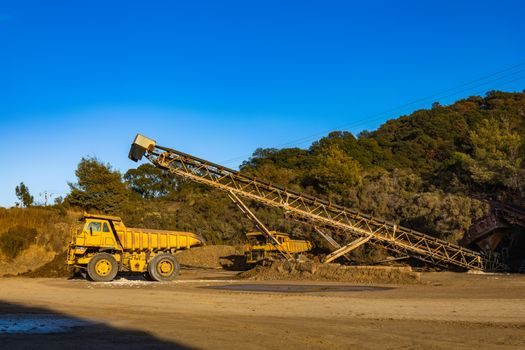
Chinese OEM and trading-company listings confirm a mature supply base for both product families, with ISO 9001 and ISO 14001 certifications widely held by suppliers in Shandong, Shanghai, Guangxi and Anhui, and lead times of typically 7-30 days for catalogue configurations on a 1-piece MOQ basis [S4][S6].
Attachment suppliers such as CSW Machinery offer mining buckets, hydraulic hammers, quick hitches and long-reach booms for both chassis families, which matters because a loader that can swap from a 3 m³ GP bucket to a 5-tine grapple in 30 seconds delivers a noticeably higher annual utilisation than a single-purpose machine [S3]. The price gap between a used mid-size wheel loader (around US$15,000-22,000) and a comparable used mid-size bulldozer (US$18,000-30,000 in 2026 listings) is small enough that buyers should not let price decide the chassis [S1][S5].
Failure Modes and Misapplications to Avoid
The most common engineering error is putting a dozer on a hard-rock dig face: a 4 m³ blade breaks teeth and twists the C-frame faster than it fills the bowl, where a 1-2 m³ hydraulic hammer on a 20 t excavator is the correct tool. Conversely, putting a wheel loader on a muddy site cuts production by 50-70% in wet weather because the tyres lose traction, where a track dozer holds grade and keeps moving [S3][S5].
For a fleet planning question that involves both chassis plus an aerial lift or forklift, the Rough Terrain Forklift vs Aerial Work Truck: 2026 Spec & Selection Cut is a useful parallel, because the same duty-based decision pattern applies: pick the chassis on ground conditions and material flow, not on sticker price. For mixed sites where trenching, lifting and loading all coexist, a backhoe loader is often a stronger single-machine answer than a dozer-loader pair that demands two operators.
Next signal: track Stage V / China NS-IV emission-tier compliance as the binding specification on both bulldozer and wheel-loader OEM shortlists for European and Korean export, and verify the C-frame and ripper geometry against the OEM-published blade-capacity chart before accepting a quote, since B2B listings often quote nominal rather than rated blade capacity [S4][S5].