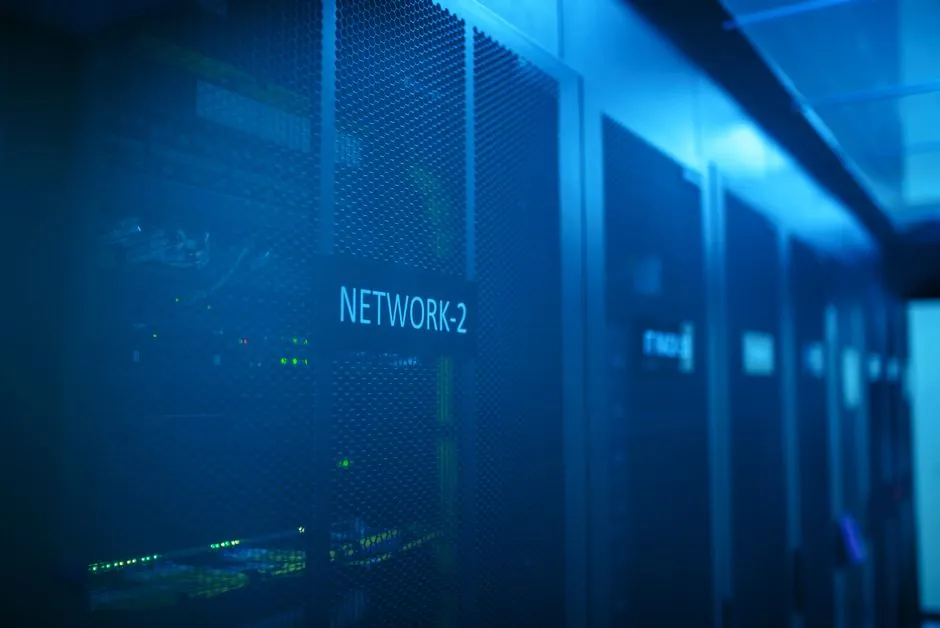
Quartz crystal resonators in the SC-cut, AT-cut, and high-overtone stress-compensated (SC) families remain the most specified frequency references for data center network switches, PTP grandmasters, and server BMC clocks, with typical room-temperature stability quoted at 200–300 ppm for cost-grade parts [S4].
That 200–300 ppm window, derived from the fundamental quartz resonator stability range, is the same number that hyperscaler timing engineers now have to defend against in cross-rack AI training fabrics, where a single NVL72 rack pulls 120 kW and needs sub-microsecond synchronization across thousands of chiplets [S4].
What "Quartz Material" Actually Means in a Data Center Spec
For facility and platform engineers, the "quartz material" decision splits into two distinct stacks: the bulk resonator crystal that drives every network switch's PTP hardware clock, and the fused quartz / fused silica used in wafer-processing tooling, EUV photomask substrates, and high-power optical interconnects inside the data hall [S1]. The USGS data center minerals infographic lists high-purity quartz as one of the strategic upstream inputs for semiconductor-grade silicon production, sitting alongside arsenic and fluorspar at 100% reliance for U.S. demand [S1].
The fundamental property both stacks rely on is piezoelectricity: a force on a properly cut quartz plate produces a stable resonant frequency, which is why synthetic cultured quartz has displaced natural quartz in almost every timing IC produced since the 1990s. Inside the data center itself, the practical material question is usually whether to use AT-cut (1–250 MHz, general purpose, room-temperature optimized) or SC-cut (stress-compensated, better for oven-controlled oscillators in PTP grandmasters) [S4].
Selection Criteria: Where 200–300 ppm Stops Being Good Enough
The 200–300 ppm stability range cited for commodity quartz crystals is acceptable for consumer electronics and edge servers, but breaks down in three data center use cases: (1) PTP grandmasters feeding IEEE 1588 timing across a hyperscaler region, (2) high-speed SerDes reference clocks inside AI training switches, and (3) coherent optical transport line cards where frequency drift maps directly to phase noise on the carrier [S4].
For data center timing, the concrete decision criteria in 2026 are: (a) frequency stability over temperature, typically ±10 to ±50 ppm for AT-cut versus ±0.05 to ±0.5 ppm for SC-cut OCXO parts; (b) ageing rate, usually ±1 to ±3 ppm per year for a quality resonator; (c) AI/ML rack power density tolerance, since 120 kW racks force oscillators near hot-aisle exhaust and raise local ambient 10–15 °C above telecom-grade baselines [S4]; (d) phase noise at 10 Hz to 1 MHz offset, which sets the bit-error floor for 100G/400G/800G SerDes lanes.
Quartz vs. MEMS Oscillators: Where the Line Sits in 2026

MEMS timing devices, silicon-based micro-electromechanical resonators, are the only credible alternative technology covered in the current data center timing literature, and the case for them in AI fabrics rests on three engineering claims: tighter stability under thermal shock, lower sensitivity to vibration from chillers and CRAC units, and a smaller package footprint for high-density switch PCBAs [S4].
The trade-off is real and is well documented: quartz has decades of qualified supply, proven ageing behaviour, and reference designs in every switch ASIC silicon, while MEMS is a younger platform with a smaller qualified-vendor base. For most data center timing sockets in 2026, the spec is hybrid: MEMS for server clock trees and PCIe reference where vibration is the failure mode, premium SC-cut OCXO for PTP grandmasters where 200–300 ppm is still the headline number but where tighter sub-ppm stability is required [S4].
Adjacent Materials Inside the Data Center Hall
Quartz timing is one slice of a much larger data center material stack, and several adjacent choices are being actively re-specified for 2026 builds. Fluoropolymer-based immersion cooling fluids such as Daikin's DAISAVE line and FEP cable coatings are now standard material choices for immersion-cooled AI racks, with the dielectric properties of FEP specifically selected to cut transmission loss at 25–56 GHz signaling rates [S2].
Graphene-loaded ESD floor coatings are replacing traditional migration-based antistatic epoxies, driven by ANSI/ESD S20.20-2021's 1×10^9 Ω to-ground floor resistance requirement and the realisation that graphene at less than 1% loading (versus 5–15% for carbon fibre additives) builds a permanent conductive network that survives forklift and cart traffic in 120 kW AI halls [S3]. Polycarbonate containment panels rated to UL 94 V-0, twinwall or monolithic, are simultaneously being re-specified to meet flame, smoke, and toxicity codes for hot-aisle separation [S5][S6].
Standards, Codes, and the Mineral Supply Side
Data center timing procurement in 2026 is anchored by IEEE 1588 precision time protocol profiles, ANSI/ESD S20.20-2021 for ESD flooring, and UL 94 V-0 for polymer containment panels, while the upstream mineral side is governed by USGS critical-mineral supply assessments that flag 100% U.S. import dependence for high-purity quartz feedstock, fluorspar, and arsenic used in semiconductor wafer processing [S1][S3].
Practical sourcing note: synthetic cultured quartz is grown hydrothermally in autoclaves at major suppliers, and lot-to-lot variation in Q-factor is what drives ageing-rate specs more than the marketing stability number. For a broader material spec workflow that links timing, optical, and mechanical choices, the quartz material selection workflow walks through the same trade-off logic from a process engineer's point of view, while the data logger selection page covers the environmental monitoring that surrounds any timing-critical deployment. The thermal-management side, often what actually kills an oscillator first, is anchored in advanced material choices for heat-spreading interfaces.
Limitations and Failure Modes Engineers Hit in 2026
Quartz timing in a data center fails in three predictable ways: thermal shock from hot-aisle/cold-aisle mixing at the rack inlet, vibration coupling from in-row CDUs and chiller pumps that lands directly on the AT-cut resonance, and ageing drift that compounds over 5–7 year refresh cycles to push 200–300 ppm parts out of PTP grandmaster spec [S4].
The newer failure mode specific to 2026 AI builds is electromagnetic interference from dense 800G optics, which raises the phase-noise floor on adjacent timing traces and forces longer guard bands or shielding changes. MEMS oscillators are partially immune to vibration, but their ageing behaviour and radiation tolerance in edge-of-grid sites are still being qualified in the field [S4].
Who Quartz Timing Is For, and Who Should Look Elsewhere

Quartz-based timing is the right call for: PTP grandmasters feeding IEEE 1588 to regional data center clusters, OCXO references on coherent optical line cards, and any switch or router silicon path where the reference design already assumes an SC-cut or AT-cut resonator. It is the wrong call for: high-vibration AI training pods that sit directly on liquid-cooling manifolds, where MEMS oscillators will out-perform quartz by an order of magnitude on phase noise under vibration [S4].
For hyperscalers evaluating a switch-ASIC clock reference in 2026, the practical decision tree is: if the platform needs 25 Gbps or 100 Gbps SerDes with sub-ppm holdover and a 10-year refresh cycle, stick with premium SC-cut OCXO; if the platform is a top-of-rack AI training switch under continuous liquid-cooling pump vibration, prototype with MEMS and benchmark phase noise at 12.5 kHz to 20 MHz offset before committing. The data center materials stack outside timing, fluoro-coolants, polycarbonate panels, graphene ESD floors, is moving in parallel and can be cross-checked against glass-quartz and chemical-material reference pages for purity and compatibility data.
Trackable next signal: the IEA's 415 TWh (2024) to 945 TWh (2030) data center electricity projection, and the parallel hyperscaler capex line of over $405 billion in 2025, both of which directly set the volume of new timing references that quartz and MEMS suppliers will have to ship through 2027 [S3].