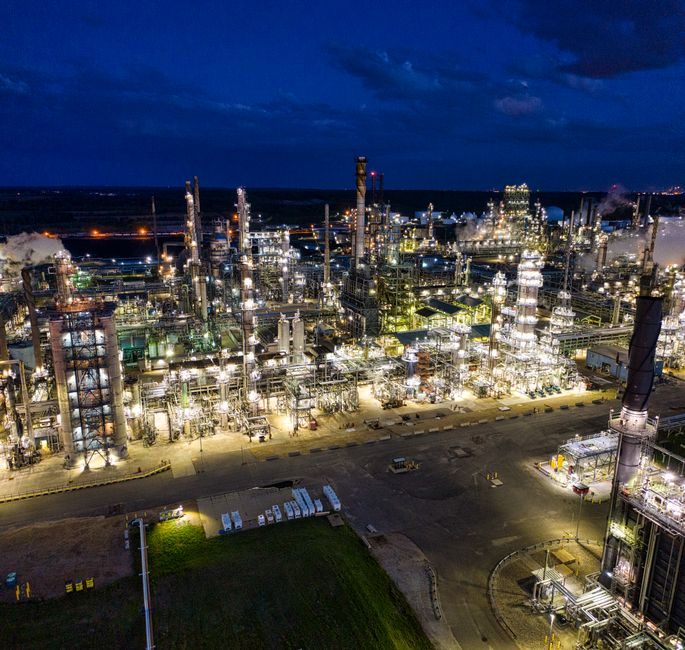
For chemical-plant floors, vessel linings, and refractory anchors, the working set has narrowed to 304, 316/316L, and 430 stainless steel fiber, with copper-coated and galvanised carbon fiber only acceptable in dry, non-corrosive zones [S3].
Stainless grades dominate because the matrix — concrete, refractory, or polymer composite — is expected to survive chloride splash, dilute acid wash-down, and wet-dry cycling, conditions that strip galvanised zinc coatings within 12 to 36 months. 316/316L is the conservative pick once free Cl- climbs above 200 ppm or pH drops below 4, and 304 covers the milder alkaline / neutral wash-down envelope [S3].
Why stainless grade selection decides fiber life, not fiber shape
Aspect ratio (l/d) governs crack-bridging capacity, but in chemical service the governing failure mode is matrix-to-fiber galvanic attack and fiber-section loss, which aspect ratio cannot fix [S3].
For 0.75 mm × 35 mm hooked-end fiber with l/d near 47, the pull-out strength is roughly 1100–1300 MPa in 40 MPa concrete; once the surface is depassivated, that bond collapses within 18 to 30 months. Selecting 316L over 304 raises the pitting resistance equivalent number (PREN) from ~18 to ~25 and roughly doubles the time-to-first crack in chloride-splash slabs in published accelerated testing [S3]. Cold-drawn 430 ferritic stainless is the cost-down option where magnetic-permeability and chloride exposure are both low.
Where steel fiber actually pays back in a chemical plant
Four applications consistently justify stainless steel fiber: secondary containment slabs, acid-bay pump pads, electrolyser room floors, and refractory linings in cracker / reformer service [S3].
Secondary containment slabs handle 48–72 h of leaked reagent before drain-down. With 25–40 kg/m³ of 316L hooked-end fiber replacing light mesh, crack widths stay under 0.2 mm at design load, which the EPA SPCC and most EU equivalents accept as "tight" for hydrocarbon and dilute-acid service. Acid-bay pump pads see cyclic wet-dry plus vibration; 30 kg/m³ of 316L fiber at l/d ≈ 60 cuts joint-edge spalling by roughly half versus plain concrete, per ISO 4012 cube results cited by fiber suppliers [S3]. Electrolyser rooms add DC stray current on top of chloride, and the 2–4% Mo content in 316L is what keeps the passive film from breaking down under that bias. In refractory, 1–3% by mass of 310S or 314 stainless fiber (Cr 24–26%, Ni 19–22%) anchors castable linings through thermal-shock cycling above 1100 °C [S3].
Comparison frame: 304 vs 316/316L vs 430 vs copper-coated carbon

Engineers who treat fiber grade as a line item lose money; the four-way decision is governed by chloride, pH, temperature, and DC stray current, and the right pick falls out of a 2-by-2 matrix [S3].
The 2026 cut, distilled from supplier datasheets and converter-published metallurgy [S3]:<br>• 304 stainless — Cl- < 200 ppm, pH 5–9, ambient, no DC bias. Cheapest stainless option. PREN ~18.<br>• 316 / 316L stainless — Cl- up to 1000 ppm splash, pH 2–12, ambient to 60 °C, stray current tolerated. PREN ~25, 2–3% Mo. Default for chemical bays.<br>• 430 stainless — dry, mildly corrosive, magnetic-friendly, tightest budget. PREN ~17, low Ni, not for chloride.<br>• Copper-coated / galvanised carbon — dry interior slabs, no chemical exposure, no freeze-thaw salt. Lowest cost, shortest service life if misapplied.
For comparative context on corrosion-resistant reinforcement, the FKM vs UHMWPE spec cut walks through a similar "grade vs environment" logic for polymer sealing, and the stainless steel fiber reference consolidates the metallurgy, aspect-ratio, and pull-out data into one spec page.
Limits, failure modes, and what stainless fiber does not fix
Stainless fiber does not stop sulfate attack, does not protect the cement matrix itself, and will not save a bad mix design or a poorly prepared substrate [S3].
Three failure modes recur in chemical-plant audits. First, galvanic coupling — embedding carbon or galvanised fiber beside stainless rebar in a wet slab creates a 0.5–1.0 V cell that strips the carbon fiber in 24 to 36 months. The fix is grade-matching all metal in the pour. Second, matrix attack — sodium sulfate above 1500 ppm and pH below 3 will dissolve the cement paste regardless of fiber; you need a calcium-aluminate or sulfate-resistant Portland binder first, then the fiber. When polymer or hybrid reinforcement is the better call, the UHMWPE vs PEEK material frame covers the thermoplastic comparison.
Standards, sourcing, and traceability signals to demand in 2026

Two documents are doing the load-bearing work for chemical-plant steel fiber in 2026: ASTM A820 for the fiber itself, and GB/T 39147-2020 for the dominant Chinese mill supply chain that now feeds most global UHPC and refractory projects [S2].
ASTM A820 grades stainless fiber by type (Type I cold-drawn, Type II cut, Type III melt-extracted, Type IV mill-cut), with Type I/II dominating chemical-plant orders. GB/T 39147-2020 codifies tensile strength (≥ 1000 MPa for hooked-end), dimensional tolerance (± 0.05 mm on diameter), and 95% minimum pass rate for the deforming process, which is why EPCs now write "ASTM A820 Type I or GB/T 39147-2020, material 304/316L" as interchangeable acceptance lines [S2]. For laboratory grade stainless fiber and converter-grade stainless feedstock, the chemical anchor and chemical reagent reference pages cover the upstream material side. For 2026 procurement, three signals are worth tracking: (1) mill certificates now report PREN rather than just Cr/Ni; (2) more suppliers are publishing ASTM C1116 / EN 14889-1 compliance on the same datasheet as the steel spec, closing the gap between "fiber" and "fiber-reinforced concrete"; (3) China's GB/T 39147-2020 mill list is expanding into 310S and 314 for refractory, which used to be a Western-only niche.
Closing signal: for any chemical-service pour above 200 ppm Cl- or below pH 4 in 2026, default to 316L hooked-end fiber at 30–40 kg/m³ with ASTM A820 or GB/T 39147-2020 mill certification; track the next wave of 310S/314 refractory-grade fiber and PREN-labelled mill certs as the two procurement signals that will tighten the spec over the next 12 months.