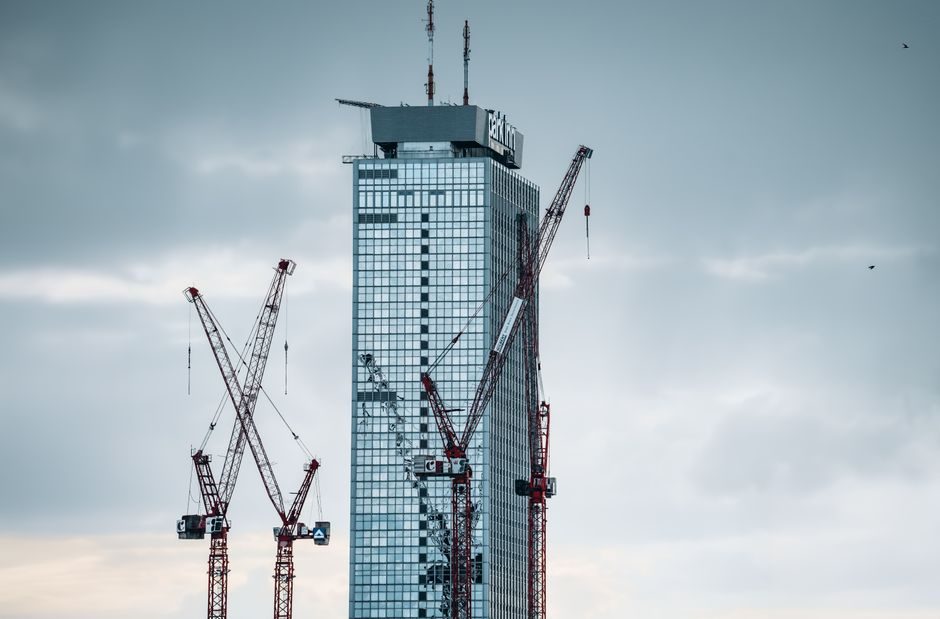
Self-climbing (ACS) and crane-climbing (CCS) formwork both anchor into the previously poured lift via wall cones and cast-in anchors, eliminating the wall-through tie-rods used in conventional cantilever wall formwork [S3].
The hydraulic ACS variant uses a dual-rail system — climbing rail, oil cylinder, and two commutators drive the lift stroke between pour cycles, with the platform climbing independently of any external crane [S4]. That crane-independence is the single biggest cost driver on cores above ~25 stories, which is the band where the payback on the hydraulic system is usually calculated.
Pour Height, Lateral Pressure and Concrete Finish Targets
Cantilever (crane-lifted) formwork carries the full hydrostatic lateral pressure of fresh concrete through the anchor system and wall-through tie-rods, allowing a single pour height per cycle that is typically larger than a traditional gang form, while still producing a finish good enough for fair-faced concrete on piers and high-rise cores [S3].
For a 4 m pour lift the maximum lateral pressure on the form face from concrete at 25 kN/m³ is in the order of 100 kN/m² at the base of the lift; design wind on the platform, and the climbing shoe's reaction into the previous lift, both have to be checked against that envelope [S3]. The single-pour-height is a real selection variable, not just a marketing line: it directly sets how many vertical re-shores, kicker time, and the daily cycle rate the site plan has to absorb.
ACS vs CCS: Selection Bands and Crane Independence
The defining split is whether the system climbs on its own rail using hydraulic oil cylinders — auto-climbing, ACS — or whether it is re-lifted by the site tower crane — crane-climbing, CCS [S4]. ACS removes the crane hook-time, which on a tight-core high-rise is roughly 8-12 lifts per floor, but it carries more steel weight per running metre and needs a regular hydraulic-power and commutation check [S4].
Selection band, by project profile: CCS suits low-to-mid cores (up to ~20 stories) where crane time is cheap and the contractor already owns crane-climbing panels; ACS suits tall cores, slanted pylons, and shaft-only projects where crane hook-time is the bottleneck; cantilever single-sided formwork suits pier shafts, elevator cores against existing structure, and repair works where through-ties are impossible [S3][S4]. For tall, irregular cores the deciding question is not the headline cycle time, it is whether the geometry lets the platform clear the previous lift's anchor shoes without striking the form.
Anchorage, Cones and the Wall-Through Tie Decision
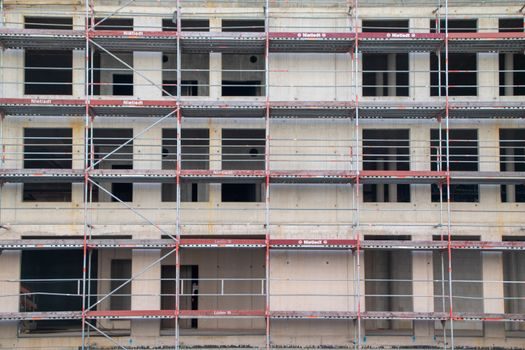
Cantilever formwork transfers all lateral concrete pressure through the anchor system and wall-through tie-rods cast into the previous lift, which removes the need for additional reinforcement at the tie points and is the reason it is classed as economical for high single pours [S3].
ACS replaces those through-ties with climbing shoes that bear on anchor cones left in the previous lift, so the design rule is that the cone embedment depth, the local concrete strength at re-stressing (typically 15-20 MPa), and the spacing of climbing rails must all be matched to the climbing shoe's allowable reaction [S4]. A frequent site failure is trying to climb on cones before the previous lift has hit its stripping strength, which is why the major ACS suppliers gate the cycle on a measured concrete-strength value, not a calendar day.
Platform Layout, Working Envelope and Crew Safety
Both ACS and CCS systems carry a top working platform, a hanging trailing platform, and usually a lower stripping platform sized for the form face area; the working envelope between the form and the trailing platform is where rebar is landed, so its width sets the rebar-bundle size the cycle can swallow [S3].
For a fair-faced core the platform also has to be designed for the wind exposure class of the building at its climbing height — the higher the lift, the more the platform governs, not the form panel. Reference project specs usually demand an enclosed upper deck, toe-boards, and a separate material-hoist area so that rebar and small tools do not share the climbing platform with personnel; this is the kind of detail that separates a workable spec from one that gets re-engineered on site.
Lead Time, Reuse Count and Total Cost Bands
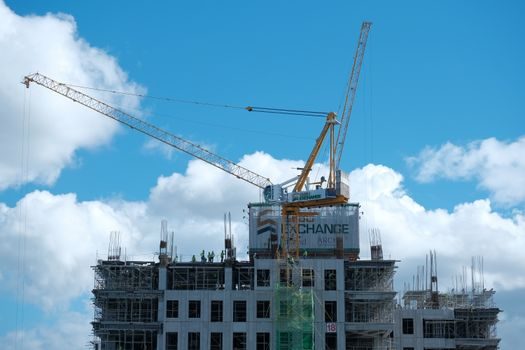
Cantilever wall formwork is described as construction-easy, construction-rapid and economical on pier and high-building work, with the bulk of the cost sitting in the form-face (usually phenolic-coated plywood or steel-ply) and the through-tie hardware [S3].
An ACS kit is heavier per running metre and its reuse count over a project is the main economic argument: above ~50 re-uses the hydraulic system amortises, below that the site is paying for capability it does not consume [S4]. Specifying a climbing system without a stated reuse target is the most common way these projects come in over budget — the procurement decision should be taken against an explicit re-use count per panel and per climbing shoe, not against a vague "cycle time" promise.
Specifying the System: Drawings, Standards and What to Put on Paper
A submittal-grade climbing-formwork spec should carry: maximum pour height per cycle, design lateral concrete pressure (kN/m²), wind class for the platform in its climbing and parked states, climbing shoe reaction per anchor, minimum concrete strength at re-stressing, platform live load, and the crane-hook weight if the project is on CCS [S3][S4].
For a sense of where the equipment sits next to other jobsite plant, see the rough-terrain forklift sizing and selection guide for capacity bands and drive-layout trade-offs that affect site logistics around a climbing core, and the aerial work truck selection guide for the boom-type and insulation bands that pair with formwork striking and finishing crews. For a structured read on the formwork category itself, the climbing formwork encyclopedia entry lays out the system families and the rail-climbing principle in more detail. The next node to track is the published kN/m² lateral-pressure envelope on the chosen panel and the named anchor-cone embedment depth — those two numbers, more than any cycle-time claim, decide whether the spec is buildable on the actual structure.
For component-level specifications, see asrs system, and shuttle system.