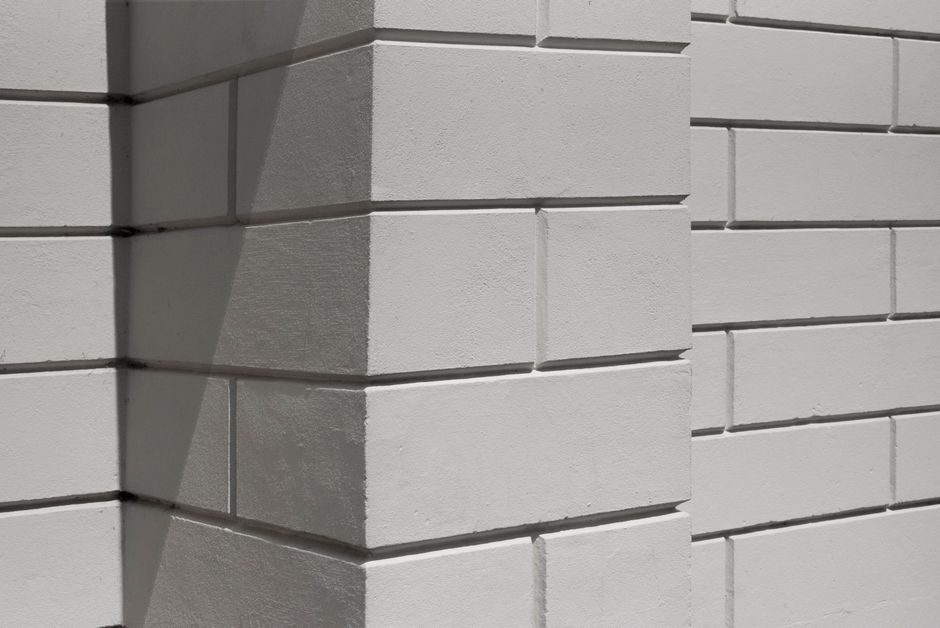
A block or brick specification fails when the specifier treats the words "block" and "brick" as interchangeable: a CMU (Concrete Masonry Unit) at 8 in × 8 in × 16 in nominal delivers a different load, fire and moisture envelope than a 3-5/8 in × 2-1/4 in × 7-5/8 in modular fired-clay brick, and a 8 in × 8 in × 24 in autoclaved aerated concrete (AAC) panel lands between them on weight and R-value [S1].
For a single-family residential veneer, a 3-5/8 in modular face brick on a 1 in air gap is the most common envelope; for a multi-wythe load-bearing commercial wall, 8 in CMU grouted at 16 in on center is the baseline, and for a 4- to 6-story mid-rise where weight matters, 8 in AAC blocks replace the CMU and drop wall dead-load roughly 60-80% relative to equivalent concrete masonry [S1][S3].
Three Unit Families: Fired Clay Brick, Concrete Block, AAC Block
Fired clay brick under ASTM C216 (face brick) and C652 (hollow brick) ships in three grades — NW (no weather), MW (moderate weather) and SW (severe weather) — with SW specifying a maximum cold-water absorption of 17% for the average of 5 units and an IRA (Initial Rate of Absorption) typically reported between 5 and 30 g/min·30 in² at the lab bench [S1]. Concrete block under ASTM C90 covers two weight classes: Normal Weight (NW, 125 pcf or more oven-dry density) and Lightweight (LW, less than 105 pcf), with minimum net-area compressive strength of 1,900 psi for NW and 1,250 psi for LW on the unit itself, and the wall assembly's equivalent f'm commonly engineered to 1,500-2,000 psi depending on grout and mortar [S1]. AAC block, typified by the 8 × 8 × 24 in Class 4 unit, has oven-dry density of 31-50 pcf and compressive strength rated at 580 psi minimum for Class 4 (higher classes reach ~1,160 psi), versus ~2,000-3,000 psi for a typical NW CMU and ~4,000-12,000 psi for an SW engineering brick [S1][S3].
Working with a concrete masonry unit block and a fired clay brick spec on the same project is normal, but the specifier must lock the type and the standard on the same drawing note — a wall line called "brick" on plan and "CMU" on elevation is the single most common submittal re-issue.
Selection Criteria: Load, Exposure, Fire, Code
Selection starts with four filters in this order: structural role (veneer, single-wythe loadbearing, multi-wythe, partition), exposure (freeze-thaw, sulfate soil, marine splash), fire rating (UL U-listed assemblies run 1-4 hr), and dimensional fit (modular 4 in grid vs non-modular tumbled or Norman brick at 2-2/3 × 4 × 12 in) [S1][S3]. For severe-weather face brick the SW-grade water-absorption cap of 17% under C216 is the binding number; in sulfate soils, ASTM C452 type-S or type-M mortar with 5% maximum sulfate-resistant cement replacement by Type II/V cement is the practical floor. For interior fire partitions, a single 8 in LW CMU wall typically achieves a 2-hour rating when both cells in the relevant stretch are grouted; an 8 in NW CMU wall of the same grout pattern reaches 4 hr on standard UL U902-class listings [S1].
Reading the spec for aerated autoclaved concrete block and dense fired brick on the same sheet: AAC's 0.1-0.2 W/m·K thermal conductivity gives roughly R-1.0 per inch versus 0.04-0.08 for normal-weight concrete block (with the cells empty), so a 8 in AAC wall (R-8) needs a 12 in NW CMU wall plus continuous insulation to match it on opaque-wall U-factor.
ASTM and CSA Standard Bands at a Glance
spec sheet; CSA A82.1 (burned clay brick) and CSA A165.1/A165.2 (concrete and AAC) cover the Canadian equivalents [S1]. Engineered CMU walls should also reference ACI 530/ASCE 5/TMS 402 (Building Code Requirements for Masonry Structures) for allowable stress design and ACI 530.1/ASCE 6/TMS 602 for the specification text — these are the two documents a structural engineer will check before signing a concrete masonry block submittal.
Three data points to write onto every brick callout: the ASTM designation with year (e.g. C216-22 Grade SW Type FBS), the unit dimensions in actual inches (not nominal), and the compressive strength or f'm for the resulting assembly. Without all three, a quote from a Tri-state-area supplier like Top Block & Brick (East Dubuque, Illinois) can drift between "comparable" units of different net compressive strength, and the wall will arrive off-spec [S1].
Side-by-Side Comparison: SW Brick vs NW CMU vs Class 4 AAC
Side-by-side on four criteria for an 8-in nominal exterior wall: (1) unit compressive strength — SW face brick ~4,000-12,000 psi, NW CMU ≥ 1,900 psi, AAC Class 4 ≥ 580 psi; (2) density — SW brick ~130-150 pcf, NW CMU ≥ 125 pcf, AAC Class 4 ~31-37 pcf, so AAC is roughly 1/4 the weight of brick or CMU at the same wall thickness; (3) fire rating per inch — brick and NW CMU each gain roughly 1 hr per 4 in of solid material, while AAC's lower thermal conductivity extends that to ~1.5-2 hr per 4 in; (4) thermal R per inch — AAC at ~R-1.0/in dominates over brick at ~R-0.2/in and NW CMU at ~R-0.05-0.08/in (empty cells) [S1][S3].
Cost band observations from a 2026 retail supplier with "hundreds of shapes, colors and patterns" in stock: modular face brick typically runs $0.85-1.50 per unit in contractor packs in the U.S. Midwest, standard 8 × 8 × 16 CMU $2.20-3.20 per unit, and 8 × 8 × 24 AAC Class 4 $5.50-8.00 per unit — these are pre-tax, pre-delivery, single-truck-pickup bands and they shift with cement and energy price [S1]. On a like-for-like 8 in exterior wall, the AAC premium erases when you stop adding rigid insulation to the CMU wall, but the AAC supplier base in the U.S. is small (1-2 domestic producers plus imports), whereas CMU is a commodity at every ready-mix plant.
Use Cases and Failure Modes by Project Type
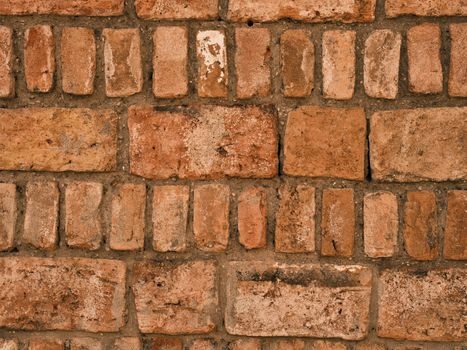
For a single-family exterior veneer with brick-look aesthetics, an SW-grade modular or engineered brick on a drained cavity is the standard; failure mode is efflorescence from wet mortar and missing through-wall flashing at penetrations, and the specifier should call for a 1 in clear cavity, weeps at 24 in on center, and a 30-mil PVC drip-edge flashing at lintels and shelf angles [S1][S3]. For a 2- to 4-story multifamily or hotel loadbearing wall, 8 in NW CMU grouted at 32 in on center is the cost-effective baseline, with Type S portland-lime mortar (ASTM C270) and ASTM C476 grout; failure mode is cracking at control-joint spacing above 20 ft, mitigated by horizontal joint reinforcement at 16 in vertical intervals.
For a mid-rise residential or hotel wall over 4 stories where weight and insulation both matter, AAC at 8 in Class 4 with bed-joint thin-set mortar is the dominant European specification and is gaining U.S. adoption; failure mode is moisture pickup on the unfinished block during storage, mitigated by factory-applied water repellent and a weather-resistive barrier behind the cladding. For a fire-rated mechanical room or stair shaft, NW CMU is still the workhorse because of the deep UL U902-class listing library and the contractor base familiar with grout placement [S1].
Sourcing and Lead-Time Signals, July 2026
U.S. Midwest regional yards like Top Block & Brick in East Dubuque, IL, stock "hundreds of shapes, colors and patterns" of natural stone, brick, block, and manufactured stone, which sets a 1-3 day pickup window on common modular brick and standard 8 × 8 × 16 CMU but stretches to 2-6 weeks for non-stock tumbled or glazed SKUs [S1]. Domestic AAC typically ships on 4-8 week lead times from one of two U.S. plants plus European imports on 10-14 week ocean-freight windows, so AAC belongs in the design phase at SD, not in shop-drawing release.
Two trackable signals to watch: ASTM C216-22 and C90-22 are the active revisions; any submittal stamped "C216-16" or "C90-15" is past the current 5-year cycle and should be re-anchored to the 2022 versions [S1]. And for projects in the U.S. Midwest river-valley sulfate belt, Type II/V cement mortar under ASTM C1324 should appear on the spec — this is a soil-and-water chemistry question, not a brand question. Sourcing HVAC site equipment for masonry-yard logistics, the specifier often hands the same 4WD loader spec sheet that HVAC mechanical contractors use, since pallets of 8-in CMU and AAC blocks land in the same 3-5 ton lift-truck envelope.