
Blondel's 1893 result reduces to one operational rule: an N-wire service requires N-1 watt-hour elements, with the Nth current path assumed to return through a common conductor that needs no dedicated sensor [S3][S5].
That single line drives every ANSI C12.20-2015 accuracy class (0.1, 0.2 and 0.5) and the meter-form numbers a utility stores clerk or spec engineer pulls from a catalog [S2]. A two-wire single-phase service needs a 1S (1-stator) meter, a three-wire delta needs a 5S (2-element) meter, and a four-wire wye needs a 9S or 16S (3-element) meter, exactly the count a CT schedule will mirror on a single-line diagram [S5].
Where the N-1 rule comes from
André Blondel derived the theorem to simplify the algebra of polyphase power, which originally required N wattmeters each measuring its own conductor current against a common reference point [S3]. When that common point is placed on one of the N conductors, that conductor's wattmeter becomes redundant because its current is the negative sum of the others, and Kirchhoff's current law guarantees its contribution is captured in the remaining sensors [S3][S7].
The simplification was published in the proceedings of the 1893 International Electric Congress in Chicago, and the same logic extends to watt-hour meters because integration over time is linear and preserves the algebraic sum [S3]. Every "element" inside a modern static meter is just that pair, one current-sensing input plus one voltage-sensing input, and the physical socket form (1S, 2S, 5S, 6S, 9S, 16S, etc.) is named by the count of those elements, not by the wire count [S5]. For metering pump context readers, the N-1 principle is the electrical analog of using one fewer positive-displacement chamber than the number of fluid ports: the last port is inferred from the others.
Mapping the rule to common meter forms
The form-to-service mapping that field crews actually use: 1S for 2-wire 120 V single-phase, 2S for 3-wire 120/240 V residential, 5S or 6S for 3-phase 3-wire delta at 240 V or 480 V, and 9S or 16S for 3-phase 4-wire wye at 120/208 V, 277/480 V, or 347/600 V [S5]. A 4-wire wye has four conductors (A, B, C, N) so three elements are correct, and a 3-wire delta has three conductors (A, B, C) so two elements are correct, with no neutral to instrument on a delta service [S4][S5].
CT schedules follow the same arithmetic. For a 4-wire wye the spec calls for three CTs (one per phase), with the neutral CT omitted because the theorem says its current is recoverable from the other three; for a 3-wire delta the spec calls for two CTs in any two of the three phase conductors [S4]. PTs (voltage transformers) are counted by phase-to-neutral or phase-to-phase references needed for the meter's voltage inputs, and they are not governed by the N-1 rule in the same way the current inputs are [S4].
When Blondel compliance breaks: documented failure modes
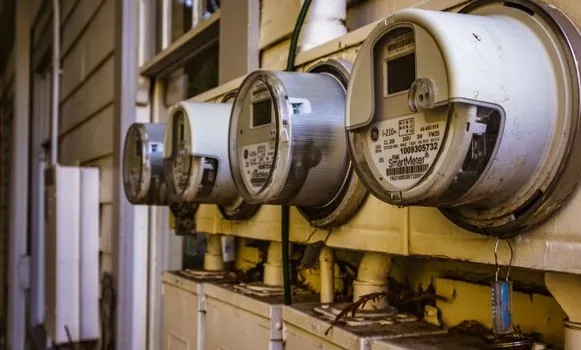
A 2020 IEEE EMC Europe paper by ten Have, Hartman, Moonen and Leferink demonstrated that the theorem fails in residential single-phase metering when protective earth carries return current, which violates the assumed Kirchhoff balance between line and neutral [S1]. In their case study a defective residual current device allowed leakage current to flow through the earth path, producing a line-to-neutral unbalance that the single 1S element could not detect, and the resulting billing error went in the homeowner's favor while exposing the meter to reverse-energy events [S1].
The other well-documented non-compliance is the legacy 2S meter on 3-wire 120/240 V residential service: a Blondel-compliant meter for that service would need two elements in a five-jaw socket, but the 2S meter uses one potential coil plus two half-rated current coils and is only accurate under balanced line-to-line loads [S3]. It is intentionally non-Blondel because it predates the rule's universal application, and ANSI C12.20-2015 accuracy classes 0.1, 0.2, and 0.5 are written so a properly installed Blondel-compliant meter meets the class under all load conditions, while a 2S meter must be evaluated against the specific load mix it will see [S2][S3]. For a weighing-metering context reader, the parallel is a load cell that sums correctly only when the mechanical support provides a known return path; once the support carries an unmeasured reaction, the sum drifts.
Non-Blondel metering and why it persists
Industry practice tolerates non-Blondel meters in three well-defined cases: 2S on 3-wire 120/240 V residential, 2.5-element meters on 4-wire wye (two potential coils, three current coils) where the third current coil is shared, and network or transformer-rated metering on services with known load symmetry [S3]. The trade-off is always the same: cost and mechanical simplicity, lower component count, and avoidance of interaction between two stators driving a single induction disc, in exchange for a metering accuracy that holds only over a restricted load envelope [S3][S5].
For new installations on 4-wire wye services the recommendation embedded in the cited material is to specify a 3-element meter (form 9S, 16S, or the modern solid-state equivalent) and three CTs rather than a 2.5-element compromise, especially where the load includes single-phase EV chargers, rooftop solar backfeed, or any non-linear load that distorts the neutral current [S5]. The theorem itself was developed before EVs, distributed generation, and switched-mode power supplies existed, and the ten Have et al. case study makes the failure mode concrete: a leaking RCD, a few milliamps through earth, and a single 1S meter that no longer knows what it is measuring [S1][S5].
Spec checklist for a Blondel-compliant installation

Concrete steps a spec engineer or meter tech can apply: (1) count the current-carrying conductors, not the physical wires in the raceway; a grounded conductor used only for equipment grounding does not count as an N for the theorem [S1][S3]. (2) Specify N-1 current sensors, and place them on the phases, not on the neutral, for any wye service [S4][S5]. (3) Match the meter form to the service: 1S/2-wire, 2S or 12S/3-wire, 5S or 6S/3-phase 3-wire, 9S or 16S/3-phase 4-wire wye, with the solid-state form being the practical choice where available [S2][S5]. (4) Verify the meter accuracy class against ANSI C12.20-2015 (0.1, 0.2, or 0.5) and confirm that the meter is rated Blondel-compliant on its nameplate, not just that the form number is correct [S2]. (5) On residential single-phase services, confirm RCD integrity and protective-earth bonding before accepting a 1S metered billing value, because the theorem silently fails the moment earth carries return current [S1].
The reading list a field engineer can take into a job: the original 1893 Blondel paper summarized in [S3], the ANSI C12.20-2015 class definitions in [S2], the form-by-form wiring walk-through in [S5], and the protective-earth failure case study in [S1]. For a deeper look at how analog and digital measurement principles intersect with industrial instrumentation, the lighting equipment and electric lamps reference covers the same current-and-voltage sensing mathematics in a different domain, and the pressure transmitter page is a useful analog for thinking about how a sensor count and placement rule like Blondel's translates from electrical to process variables.
Background reading: Fire Door Intumescent Seal Hardware Spacing and Listing Rules.