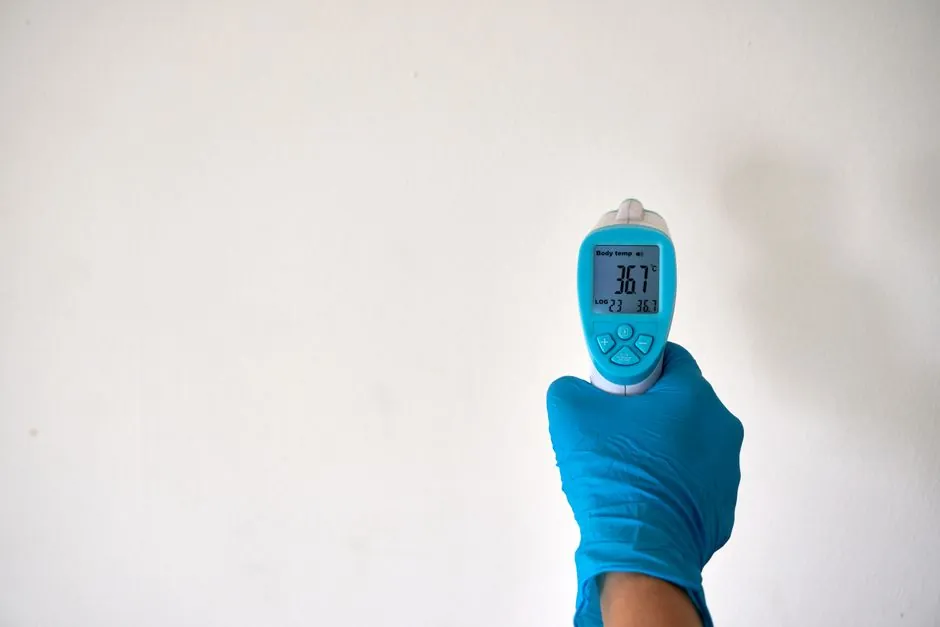
Bimetal dial thermometers and digital stem thermometers both fit into the same thermowell and both read the same process, but they diverge sharply on accuracy class, power need, output signal, and cost. On a 2026-07 product sheet, Reotemp rates its industrial bimetal series at ±1% of full scale across dial sizes 3, 4, and 5 inches, while its digital stem series (DTA/DTX/DTE, DTL, DTR) is specified to Class A RTD accuracy over a wider range of -328 to 1,112°F [S5].
For plant engineers specifying local indication on a pipe, tank, or heat exchanger, the practical decision comes down to four questions: do you need a transmitter output, do you have power at the point of measurement, what accuracy does the loop require, and what is the ambient readability distance. A bimetal unit answers yes to the last question and no to the first three; a digital stem unit answers the opposite. Reference coverage of the bimetal thermometer sensing principle and the infrared thermometer alternatives is worth a cross-check when non-contact measurement is also on the table.
Sensing Principle and Mechanical Behavior
A bimetal thermometer uses two bonded metals with different thermal expansion coefficients formed into a coil or helix; as temperature changes, the differential expansion winds or unwinds the coil, and that motion is mechanically linked to a pointer on a calibrated dial, so the device needs no external power and no signal cable [S2]. The same mechanism is described in the engineering literature as "two strips of metals with different thermal expansion coefficients, which bend in response to" temperature change [S6].
A digital stem thermometer replaces the mechanical coil with an RTD or thermocouple sensing element at the probe tip; the head contains electronics that linearise the sensor, drive a local LCD, and (on most industrial models) output a 4-20 mA, HART, or RTD signal for the control loop.
Accuracy, Range, and Dial Size Compared
Across Reotemp's 2026 industrial catalogue, the head-to-head comparison lines up clearly. Bimetal industrial series (AA, CC, BB, RR, CN, SS, LL, MM, JJ, XR, YY, VR, XX, YN, VN) all share ±1% full-scale accuracy, dial sizes 3, 4, or 5 inches, and a range of -100 to 1,000°F; digital series (DTA/DTX/DTE, DTL, DTR) hold Class A RTD accuracy at the same 3.5-inch form factor but extend the range to -328 to 1,112°F [S5]. Small-dial bimetal units drop accuracy further: the OEM Series NO/UO is rated at ±1.5% full scale, and pocket Series K79 and K82P sit at ±2% full scale across ranges of -40 to 550°F and -40 to 220°F respectively [S5].
For a spec-driven pick, the rule of thumb is: if the loop tolerates ±1% FS and the range is within -100 to 1,000°F, a bimetal unit is the lower-cost, no-power option; if the process sits below -100°F, above 1,000°F, or requires transmitter-grade accuracy, step up to a digital stem. The same dial-vs-digital decision pattern appears when comparing a digital multimimeter to an analog panel meter, where the trade is always the same: electronics for accuracy, mechanics for simplicity.
Power, Output, and Integration into the Control Loop
Bimetal thermometers are entirely passive: no power, no signal, no cable, and the operator reads the dial directly. The Reotemp dual-mode Series DM keeps the mechanical dial but adds electronic output, a useful middle ground for plants that want a glance-readable local indicator plus a 4-20 mA feed to the digital panel meter in the control room [S5].
Digital stem thermometers require 24 VDC loop power (or battery on portable units) and natively produce a linearised output that drops straight into a DCS, PLC, or flow-meter style indicator panel. Reotemp's DTL and DTR are described as "adjustable-angle digital thermometer/transmitter" and "digital remote-reading thermometer with threaded connection" respectively, both at Class A RTD accuracy, which confirms they are intended for hard-wired integration rather than handheld use [S5]. For hazardous-area plants, the digital path also makes it easier to add intrinsic-safety barriers; the bimetal path stays simple because there is no electrical energy in the field device at all [S2].
Calibration, Drift, and Field Maintenance
Both technologies use the ice-point method for field calibration, but the failure modes differ. For a bimetal dial unit, the operator fills a container with crushed ice and cold water, inserts the stem to at least 1/2 inch past the indicator notch, holds 30 seconds to 1 minute, and uses a wrench on the calibration nut under the dial to set the needle to 32°F (0°C) [S3]. NC State Extension repeats the same procedure and notes calibration is needed after very hot or cold food, or after a drop, with a four to five minute wait in an ice-water slush [S4].
For a digital stem thermometer, the ice-point check first tries a fresh battery; if the reading is still off, the unit is sent in for service or replacement, since most consumer-grade digital probes cannot be mechanically recalibrated [S3]. Industrial digital stems with HART or RTD output are typically calibrated against a dry-block at 32°F, 212°F, and a process-relevant midpoint, then the trim constants are written through the handheld communicator. The USDA Food Safety and Inspection Service adds an insertion-depth rule that applies to both: "the probe of the bimetal coil thermometer must be inserted the full length of the sensing area (usually 2 to 3 inches)" [S1]; ignoring that rule is the most common source of a false low reading on either technology.
Use-Case Fit: Who Should Specify Which

Specify a bimetal dial thermometer when the application is local visual indication on a steam line, hot water loop, or HVAC duct, when no power is available at the tap, when ambient vibration is low to moderate, and when ±1% full-scale accuracy is acceptable. The Ashcroft selection guide points to the same use cases: air, gas, or liquid in an industrial environment where "electrical power is unavailable or where a simple visual reference is preferred" [S2]. Typical installations are back-connect, bottom-connect, or adjustable-angle units in a 3-5 inch dial with a thermowell, often mounted alongside an electronic sensor for secondary visual confirmation.
Specify a digital stem thermometer when the loop needs a transmitter output, when the range goes below -100°F or above 1,000°F, when Class A RTD accuracy is required for energy billing or custody transfer, or when the local readout is in a poorly lit area where a backlit LCD beats a 3-inch dial. The Reotemp digital range tops out at 1,112°F, which covers most process steam and hot-oil duties, and bottoms out at -328°F, which covers cryogenic lines where a bimetal coil would be sluggish or out of range [S5]. Plants already running a pressure transmitter network will find the digital stem drops into the same wiring and configurator infrastructure with no new tooling.
Cost, Lead Time, and Total Ownership
On the Reotemp 2026 product page, bimetal industrial units are marked at a "$$" cost tier and digital stem units at "$$$", with both families listed as "highly customisable, shippable in days" [S5]. The premium on the digital side reflects the RTD element, the head-mounted transmitter electronics, and the certification paperwork; the savings on the bimetal side are the lack of power supplies, I.S. barriers, and signal wiring.
For a total-cost view, add the wiring cost (zero for bimetal, hundreds of dollars per point for digital in a Class I Div 1 area), the calibration labour (mechanical nut-turn on bimetal, dry-block + HART trim on digital), and the spare-parts strategy (bimetal stocks a dial and a coil; digital stocks a head and an RTD). The mechanical option typically wins on installed cost below 50 local indication points, while the digital option pays back when the same measurement must drive control, alarming, and trending in parallel. For projects where a non-contact check is also useful, see how a digital multimimeter with a thermocouple input compares to either local-reading technology.
The trackable next node is the IEC 60751 revision track for Class A RTD tolerance bands and the ATEX/IECEx certification status of any specific digital head being considered; either of those will shift the digital-stem premium and the safe-area vs hazardous-area decision for new installations.
Related analysis: Custom vs Off-the-Shelf Industrial Hose: A Spec-Driven Decision.