A metering pump is a reciprocating positive displacement pump engineered to deliver a precise, repeatable volume of liquid against a defined back pressure. It is the workhorse of chemical dosing, additive injection, and proportional blending, where the value of the pump lies not in moving large volumes but in delivering exactly the right small volume, stroke after stroke, regardless of downstream pressure swings. The industry also calls these devices dosing pumps, controlled volume pumps, proportioning pumps, and chemical injection or feed pumps.
Unlike a centrifugal pump, whose flow collapses as back pressure rises, a metering pump captures a fixed cavity volume and discharges it each cycle, so flow stays essentially constant with pressure. That property, combined with adjustable stroke length and stroke frequency, is what lets a metering pump hold the steady-state accuracy that standards such as API 675 demand.
Photo: LaurelBloch, CC BY-SA 4.0, via Wikimedia Commons
This guide is written for procurement engineers and design engineers selecting dosing equipment. It covers 6 chapters spanning what a metering pump is, drive and liquid-end classifications, actuation technologies, wetted materials and media, key specification parameters, and the selection decision sequence, with 7 selection FAQs and manufacturer comparisons. All performance figures reference API 675 (Controlled Volume Positive Displacement Pumps), the related API 674 reciprocating pump standard, ANSI/HI 7.1-7.5, and public manufacturer datasheets.
Chapter 1 / 06
What is a Metering Pump
A metering pump is a reciprocating positive displacement pump whose defining purpose is volumetric precision rather than throughput. Each cycle, a plunger or diaphragm expands a chamber to draw a fixed volume of liquid through a suction check valve, then contracts the chamber to expel that same volume through a discharge check valve. Because the displaced volume per stroke is set by mechanics, not by hydraulics, the delivered flow is almost independent of discharge pressure. This is the single property that separates a metering pump from a centrifugal pump and makes it suitable for dosing: injecting coagulant ahead of a clarifier, feeding corrosion inhibitor into a pipeline, or blending two reactants in a fixed stoichiometric ratio.
Functionally, every metering pump is built from two halves. The power end (drive) converts continuous rotary or pulsed electromagnetic energy into reciprocating linear motion, and provides the means to adjust how much liquid moves per unit time. The liquid end (process side) contains the chamber, the actuating element (plunger or diaphragm), the suction and discharge check valves, and the wetted surfaces that contact the chemical. Selection always proceeds on both halves at once: the power end is chosen for duty cycle, pressure, and control, while the liquid end is chosen for chemical compatibility, containment, and accuracy.
Flow is regulated by two independent levers. Stroke length sets the displacement per stroke, typically adjustable from 0 to 100 percent by a micrometer dial or a servo actuator. Stroke frequency sets the number of strokes per minute, adjustable by a variable-frequency drive on motor-driven pumps or by pulse rate on solenoid-driven pumps. Combining both levers yields a wide adjustable span, called the turndown ratio, and lets the pump follow a control signal such as 4-20 mA or a pulse input from a flow meter for flow-proportional dosing.
Metering pumps occupy a specific corner of the pump map: low to moderate flow, low to very high pressure, and high accuracy. Capacities range from a fraction of a litre per hour for laboratory and trace dosing up to several thousand litres per hour for large process trains. Discharge pressures range from a couple of bar for atmospheric tank dosing to well over 1,000 bar for high-pressure pipeline and chemical-injection service. No single pump spans this whole envelope, which is why families of frames, drives, and liquid ends exist.
The governing performance reference is API Standard 675, the controlled-volume positive displacement pump specification for petroleum, chemical, and gas industry service. API 675 sits alongside API 674 (reciprocating positive displacement pumps) and the ANSI/HI 7.1-7.5 standard for controlled-volume metering pumps. API 675 is the document a procurement engineer cites when a dosing skid must be verified by test rather than trusted by catalog, and it fixes the three accuracy metrics decoded in Chapter 5.
Chapter 2 / 06
Drive Types and Classification
Metering pumps are first classified by how the power end actuates the liquid end. Two drive families dominate: solenoid-driven (electromagnetic) and motor-driven (mechanical). The choice fixes duty cycle, achievable pressure, flow ceiling, and price more decisively than any other early decision, so it belongs at the top of the selection tree. The table below contrasts the two families on the parameters that matter at specification time.
Drive Type
Typical Flow
Typical Pressure
Stroke Rate
Best Fit
Solenoid-driven (electromagnetic)
0.74 to 80 L/h
up to ~25 bar
50 to 180 spm
Intermittent low-flow water treatment dosing
Motor-driven (mechanical)
up to ~12,500 L/h
up to >1,000 bar
geared, continuous
Continuous process duty, high pressure, high flow
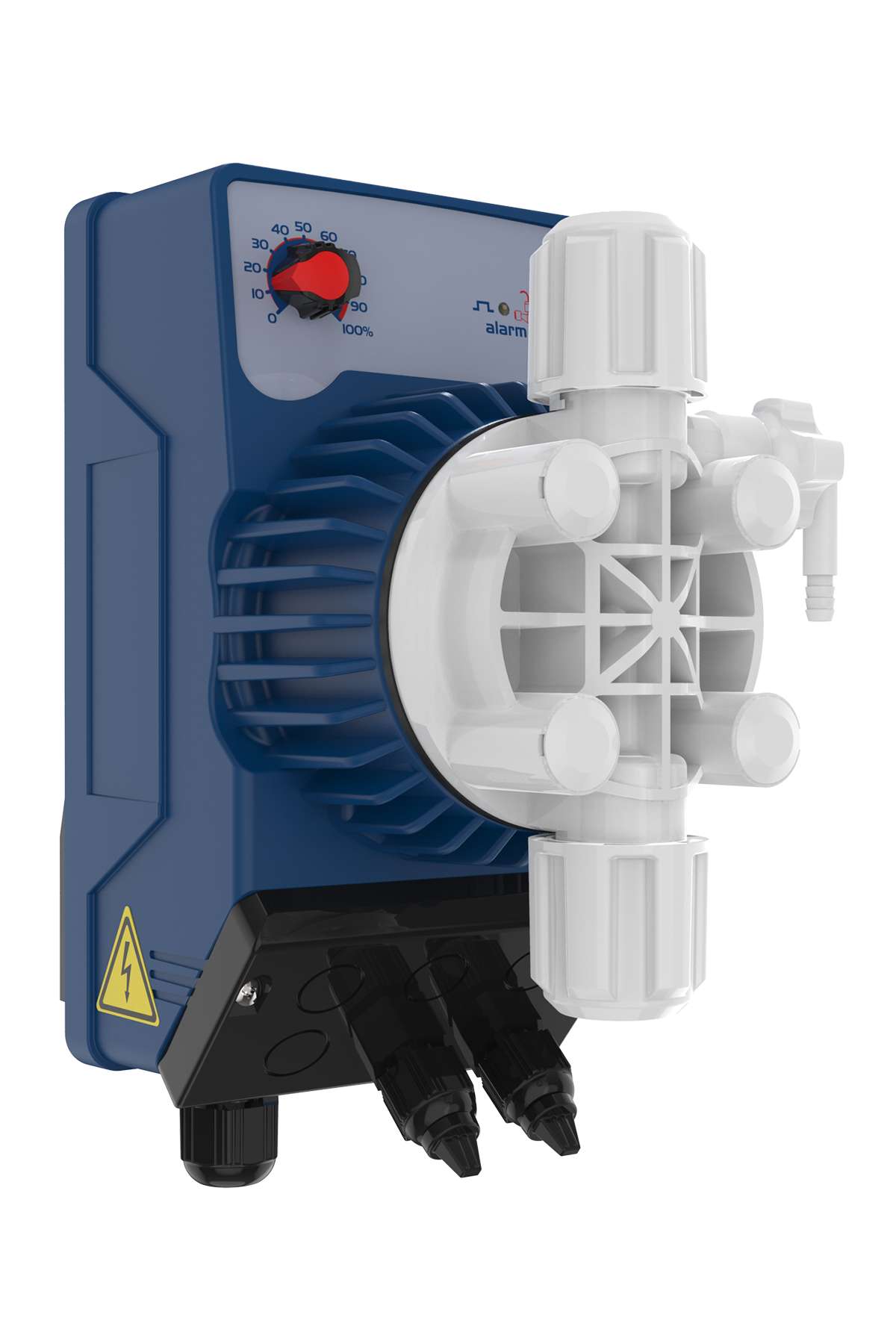
Solenoid-driven pumps move the diaphragm by switching an electromagnet on and off. The coil pulls a magnetic armature against a return spring, the armature pushes a small PTFE diaphragm forward on the energized half-cycle, and the spring retracts it on the de-energized half. Stroke rate is set electronically, commonly 50 to 180 strokes per minute, and flow is trimmed by stroke length and pulse frequency. These pumps are compact, low cost, and quick to install, covering roughly 0.74 to 80 L/h at back pressures up to about 25 bar. Their limitation is duty: the coil and spring are not built for unbroken 24/7 heavy service, so they suit intermittent and light continuous dosing rather than primary process trains.
Motor-driven pumps use an electric motor, worm-gear reduction, and an eccentric or crankshaft to convert rotary motion into reciprocating motion of a plunger or diaphragm. Because the mechanism is gear-driven and oil-lubricated, motor-driven pumps deliver continuous duty, far higher pressures, and far higher flows, scaling into the thousands of litres per hour and above 1,000 bar with the right liquid end. Capacity is adjusted by stroke length (often while running), by motor speed via a variable-frequency drive, or by both, and many frames can be multiplexed so several liquid ends share one gearbox for proportional blending.
A second classification axis is the liquid end principle, which is independent of the drive: a motor-driven pump may carry a mechanically actuated diaphragm, a hydraulically actuated diaphragm, or a packed plunger head. Chapter 3 decodes those liquid-end technologies in detail. A practical first cut is therefore a two-part label, for example a motor-driven hydraulic-diaphragm pump or a solenoid-driven mechanical-diaphragm pump, and most catalog families are organized exactly this way.
A useful sanity check on the drive decision is the operating point. If the dose is small, the pressure modest, and the duty intermittent, a solenoid pump is the economical answer. If the service is continuous, the pressure high, or the flow large, a motor-driven frame is the only durable answer, and the extra capital is repaid in reliability and turndown. Oversizing a solenoid pump to chase a continuous duty it was never built for is a common and expensive specification error.
Chapter 3 / 06
Liquid End Technologies
The liquid end is where the chemistry happens, and its design governs containment, achievable pressure, accuracy, and maintenance burden. Three liquid-end technologies cover the overwhelming majority of industrial service: mechanically actuated diaphragm, hydraulically actuated diaphragm, and packed plunger. Each makes a different trade between pressure capability, leakage safety, and cost. The comparison table below frames those trades before the detailed notes that follow.
Liquid End
Pressure Ceiling
Std. Turndown
Leakage Risk
Best Fit
Mechanically actuated diaphragm
low to medium
~10:1
Zero (sealed)
Water treatment, general chemical dosing
Hydraulically actuated diaphragm
medium to high
~10:1
Zero (sealed)
Toxic, corrosive, flammable media; API 675
Packed plunger
very high (>1,000 bar)
~10:1
Small controlled leakage
High-pressure injection of benign fluids
Mechanically actuated diaphragm liquid ends connect the drive directly to a flexible diaphragm (PTFE-faced) that flexes back and forth to displace the chemical. The process fluid never touches a sliding seal, so containment is inherently leak-free, which suits the broad middle of water-treatment and general chemical dosing. The mechanically driven diaphragm carries the full differential pressure across itself, which caps the practical pressure to the low-to-medium range and bounds diaphragm life, but the design is simple, robust, and easily serviced. Standard turndown is about 10:1, extendable toward 100:1 by combining stroke-length and VFD frequency control.
Hydraulically actuated diaphragm liquid ends interpose hydraulic oil between the plunger and the process diaphragm. The plunger pressurizes the oil, the oil flexes the diaphragm, and crucially the pressure is balanced across the diaphragm, so the membrane sees almost no net differential and can survive far higher process pressures with long life. The result combines the high pressure and accuracy of a plunger with the zero-leakage containment of a diaphragm, holding roughly plus-or-minus 1 percent accuracy over a 10:1 turndown. This is the workhorse construction for toxic, corrosive, or flammable chemicals and is the design most associated with API 675 process pumps. Multi-layer safety diaphragms with rupture detection are common, signaling a leak before the second layer fails.
Packed plunger liquid ends use a solid plunger sealed by adjustable packing rings that directly displaces the process fluid. The plunger construction reaches the highest pressures of any liquid end, with plungers operating well above 1,000 bar and special designs cited to roughly 15,000 psi, and tolerating high temperature. The trade is leakage: a small, controlled amount of fluid weeps past the packing by design, packing friction wears and must be periodically adjusted, and consequently a packed plunger should not be used for hazardous or toxic media. It is the right choice for high-pressure injection of benign or lubricating fluids where leakage is acceptable and pressure capability is paramount.
Across all three, the check valves do the actual metering. Suction and discharge valves, often double-ball designs, must seat repeatably for the displaced volume to translate into delivered volume. Worn, fouled, or chemically attacked check valves are the most common root cause of a metering pump that turns but under-delivers, which is why valve material and condition feature prominently in both the materials chapter and the troubleshooting FAQ.
Chapter 4 / 06
Process Media and Wetted Materials
A metering pump fails at its weakest wetted component, so every part that touches the chemical (the liquid-end head, the diaphragm or plunger, the valve balls and seats, the gaskets and O-rings) must be compatible with the media at the actual concentration, temperature, and presence of solids. Material selection is not a single choice but a coordinated set, because mixing an incompatible seal with a compatible head still produces a leak. Common wetted materials are PVC, 316 stainless steel, Alloy 20, PVDF, PTFE, and ceramic for valve balls, with FKM, EPDM, or PTFE elastomers for seals.
PVC is the economical default for ambient-temperature water-treatment chemistry: dilute acids and alkalis, sodium hypochlorite at moderate strength, coagulants, and polymer solutions. It is limited by temperature and by aggressive solvents and oxidizers, where a fluoropolymer head is required instead.
316 stainless steel handles many organic chemicals, hydrocarbons, and dilute mineral acids, and is the choice when mechanical strength or high temperature rules out plastics. Its weakness is chlorides and reducing acids: 316 is generally acceptable with hydrochloric acid only up to about 5 percent, and is attacked by wet chlorine and chloride brines, where Alloy 20 or higher nickel alloys become necessary.
PVDF and PTFE offer the broadest chemical resistance of the common head materials and are the default for strong acids, oxidizers, and solvents. PTFE has the widest compatibility overall, with PVDF very close and each covering a few media the other does not, which is why diaphragm faces are almost universally PTFE. These fluoropolymers are the right answer for concentrated sulfuric acid, sodium hypochlorite, ferric chloride, and similarly aggressive dosing duties.
The table below is a first-pass lookup of common dosing chemicals against recommended wetted materials. Treat it as a screening tool only: before ordering, obtain the manufacturer corrosion chart and confirm the exact concentration, temperature, and any abrasive solids, because compatibility ratings shift sharply with all three.
Two media properties deserve special attention beyond chemistry. Viscous fluids reduce capacity: high-viscosity liquid ends meter roughly 10 to 20 percent below their rated flow and are typically not self-priming, so a flooded suction and oversized suction valves are mandatory above a few hundred centipoise. Off-gassing or volatile media (sodium hypochlorite, hydrogen peroxide, ammonia) form vapor bubbles that destroy metering accuracy, which is why degassing or auto-degassing valve liquid ends and flooded suctions are specified for those duties.
Chapter 5 / 06
Key Specification Parameters
A metering pump datasheet lists many numbers, but only a handful drive the selection and the acceptance test. The eight parameters below are the ones a procurement engineer must read, decode, and where critical verify by test against API 675 rather than accept from the catalog.
Rated capacity and turndown. Capacity is the maximum flow at 100 percent stroke length and maximum frequency, quoted in L/h (or gph). Turndown ratio is the span between the minimum and maximum controllable flow: about 10:1 for a standard mechanically actuated diaphragm pump, up to roughly 100:1 with combined stroke-length and VFD control, and up to 1:3000 for advanced digital solenoid pumps with electronic stroke control. Size so the normal dose lands between about 30 and 85 percent of maximum, and avoid running permanently below 10 percent stroke length where seating and accuracy degrade.
Maximum discharge pressure. The pressure ceiling is fixed by the liquid end: low-to-medium for mechanical diaphragm, medium-to-high for hydraulic diaphragm, and very high for packed plunger (above 1,000 bar). Capacity and maximum pressure are inversely related within a frame, so a catalog typically lists a pressure that falls as capacity rises across the model range.
Steady-state accuracy. Under API 675 this must be within plus-or-minus 1 percent of rated flow over the specified turndown range. It measures how close the average delivered flow sits to the set point under fixed conditions, and it is the headline metric most users mean when they say accuracy.
Linearity. API 675 caps linearity at plus-or-minus 3 percent of rated flow over the turndown range. It describes how proportionally the delivered flow tracks the capacity-adjustment setting: a perfectly linear pump that is set to 40 percent delivers 40 percent of rated flow. Poor linearity forces a lookup curve rather than a simple set-point relationship.
Repeatability and reproducibility. API 675 requires flow repeatability within plus-or-minus 3 percent of rated flow over the turndown range. It is the scatter between successive measurements at one unchanged setting, and it bounds how tightly a closed-loop controller can hold the dose. Reproducibility, the longer-term version, is typically better than plus-or-minus 1 percent in the 10 to 100 percent stroke range when correctly installed. These three metrics (accuracy, linearity, repeatability) are reported separately and must never be merged into a single accuracy figure.
Wetted materials and containment. The liquid-end material set decided in Chapter 4 is a hard specification line: head, diaphragm or plunger, valve balls and seats, and seals, each named explicitly. For hazardous media, zero-leakage containment (hydraulic or mechanical diaphragm with rupture detection) is non-negotiable.
Control interface. How the pump receives its set point. Common options include manual dial, 4-20 mA analog input for flow-proportional dosing, pulse input slaved to a water-meter contact, digital bus (PROFIBUS, Modbus), and integrated batch timers. Digital pumps may add integrated flow measurement that closes the loop on actual delivered volume rather than commanded strokes.
Connections, NPSH, and certification. Process connections (threaded, union, or flanged), required NPSH (raise the suction head for viscous or volatile media), motor enclosure and area rating (ATEX or IECEx for hazardous areas), and applicable standards (API 675 acceptance test, ANSI/HI 7.1-7.5, PED for pressure equipment). For ATEX-area chemical injection, an API 675 hydraulic-diaphragm pump with an explosion-proof motor is the usual answer.
Chapter 6 / 06
Selection Decision Factors
To turn the preceding five chapters into a specific model, follow the ordered sequence below. Most selection errors are not a single wrong value but a decision taken at the wrong level, for example fixing on a brand before the duty cycle and pressure are settled. These eight steps double as a fixed RFQ template.
Define the dosing duty: chemical, normal and maximum flow (L/h), required dosing accuracy, and whether the duty is intermittent or continuous. This single line decides solenoid versus motor-driven more than anything else.
Fix the discharge pressure: system back pressure plus static head plus a margin, then confirm it sits within the chosen liquid end's ceiling. High pressure forces hydraulic diaphragm or packed plunger; modest pressure allows mechanical diaphragm.
Choose the liquid end for containment: hazardous, toxic, or flammable media require a sealed diaphragm (hydraulic for high pressure). Reserve packed plunger for benign high-pressure fluids where small leakage is acceptable.
Select wetted materials: match head, diaphragm or plunger, valve balls and seats, and seals to the chemical per Chapter 4, verifying against the manufacturer corrosion chart at the real concentration and temperature.
Set the turndown and control interface: size for the normal dose at 30 to 85 percent of maximum, pick the turndown the process needs, and choose manual, 4-20 mA, pulse, or bus control. Add integrated flow measurement for closed-loop verification where the dose is critical.
Specify accessories for stable metering: back-pressure valve to hold a constant discharge differential and stop siphoning; pulsation dampener (precharged to 60 to 80 percent of operating pressure) to remove about 95 percent of pressure spikes; calibration column to verify true flow; relief valve to protect against a blocked discharge.
Confirm certification and environment: API 675 acceptance test where contractually required, ATEX or IECEx motor for hazardous areas, PED for pressure equipment, and ambient and media temperature limits.
Cost the total ownership: purchase price plus installation plus the recurring cost of diaphragm and check-valve spares, packing adjustment (plunger), calibration labor, and the process cost of an off-dose event. A cheap pump that drifts or under-delivers can ruin product quality or trip a permit limit, dwarfing the price difference.
One dimension often overlooked is serviceability and spare-part logistics: diaphragm and check-valve kits are consumables, and a pump whose spares are stocked locally and whose liquid end can be rebuilt in the field keeps a dosing skid running for years. Established suppliers cover the major use cases with documented series: Milton Roy (mROY hydraulic diaphragm about 0.8 to 330 L/h up to 207 bar; Primeroyal to roughly 12,500 L/h and above 1,000 bar), ProMinent (beta and gamma solenoid pumps; Sigma/3 motor-driven about 146 to 1,030 L/h at 12 to 4 bar; Hydro/4 API 675), Grundfos (SMART Digital DDA solenoid, turndown to 1:3000 with integrated flow measurement), and Iwaki / Walchem (LKN motor-driven mechanical diaphragm to about 432 L/h at 1.5 MPa), with Seko and LMI common in water-treatment dosing. Always verify the exact model datasheet for capacity, pressure, materials, and certification before purchase.
FAQ
What is the difference between a metering pump and a centrifugal pump?
A metering pump is a reciprocating positive displacement pump: every stroke displaces a fixed, repeatable volume of liquid that is almost independent of discharge pressure, which is what makes it a dosing device. A centrifugal pump imparts kinetic energy with a rotating impeller, so its flow falls as back pressure rises along a head-capacity curve. Metering pumps target precise low flow against high pressure, with API 675 requiring steady-state accuracy within plus-or-minus 1 percent over the turndown range. Centrifugal pumps target high flow at moderate pressure and cannot meter. The two are not interchangeable: you would never use a centrifugal pump to inject a stoichiometric chemical dose, nor a metering pump to fill a tank quickly.
What does API 675 specify for metering pump accuracy?
API 675 (Positive Displacement Pumps, Controlled Volume, for petroleum, chemical and gas industry service) defines three independent performance metrics over the specified turndown range. Steady-state accuracy must be within plus-or-minus 1 percent of rated flow, a measure of how close the average delivered flow sits to the set point at fixed conditions. Linearity must not exceed plus-or-minus 3 percent of rated flow, describing how proportionally flow tracks the capacity-adjustment setting. Repeatability (reproducibility) must be within plus-or-minus 3 percent of rated flow, describing scatter between successive measurements at one setting. These three are reported separately and must not be merged into a single accuracy figure; an API 675 acceptance test verifies all three on the actual pump.
Should I choose a solenoid-driven or a motor-driven metering pump?
Solenoid-driven (electromagnetic) diaphragm pumps pulse a small PTFE diaphragm via an electromagnet, typically 50 to 180 strokes per minute, covering roughly 0.74 to 80 L/h at back pressures up to about 25 bar. They are compact, inexpensive, and ideal for intermittent low-flow water-treatment dosing, but they are not built for continuous heavy 24/7 duty. Motor-driven pumps use a worm gear, eccentric, and crankshaft to drive a plunger or diaphragm, providing continuous duty, far higher pressure (hundreds to over 1,000 bar), and higher flow (into the thousands of L/h). Rule of thumb: low flow plus low pressure plus intermittent duty favors solenoid; continuous process service, high pressure, or large flow favors motor-driven.
What is the difference between a packed plunger and a hydraulic diaphragm liquid end?
A packed plunger liquid end uses a solid plunger sealed by packing rings that directly contacts and displaces the process fluid. It reaches the highest pressures (plungers can exceed 1,000 bar, with special designs to roughly 15,000 psi) and tolerates high temperature, but a small amount of controlled leakage past the packing is unavoidable, so it should not be used for hazardous or toxic media, and the packing needs periodic adjustment. A hydraulically actuated diaphragm liquid end places hydraulic oil between the plunger and a flat process diaphragm; the plunger pressurizes the oil, which flexes the diaphragm. Pressure is balanced across the diaphragm, giving long diaphragm life and zero process leakage, which makes it the standard for toxic, corrosive, or flammable chemicals under API 675.
How do I size the flow range and turndown of a metering pump?
Pick a pump whose rated capacity places your normal dose between roughly 30 and 85 percent of maximum so you keep resolution and reserve headroom for ramping. Turndown ratio is the span between minimum and maximum controllable flow: a mechanically actuated diaphragm pump gives about 10:1 as standard, extendable toward 100:1 by combining stroke-length and stroke-frequency (VFD) control, while advanced digital solenoid pumps such as the Grundfos DDA reach up to 1:3000. Adjusting stroke length changes the displaced volume per stroke; adjusting stroke frequency changes strokes per minute. Do not run a pump permanently below about 10 percent stroke length, where valve seating and accuracy degrade. For dilute trace dosing, prefer a small pump with high turndown over a large pump throttled hard.
Which wetted materials should I choose for corrosive chemicals?
Match the liquid-end head, diaphragm, valve balls, seats, and seals to the chemical, since a single weak component fails the whole pump. PVC suits dilute acids, alkalis, and most water-treatment chemistry at ambient temperature. 316 stainless steel handles many organics and dilute acids but is attacked by hydrochloric acid above about 5 percent and by chlorides, where Alloy 20 or higher alloys are needed. PVDF and PTFE offer the broadest resistance and are the default for strong acids, oxidizers, and solvents (sodium hypochlorite, sulfuric acid, ferric chloride). Seals are typically FKM, EPDM, or PTFE depending on media. Always confirm against the manufacturer corrosion chart for the exact concentration, temperature, and any solids before ordering.
Why does my metering pump lose prime or under-deliver, and what accessories help?
Loss of prime and under-delivery usually trace to vapor lock, low NPSH available, viscous or off-gassing media, worn check valves, or insufficient back pressure. High-viscosity liquid ends meter 10 to 20 percent less and are not self-priming, so a flooded suction is essential. A back-pressure valve set above the system static head holds a constant differential across the discharge check, which stabilizes the per-stroke volume and prevents siphoning, improving repeatability. A pulsation dampener (gas cushion precharged to roughly 60 to 80 percent of operating pressure) smooths the reciprocating flow and removes around 95 percent of pressure spikes, protecting piping and downstream instruments. A clear calibration column lets you verify true delivered flow by timing a drawdown rather than trusting the dial.
Metering Pump Manufacturers
Source-backed product routes. Open a company dossier for procurement scope and cited evidence.
ETATRON documents eOne and eOne B as intelligent solenoid metering-pump product routes.
Published product fact
eOne and eOne B intelligent solenoid metering-pump models with stated flow adjustment as system pressure changes and injection frequencies up to 300 strokes per minute.
Published product fact
PK-Pool peristaltic dosing-pump series for domestic swimming-pool, SPA and wellness contexts identified by ETATRON.
HNP documents the mzr-7242 micro annular gear pump as a precision low-volume dosing and metering route.
Published product fact
mzr-7242 modular-series micro annular gear pumps for dosing and metering, with the published 4.8–288 ml/min flow range and 30 µl smallest dosage volume.
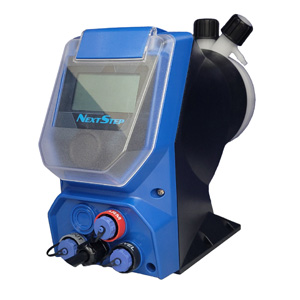
Pulsafeeder documents its NextStep precision metering-pump family for controlled chemical dosing.
Published product fact
NextStep stepper-motor diaphragm precision metering pumps, described by Pulsafeeder as positive-displacement chemical pumps with 3,333:1 turndown and 4,800-step resolution.