
A concrete mixer truck configured for federal Bridge Formula compliance needs at least 427 in (about 35.6 ft) from the centerline of the front steer axle to the centerline of the rear booster axle, per Kenworth market segment manager Brian Lindgren [S2]. That span keeps the truck on the 36 ft external-bridge band, which is the practical limit while still respecting the 40 ft overall length cap on most U.S. highways.
The Bridge Formula itself, codified at 23 U.S.C. §127 and 23 C.F.R. §658 and illustrated in the FHWA Bridge Formula Weights pamphlet (FHWA-HOP-19-028, August 2019), caps single axles at 20,000 lb, tandem-axle groups (40-96 in spacing) at 34,000 lb, and total gross weight at 80,000 lb on the Interstate system [S1]. A standard three-axle single-axle concrete truck in the U.S. is limited to about 48,000 lb gross, which is enough for small pours only and forces a four-or-more-axle layout for ready-mix work [S4].
What the Federal Bridge Formula actually constrains
Bridge Formula B, enacted by Congress in 1975 and effective through 23 U.S.C. §127, expresses the relationship W = 500 × (LN / (N-1) + 12N + 36), where W is the maximum weight rounded to the nearest 500 lb on a group of two or more consecutive axles, L is the distance in feet between the outer axles, and N is the number of axles in the group [S3][S5]. The formula is the U.S. implementation of a wider weight-to-length control used in Canada (Ontario), Mexico, Europe, South Africa, Australia, and New Zealand [S3].
Three definitions drive the formula. Gross weight is the loaded vehicle or combination weight, capped at 80,000 lb federal. Single-axle weight applies to one axle or to axles spaced 40 in or less center-to-center, capped at 20,000 lb. Tandem-axle weight applies to consecutive axles spaced more than 40 in but not more than 96 in apart, capped at 34,000 lb [S1][S6]. A standard five-axle semi configuration is the one exception engineered into the law so tank trucks can reach 80,000 lb without tripping the formula [S5].
The physical reasoning: bridge stress under a long-wheelbase truck is much lower than under a short truck of the same total weight, because the load is spread over more of the structure at any instant [S1][S5]. That is why the formula only restricts weight for shorter combinations, and why lifting a pusher axle or adding a booster axle is the standard escape valve for a heavy cement concrete load.
Axle spacing rules: the numbers a spec sheet must show
The FHWA defines a single axle as 40 in or less center-to-center and a tandem as 40-96 in center-to-center [S1]. Below 40 in, the pair counts as one axle for the 20,000 lb cap. Above 96 in, the two axles are treated as separate singles or as part of a wider tridem grouping. TruckScience's worked example shows a trailer wheelbase stretched from 307 in to 385 in lifting legal gross from 75,500 lb to the 80,000 lb ceiling, which is exactly the kind of geometry a mixer spec writer is chasing [S3].
For external bridges (axle 1 to axle 5), 51 ft is the minimum spacing needed to reach 80,000 lb gross, with the table continuing into higher weights for longer spans [S7]. For a typical four-axle mixer with a booster, the external bridge is much shorter, which is why fleets in non-formula states can pull the rear axle in tighter and use lift axles only when loaded [S2]. A standard three-axle, single-axle-tridem configuration in the U.S. is limited to about 48,000 lb total, which is rarely enough to carry a full 10 yd³ drum of normal-weight concrete admixture mix plus chassis weight [S4].
Booster axles, lift axles, and the 427 in rule of thumb
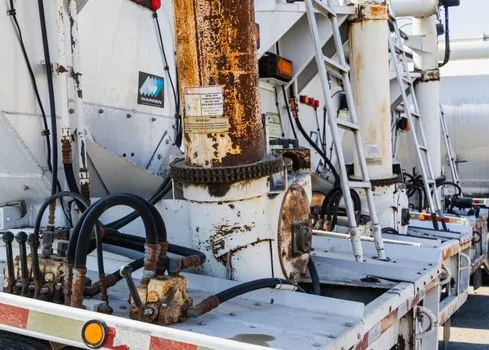
In formula-compliance states, mainly across the Western U.S., spec writers extend the wheelbase and add a rear booster or tag axle to spread weight and clear the formula [S2]. Lindgren's published rule: 427 in from front steer centerline to rear booster centerline, with the steer axle pushed as far forward as the bumper allows, and no protruding tow hook that would push overall length past 40 ft [S2]. That layout lets the truck sit on a 36 ft external bridge and still carry close to the 80,000 lb federal ceiling when paired with a 34,000 lb tandem and a 20,000 lb steer.
In non-formula states, the same chassis can be shorter and heavier, with a lift (pusher) axle that is dropped only when loaded. Wide-base single front tires such as 425/65R22.5 may be required where tire footprint is regulated at roughly 600 lb per inch of tire width, because a 20,000 lb steer load on standard front tires is hard to make legal on footprint alone [S2]. For comparison, the standard 425/65R22.5 size class is the typical "super-single" alternative that a ready-mix fleet uses in these states, while tandem-axle spreads in the 54-61 in range remain the workhorse geometry for the rear bogie.
Concrete payload math behind the axle choice
A 10 yd³ drum of normal-weight concrete weighs about 40,000 lb at roughly 4,000 lb/yd³, and the mixer chassis itself adds roughly 26,000 lb, so a fully loaded truck is around 66,000 lb before any incidental drum residue [S4]. Drum residue plus mixing dynamics push the realistic working payload toward 60,000-80,000 lb, depending on mix design and remaining concrete in the drum, and lightweight concrete drops the per-yard figure to about 3,000 lb/yd³ [S4].
Empty chassis weight (tare) of mainstream U.S. mixers runs 15,000-30,000 lb, so any spec over 66,000 lb loaded is already bumping the 80,000 lb federal cap once the drum is full [S4]. That is why a three-axle single-steer truck limited to 48,000 lb gross is only useful for small pours, and a four-or-five-axle bridge-formula layout is the default for production ready-mix work [S4].
State overlays: Kentucky, grandfather states, and intrastate rules

Federal limits are the floor, not the ceiling. Several "grandfather" states run heavier Interstate limits under pre-1982 rights, and intrastate highways are governed by each state's own size-and-weight code [S1]. Kentucky, for example, sets the Class AAA Interstate single-axle cap at 20,000 lb, the tandem cap at 34,000 lb, and the gross cap at 80,000 lb on the same federal numbers, but applies a separate intrastate schedule for non-Interstate routes [S8].
For spec purposes, the practical rule is: read the FHWA pamphlet for the formula and the federal caps, then read your state's bridge table for the exact spacing-vs-weight curve, because most Western states have tighter curve fits that effectively force the 427 in / 36 ft geometry on any production sand mixer drum truck that hauls across state lines [S2][S1].
Comparison: bridge-formula vs non-formula mixer configurations
Side by side, the two layouts trade maneuverability for payload reach. A bridge-formula mixer is longer (around 36-40 ft), uses four or five axles, carries closer to 80,000 lb gross, and qualifies for federal Interstate work in formula states [S1][S2]. A non-formula mixer is shorter (often 30-34 ft), uses three axles plus a lift axle, carries 48,000-66,000 lb gross, is more maneuverable on tight jobsites, but is restricted geographically and typically needs lift-axle management at every job [S2][S4]. Tire spec also diverges: bridge-formula trucks often run standard dual rear tires and wide-base 425/65R22.5 fronts, while non-formula trucks can sometimes run standard front footprints in footprint-regulated states if they stay under 20,000 lb on the steer [S2].
Limitations and failure modes a spec writer should plan for
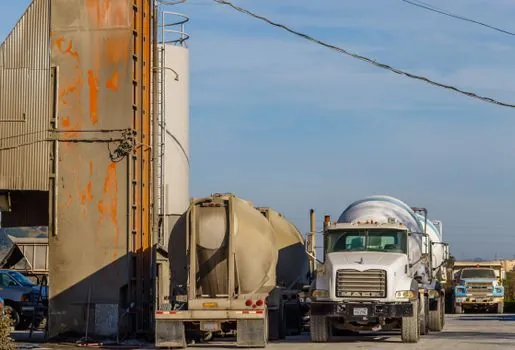
The most common bridge-formula trap is overshooting the 40 ft overall length limit, which can happen with a long permanently mounted tow hook, a protruding chute, or a tag axle pushed too far behind the rear bogie [S2]. The most common load-side trap is assuming a 48,000 lb three-axle chassis can carry a full drum; it cannot, and a fleet that orders the smaller truck for capital savings will end up shuttling half-loads on production pours [S4].
A subtler failure is mis-classifying an axle group: any two axles 40 in or less apart count as a single 20,000 lb axle, while two axles 40-96 in apart count as a 34,000 lb tandem, so even small geometry errors can move a truck 14,000 lb on the formula [S1]. Weigh-station enforcement is the closing check, and the formula is checked group-by-group across the full vehicle, not just on the gross number [S3].
Verification path and what to track next
The canonical reference is the FHWA Bridge Formula Weights pamphlet, FHWA-HOP-19-028 (August 2019), which paraphrases 23 U.S.C. §127 and 23 C.F.R. §658 and is the version currently posted on the FHWA Office of Operations site [S1]. TruckScience's Bridge Formula Weights Calculator and the Federal Bridge Gross Weight Formula Wikipedia page reproduce the W, L, N definitions consistently with the FHWA text and are the two fastest tools for a spec check on a candidate axle layout [S3][S5]. Lindgren's 427 in / 36 ft / 40 ft overall guidance remains the most-cited Western-U.S. benchmark for a bridge-formula power mixer chassis [S2]. For a complete spec pass, cross-check FHWA + state bridge table + axle-manufacturer rating, and confirm tire footprint in any footprint-regulated state before locking the steer-axle weight.
For related coverage, see Arc Welder Power Sizing for 200 A Output: Breakers, Watts, and Generator Headroom.