
Welding at 200 A or more requires a minimum 50 A breaker on 208-230 V single-phase primary, per the ESAB buying guide rule of thumb published in April 2025 [S2]. On modern inverter machines that same envelope typically draws 6,000-10,000 W from the wall, while a legacy transformer-style MIG set can theoretically pull 44,000 W at 200 A by 220 V arithmetic [S1][S4].
Output current is not input current: a 350 A inverter welder running near full output still draws around 65 A at 240 V AC single-phase, because the inverter trades voltage for current on the secondary side, an exchange that trips a 100 A shop service if you push the unit hard for long [S3].
Breaker and Circuit Sizing for 200 A Single-Phase Output
The widely cited ESAB rule tiers the primary-side breaker to the output envelope, not to the output nameplate directly: 115 V primary welders up to 140 A output need a 20 A minimum / 30 A recommended breaker, 208-230 V units up to 180 A output need 30 A minimum / 50 A recommended, and any welder running 200 A or more needs at least a 50 A breaker on 208-230 V primary [S2]. The same reference gives a worked example for the ESAB Fabricator 181i: 208-265 V AC, 25 A minimum circuit, 40 A recommended at 208-230 V, or 50 A at 230 V [S2].
Dual-voltage machines such as the Thermal Arc 161 and 201 inverters accept both 115 V and 208-230 V primary, which is why they are popular for farm and motorsports work where 115 V receptacles are the only available power [S2]. For fixed 200 A-class stick work, see the stick/SMAW process reference for electrode-class limits that drive the 200 A threshold in the first place.
Real Input Watts at 200 A: Inverter vs Transformer
For modern inverter arc welders sized to 200-250 A output, the realistic input power band is 6,000-10,000 W at 240 V, depending on stick versus MIG versus TIG and on the actual arc voltage, per ALLPOWERS generator-sizing guidance from June 2026 [S1]. An inverter-based stick unit at 200 A is typically pulling 30-40 A from a 240 V receptacle, which matches the 50 A recommended breaker with comfortable headroom for inrush.
By contrast, the legacy transformer-style MIG calculation in the ARCCAPTAIN article states 200 A times 220 V equals 44,000 W, which is a worst-case VA product and ignores power factor and inverter efficiency, but is still the figure some spec sheets quote for older constant-current transformer machines [S4]. Treat the 44 kW number as a sizing ceiling, not a steady-state load, and confirm the real kW on the nameplate of the specific machine you are buying. For process definition across stick, MIG, and TIG, the GTAW/TIG specification note explains why 200 A on TIG draws less primary current than 200 A on heavy stick.
Why Output Amps Exceed Input Amps: Volts-Amps Exchange
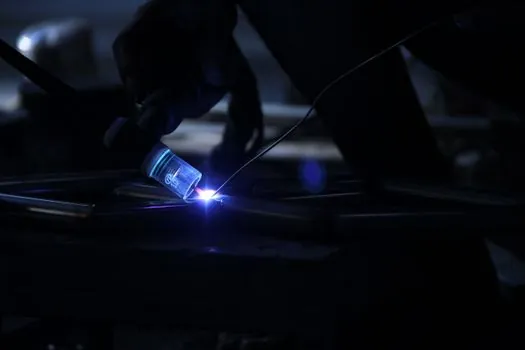
The confusion at the heart of the Practical Machinist thread is that 350 A output does not require 350 A input: a 350 A / 35 VDC welding output is 12,500 W, and from a 240 V single-phase line at roughly 95 percent inverter efficiency that is about 65 A input, a value that can be supplied from a 100 A shop service with margin but not from a 60 A RPC feed [S3].
For 200 A output the same math works out to roughly 7,500-8,000 W secondary, or 35-40 A primary on a 240 V inverter, which is the practical reason ESAB sets the 50 A breaker floor for that output class [S2][S3]. The 200 A threshold is also the point where most small 115 V welders stop being useful: a 115 V, 20-30 A branch can only sustain about 140 A of output before the duty cycle becomes unusable [S2].
Generator Sizing and Field-Headroom Math
ALLPOWERS recommends sizing a generator to roughly 1.5-2 times the welder's continuous input wattage, putting a typical 200 A inverter in the 9,000-15,000 W generator envelope and a transformer MIG closer to 50,000 W [S1]. Pure sine wave inverter generators in the 8,000-10,000 W class will run most 200 A inverter welders comfortably, but surge capacity matters because arc strikes pull 1.5-2x steady-state current for a few cycles [S1].
For users pairing a 200 A stud welder cycle to a portable genset, the same surge caveat applies, with the additional twist that stud welding's peak current is much higher but the duty cycle is much shorter, so the generator's continuous rating, not its peak, is the binding constraint. Field-tested practice: a 10 kW inverter generator will sustain a 200 A stick or MIG cycle at 60-180 A output without tripping; pushing to 200 A steady output may require a 12-15 kW unit for clean, uninterrupted operation [S1].
Decision Matrix: 115 V vs 230 V vs Three-Phase for 200 A Output
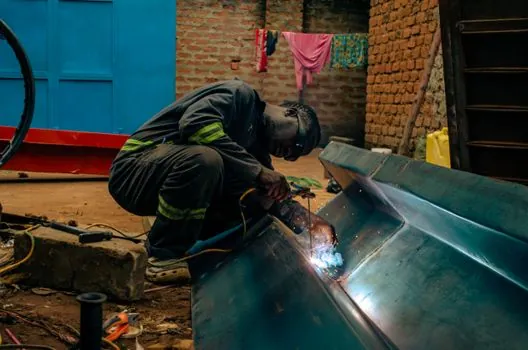
If the available primary is 115 V single-phase, the practical 200 A ceiling is not reachable on most small inverters and you are limited to roughly 140 A output on a 30 A recommended branch [S2]. At 208-230 V single-phase, 200 A is fully reachable on a 50 A breaker and represents the standard farm, garage, and light-fabrication baseline [S2].
Three-phase 208/408/480 V primary, found in commercial fab shops, lets a 350 A class machine run near its nameplate without tripping, and the same 350 A welder typically draws 55-68 A single-phase at 240 V, which is borderline for a 100 A service [S3]. In short: 115 V for portability, 230 V single-phase for 200 A, three-phase for 250 A and above with margin. For machinery buying decisions where the same panel also feeds CE/UL listed equipment, the CE vs UL 2026 decision matrix applies to the welder's own conformity marking, not to its primary feed.
Limitations and Common Sizing Mistakes
Three recurring errors show up on 200 A jobs. First, sizing the breaker to the input nameplate rather than the recommended circuit size, which is typically one step larger to absorb inrush [S2]. Second, ignoring duty cycle: a 200 A / 60 percent duty cycle welder pulls its rated input only 6 of every 10 minutes, so a 40 A breaker can suffice if the operator pauses between beads, but a 50 A breaker is still the safe call for continuous fabrication [S2].
Third, quoting the 44,000 W theoretical input as a real load, which leads to oversizing the generator and overloading the panel when the same welder is plugged into a different outlet [S4]. A useful sanity check: divide the welder's input nameplate kW by 0.24 to get the expected 240 V primary current, and size the breaker at 1.25 times that figure, which is how the 50 A recommended value for 200 A output is derived [S1][S2].
For 200 A-class work that also involves aluminium MIG or AC TIG, confirm that the chosen machine is a true AC/DC inverter, since DC-only units will not strike an aluminium arc cleanly and will pull more primary current doing it badly. The TIG welding process reference documents the AC versus DC envelope and why some 200 A inverters are actually 200 A DC plus 150-160 A AC.
Track these signals before the next purchase: nameplate input kVA, recommended breaker on the spec sheet (not minimum), and the generator's continuous watts at 0.8 power factor. With those three numbers on hand, sizing a 200 A arc welder circuit becomes a 10-minute exercise rather than a 10-hour service upgrade.