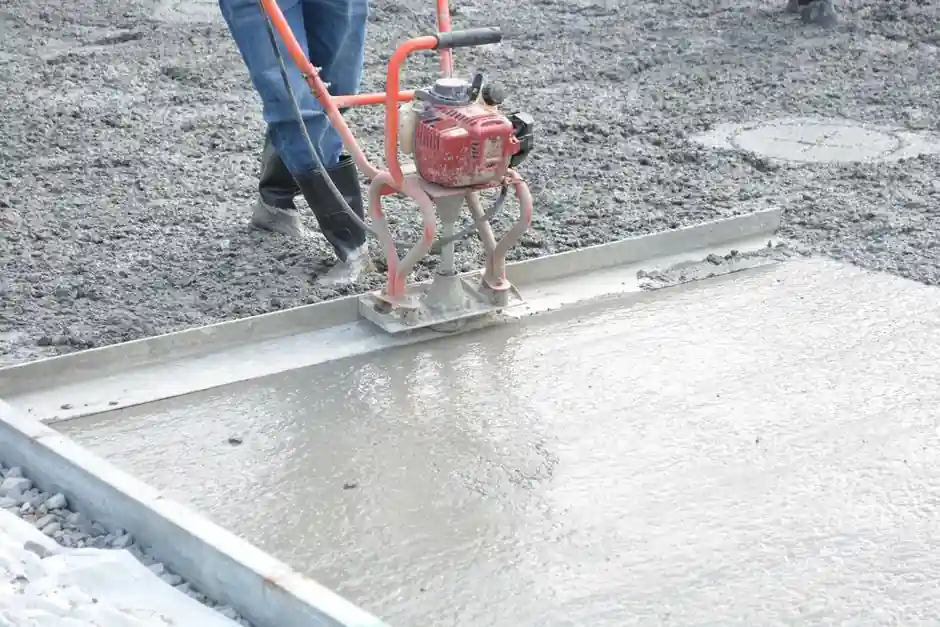
Asphalt paver screed plates must reach and stay in the 250-350°F band during operation, with most modern screeds running nearer the middle of that range to keep bituminous mix from sticking, dragging, or tearing at the strike-off [S4].
That plate temperature is not a comfort setting: it directly gates mat density. The screed typically delivers 85-90% of target density as the mat leaves the trailing plate, and high-density screed configurations can push that to 92-95% before any roller touches the mat [S7][S4]. The roller train behind the paver can only refine what the screed has already largely achieved, so a cold or under-heated screed caps the entire mat's achievable density on that pass [S1].
Why plate temperature is a density variable, not a comfort setting
A screed plate that runs below the 250°F lower edge drags and tears the mat surface rather than striking it off cleanly, which is the failure mode the heating system exists to prevent in the first place [S1]. Automated burner control on modern screeds holds plate temperature in a tighter band than manual control, which matters disproportionately in ambient extremes, where summer heat pushes mix temperature high before the truck even reaches the paver and cold-morning starts drop plate temperature fast if the burner ramp is sluggish [S1].
The patent landscape mirrors that engineering reality: of 212 published screed-heating records spanning 2015-2026, 96.7% carry the E01C (road construction) IPC classification, while H05B electric heating only shows up on 10.4% and G05D non-electric control on 6.6% [S5]. The dominant inventive activity sits in mechanical heating chambers and burner assemblies rather than in the control electronics, consistent with the industry's view that the physical heat transfer into the plate is the limiting factor for mat surface finish [S5].
Operating temperature windows: screed, mix, and rolling
The screed operating window, the mix production window, and the rolling window overlap but are not identical, and confusing them is one of the most common field errors. Standard hot mix asphalt (HMA) is produced at 275-325°F depending on binder grade, with a typical PG 64-22 mix shipping around 300°F and stiffer polymer-modified PG 76-22 mixes needing higher production temperatures to coat aggregate properly [S2].
Once that mix hits the screed plate, the 250-350°F plate band is the working envelope, and from there the rolling train has to close density before the mat cools through its compaction range. Compaction rolling typically runs between 250-320°F, with a tighter critical band often cited at 180-220°F where density must already be locked in [S6]. Haul loss alone can be 15-25°F over a 30-minute run in 60°F weather, and 40°F or more over a 60-minute run, so by the time the mix reaches the screed the operating window has already shrunk from the plant [S2].
Pre-compaction: the density ceiling the screed sets for the rollers
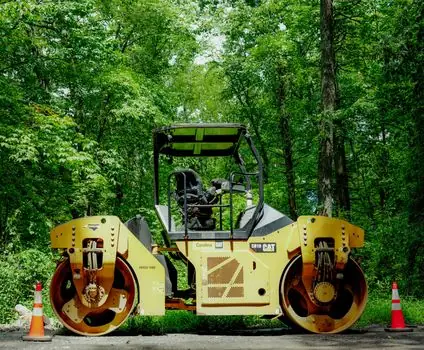
Two mechanisms on the screed itself deliver that pre-compaction number: tamping bars that mechanically impact the mat before it leaves the plate, and vibratory oscillation across the full mat width that settles aggregate and reduces surface voids [S1][S4]. The choice between them is not free: tamping bars tend to be preferred for thicker lifts, vibration for thin overlays, and many high-density screeds run both together to reach the 92-95% range [S4].
Beyond the vibration and tamping systems, screed angle of attack and downward pressure are the two operator-controlled levers that move pre-compaction up or down on a given mix, and they affect surface texture at the same time, which is why screed setup is as much a skill exercise as a machine capability question [S1][S3]. Consistent paving speed, matched to roller capacity, is the third variable: the mat has to stay inside its compactable temperature window when the rollers reach it, or the screed's pre-compaction work is partially wasted [S1].
Screed types compared against density, width, and use case
Six commonly specified screed configurations trade density capability against width flexibility, visibility, and cost [S4]:
Front-mount screeds give better operator visibility and simpler maintenance, but are limited to smaller paving widths and are less common on modern equipment. Rear-mount screeds deliver better compaction and wider paving widths at the cost of reduced operator visibility, and dominate highway and commercial paving. Fixed-width screeds are mechanically simple with low maintenance, but cannot adjust width and suit jobs with consistent dimensions. Extendable screeds cover a range of widths on one machine but carry higher cost and maintenance overhead. High-density screeds reach the 92-95% pre-compaction band and need fewer roller passes, but consume more fuel and have higher equipment cost. Adjustable-crown screeds create drainage cross-slope without external grade controls but require more operator skill [S4].
Ambient temperature, mat temperature, and the cold-base failure mode

Most state DOTs and ASTM standards set 50°F as the minimum ambient temperature for HMA placement, with the temperature rising (not falling) across the paving window, so a job that starts at the limit and slips into cooling air is out of spec before the last truck arrives [S2]. Surface temperature of the base course matters more than ambient air because the mat loses heat from the bottom and the top simultaneously, and a cold base pulls heat out faster than cold air does [S2].
Field rules that follow from those numbers: reject any HMA load arriving at the paver hopper below 250°F unless the mix design and spec explicitly allow it; check every load with an infrared thermometer at the hopper; in ambient conditions below 55°F, insulated truck beds and tarps are not optional; and if loads are arriving cool, raise plant discharge temperature by 10-15°F or shorten haul distance before adjusting the screed [S2]. Daily screed stringline checks on the rear edge for flatness and crown pre-set, and on the front edge for lead crown, are the operator-level controls that keep plate temperature translating into mat quality rather than just heat [S3].
Patent and assignee signal: where the heating R&D is concentrating
Caterpillar Paving Products leads the 212-record screed-heating patent set with 88 family filings, followed by Sumitomo Construction Machinery and Joseph Voegele AG at 12 each, Carlson Paving Products at 9, Hanta Machinery at 8, Astec Industries at 7, and RI Properties, Enviro Pave, and Ingersoll Rand at 6 each [S5]. Annual filings ran from 6 in 2007 to a peak of 19 in 2013, then cooled to a 2021-2024 drop from 8 to 3, a 63% decline across those three years, with 2025 and 2026 figures still filling in due to the roughly 18-month publication lag [S5].
That assignee concentration at the top of the ranking, with Caterpillar alone holding roughly 41% of the 212 records in scope, is a reasonable proxy for where the burner and heating-chamber design effort sits today; cross-over into sensing and control is real but thin, with G01J radiation measurement and G01K temperature measurement each showing on 0.9% of records [S5]. For an engineer specifying a new paver, the practical read is that the mechanical heating system has the deepest installed knowledge base and the control layer is comparatively open for differentiation.
For applied density work, the asphalt paver reference page covers the machine-side pre-compaction mechanisms in more detail, while the temperature measurement and temperature controller entries cover the sensor and burner-control instrumentation that closes the screed heating loop in modern automated systems.
Related analysis: ASME B30.3-2025: Tower Crane Compliance Essentials.