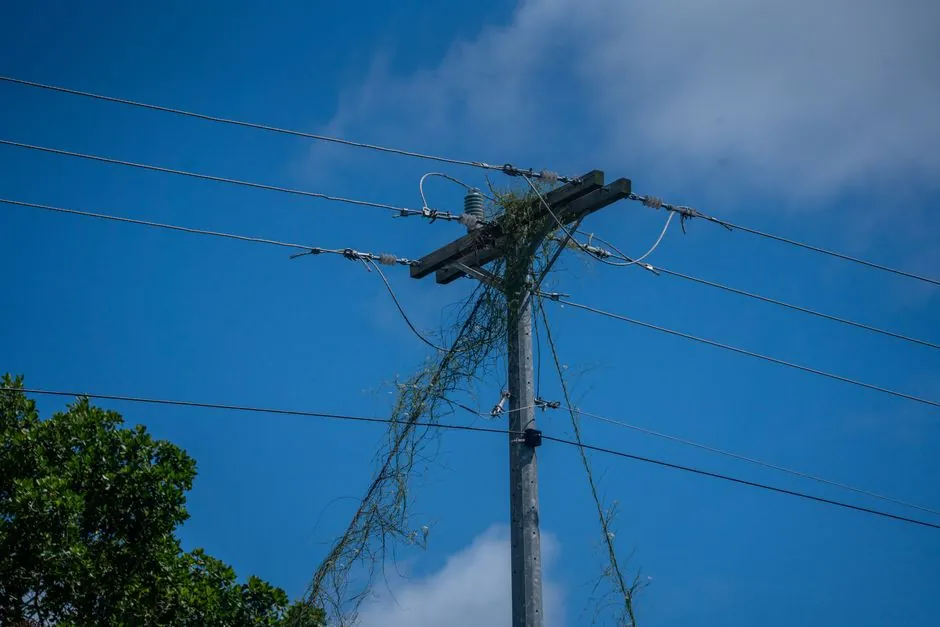
For line crews and utility contractors, the working decision between an aerial work truck and a self-propelled boom lift comes down to three measurable factors: drive-up mobility to the pole, terrain tolerance at the base, and platform height needed for the conductor or hardware.
Both machines must meet the same U.S. aerial-lift standard set: OSHA 29 CFR 1910.67 (vehicle-mounted elevating and rotating work platforms) plus the ANSI A92.20 / A92.22 design, test, and training family referenced in [S2] (2026-10-08). Below that compliance layer, the operating envelope diverges sharply, and that is what determines which chassis belongs on a utility right-of-way.
Reach envelope: working height and side reach
Truck-mounted articulating booms in the North American utility class typically deliver 35 to 65 ft of working height from a single 1-ton or medium-duty chassis, with side reach governed by outrigger spread; an Elliott H110F or Terex LT40-style unit illustrates the envelope [S4]. Self-propelled telescopic booms from manufacturers such as Genie and JLG extend the working-height ceiling to 180 ft on rough-terrain chassis, with horizontal outreach that exceeds 50 ft on long-range models [S2] (2026-10-08). Articulating booms trade straight-line reach for knuckle geometry that lets the platform go up-and-over a crossarm or tree canopy without repositioning the base [S1].
For overhead distribution work at 40 ft class poles, an articulating bucket truck on a 4x4 chassis is the closest match to the standard task; a 60 ft self-propelled articulating unit, by contrast, can sit on one outrigger pad, snake its jib past the neutral and phase conductors, and let the lineworker stage tools on the deck rather than the truck bed.
Mobility: drive-to-pole vs reposition at the pole
Bucket trucks are licensed highway vehicles: they drive from depot to pole under their own power, often with an insulated boom rated for ANSI / IEEE 516 live-line work, which lets a crew respond to a trouble call without flatbed transport [S4]. A self-propelled boom lift is a jobsite machine, not a road vehicle, so it must be trailered or hauled on a lowboy between non-adjacent work sites, which adds logistics cost and a second driver [S2] (2026-10-08), [S5] (2016-01-29).
Once on site, the comparison flips. A four-wheel-drive, oscillating-axle boom lift can climb a curb, cross soft shoulders, and reposition inside a substation yard while the operator stays in the platform, because the start and steer controls are at the bucket rather than the chassis [S2] (2026-10-08), [S5] (2016-01-29). A bucket truck needs the operator down, the parking brake set, wheels chocked, and the outriggers deployed before the next elevation cycle, a discipline that is non-negotiable on slopes [S5] (2016-01-29).
Setup, outriggers, and ground pressure
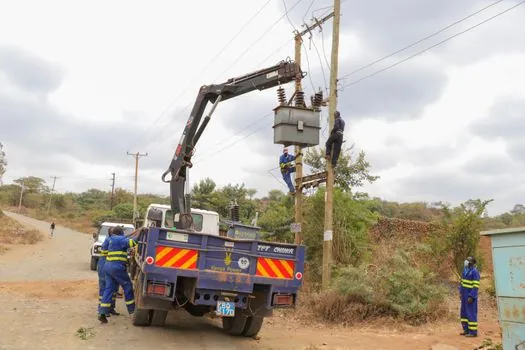
Bucket trucks in the 1-ton class with no outriggers (the classic Versalift-on-Ford-F-350 configuration) rely on chassis weight and a tip-resistant boom geometry; the operator is expected to chock the wheels and avoid parking on grades [S5] (2016-01-29). Larger overcenter and articulating-telescopic bucket trucks (Elliott E160, Versalift VST-7500-E108) require outriggers, and the side reach figures in their load charts are only valid when all stabilizers are set on firm, level bearing [S4].
Self-propelled booms in the 30 to 60 ft class are routinely specified without outriggers, using a wide footprint and low-pressure flotation tires to keep ground bearing pressure under roughly 6 to 8 psi on finished surfaces, which matters on landscaped rights-of-way or finished asphalt. Towable boom lifts sit between the two, with manual outrigger jacks and a tow vehicle doing the road duty at a lower entry cost than a bucket truck, a trade-off that drives faster break-even for sign and lighting contractors [S3] (2026-08-06).
Tooling, payload, and crew comfort at the platform
Bucket trucks carry the job. A utility body adds cross-body toolboxes, reel racks, hydraulic and electric outlets at the bucket, and storage for hot sticks, grounds, and PPE; a gas welder or hydraulic compressor can be PTO-driven so the truck becomes a mobile substation workshop [S5] (2016-01-29). The bucket rating is typically 300 lb single-person or 500 to 600 lb two-person on a 1-ton chassis, with electric, momentary toggle controls at the platform [S4], [S5] (2016-01-29).
Self-propelled booms concentrate capacity at the platform, not the deck, with platform load charts in the same 500 to 1,000 lb band for 40 to 60 ft units, and tilt/rotate jibs on articulating models that let a lineworker set a crossarm lug without leaving the bucket [S5] (2016-01-29). What the boom lift does not bring is a parts runner, a hot stick, or a place to stow a 50 ft rope, so utility crews either pre-stage at the truck or run a second support vehicle.
Standards, certification, and operator rules
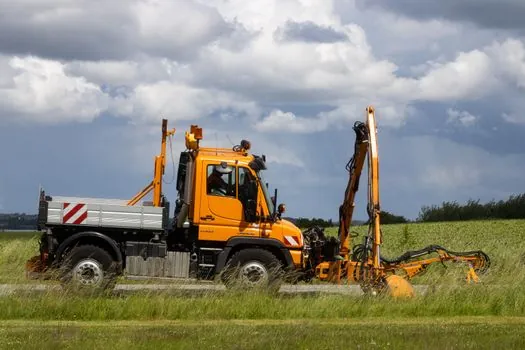
Both machine types fall under OSHA 29 CFR 1910.67 for vehicle-mounted platforms and the ANSI A92.20 / A92.22 series that replaced the older A92.2 / A92.3 vehicle-mounted standards, with operator training required before any elevated use [S2] (2026-10-08). Insulated booms used for live-line work additionally have to meet IEEE 516 line-work protection rules and the relevant ASTM F968 dielectric test for the upper boom insert, which is a bucket-truck specialty that off-highway self-propelled booms rarely carry [S4].
Falls from ladders remain a leading trigger of OSHA citations in utilities and sign work, and tightening enforcement is the single most cited reason fleets are moving from ladders to either machine class [S4]. Crews should size the machine to the worst-case reach and the worst-case ground condition, then back-solve the chassis: if the duty cycle is one pole every 20 minutes along a public road, the bucket truck is the right tool; if the duty cycle is one lift every two hours inside a plant or substation on uneven ground, the self-propelled boom lift is.
Cost frame and total ownership
Entry cost for a used 1-ton articulating bucket truck in serviceable condition typically lands in the low five figures, with a new Versalift or Altec 35 to 45 ft build in the $80k to $150k range depending on insulation class and options; a comparable 40 to 60 ft self-propelled articulating boom from Genie, JLG, or Haulotte lists at $100k to $250k new and a fraction of that on the used market [S3] (2026-08-06), [S4]. Towable boom lifts sit at the bottom of the ladder on acquisition cost, but the break-even math depends on the tows per year, the crew-hour value, and whether the work is mostly horizontal moves or vertical [S3] (2026-08-06).
Insurance, annual dielectric re-certification on insulated booms, and ANSI A92-compliant operator training are recurring costs that apply to either platform. For a fleet that already runs medium-duty chassis and in-house mechanics, a bucket truck is a bolt-on; for a contractor that already owns trailers and telehandler iron, a self-propelled boom is.
Decision matrix for utility pole work
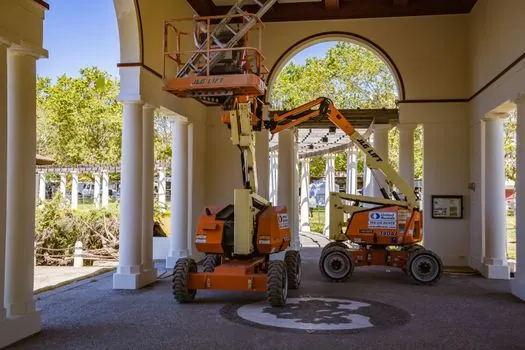
Use the following four-criterion grid to pick. <strong>Road travel between poles</strong>: bucket truck wins (highway-legal, drive-up, ~60 mph). <strong>Off-road and yard repositioning</strong>: self-propelled boom lift wins (4x4, controls in bucket, no outriggers on most 30 to 60 ft units) [S2] (2026-10-08), [S5] (2016-01-29). <strong>Tool and material hauling</strong>: bucket truck wins (utility body, tool circuits, welder/compressor). <strong>Platform height above 65 ft</strong>: self-propelled telescopic boom wins, since truck-mounted booms rarely exceed 65 ft of working height on a production chassis [S2] (2026-10-08), [S4].
For the 90% case of a distribution line crew servicing 35 to 55 ft wood poles along a public right-of-way, the aerial work platform of choice remains the articulating bucket truck on a 4x4 chassis; for substation, transmission lattice, or industrial-plant work above 60 ft, the self-propelled boom lift is the correct specification. Fleet buyers should match the chassis and insulation package to the worst-case task on the route, and route cost, not acquisition price, is the right optimization target. For an apples-to-apples chassis-versus-package read on a 2026 spec, the 2026 aerial work truck cost split breakdown lays out the split that drives that route-cost math.