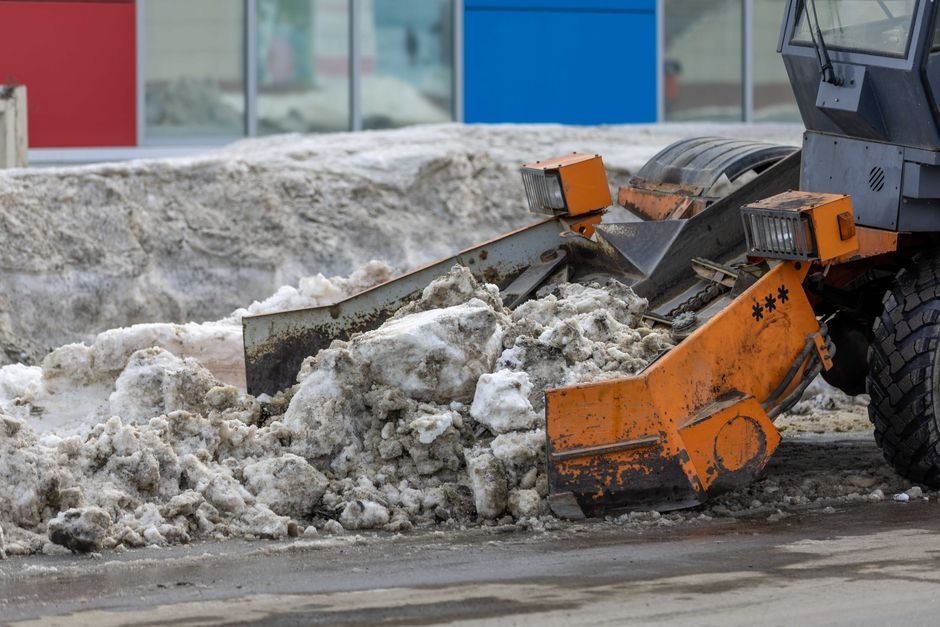
Bulldozer selection for road building in 2026 is dictated by three engineering variables — operating weight class, blade geometry, and undercarriage duty — rather than by brand loyalty, with the 13–18 t medium class covering roughly 60% of highway subgrade work and 20–45 t large crawlers reserved for rock and overburden push [S3].
Used-equipment channels from Road Machinery LLC, OEM channels including Caterpillar, Volvo CE, John Deere, Wirtgen and Sany, and component suppliers such as Jiangsu Benyu (cabs) and A&S Machinery (GET/undercarriage) form the active 2026 sourcing map observed in the research [S1][S2][S3][S4][S5].
Operating-Weight Class Bands and Their Road-Build Roles
The 2026 road-construction fleet splits into four operating-weight bands that map cleanly to the pavement construction sequence: subgrade preparation, fill placement, fine grading, and rock handling [S3].
The 13–18 t class — typified by Cat D6/D6T-equivalent, John Deere 700L, and Sany SD16-class units — is the workhorse for clearing, grubbing, and the first subgrade push on highway and rural-road jobs, where ground pressure stays manageable on prepared surfaces [S3]. The 20–32 t class (D8-equivalent, SD22–SD32) handles the bulk of embankment fill and long-haul dozing, while 35–45 t+ large mining-class units (D9T/D10T2-equivalent) are reserved for hard-rock rip-and-push, overburden removal on cut sections, and contractor spreads where a single machine must replace two mid-size units [S3]. Machines under 10 t (mini and utility dozers) are reserved for utility trenching, landscaping shoulders, and confined urban widening where a full-size crawler cannot stage [S3].
Blade Geometry: S, U, SU, PAT and Angle Configurations
Blade type — not horsepower — is the single most consequential specification for road-building productivity, with five configurations covering the full scope of earthmoving tasks [S3].
Straight (S) blades give the highest ground penetration per pass and are the default for stumping, light ripping, and fine finish grading on subgrade. Universal (U) blades carry the largest capacity (typically 20–30% more material than S in matched weight classes) and excel at light, loose material push over distance. Semi-Universal (SU) blades split the difference and are the most common factory configuration on 20–30 t highway-class dozers. Power-Angle-Tilt (PAT) blades add hydraulic pitch, lift, and tilt without leaving the cab, which is mandatory for road projects where finish tolerance and side-casting accuracy drive the schedule. Angle blades push material sideways to one side and are specified for ditching, trail cutting, and shoulder work [S3]. For multi-phase road projects the practical recommendation is one SU or PAT-blade machine per spread, with S blades assigned to dedicated ripping/clearing crews.
Engine Power, Drivetrain, and Fuel-Consumption Reality
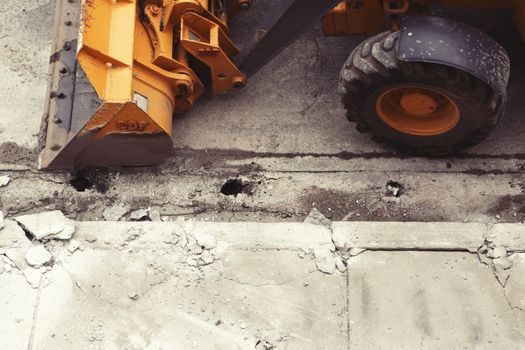
Net engine power scales with operating weight and is the second-tier decision once class is fixed, with modern road-build crawlers falling into a 90–600 kW (120–800 hp) envelope [S3].
Hydrostatic drivetrains have become the default on 13–25 t machines in OEM catalogs because they allow infinite speed modulation from 0 to ~10 km/h without torque interrupt, which is what finish grading requires. Torque-converter + powershift drivetrains remain the standard above 30 t because they tolerate the shock loads of ripping and rock push that hydrostatic components cannot absorb [S3]. Fuel consumption on a 20–25 t class machine during steady dozing runs 12–18 L/h; aggressive ripping can push that to 25 L/h+, and that figure is what the contractor's cost-per-cubic-metre model should be built around rather than the brochure number [S3].
Undercarriage, Ground Pressure, and Ground-Condition Matching
Undercarriage design — sealed-and-lubricated track (SALT), heavy-duty extended-life (HDXL) pins and bushings, and track-shoe width — controls both hourly owning cost and the ability to work on weak subgrade without bogging [S3][S5].
Standard track-shoe widths of 380–510 mm on a 20 t class machine produce ground pressures of roughly 55–70 kPa, which is the safe envelope for prepared but unfilled subgrade. Wide-pad shoes (610–760 mm) drop ground pressure into the 35–45 kPa band and are specified for work over soft clays, peat, or newly placed fill where standard shoes would shear the surface [S3]. A&S Machinery Co., Ltd. supplies the consumable GET (ground engaging tools) and undercarriage replacement parts — bucket teeth, cutting edges, end bits, and idler/track groups — that determine the actual owning-and-operating cost line on any road job, regardless of OEM paint color [S5]. Sealed-and-lubricated track chains are now standard on all OEM highway-class builds because they extend bushing life from ~2,000 hours to ~5,000+ hours between re-pin work [S5].
Cab and Operator-Station Considerations
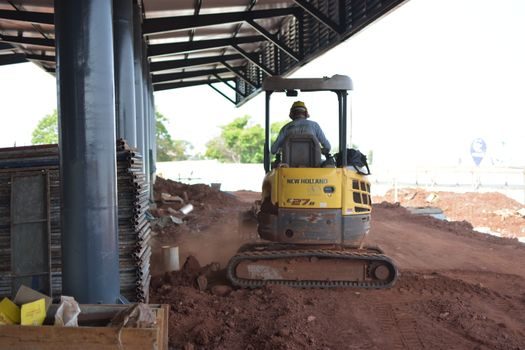
ROPS/FOPS certification, sound attenuation, and HVAC capacity have moved from optional to mandatory on European and North American road projects, and cab manufacturers have retooled around this demand [S4].
Jiangsu Benyu Vehicle Body Manufacturing supplies the cab assemblies for micro/mini excavators, medium/large excavators, skid-steer loaders, mining trucks, and a growing share of the bulldozer and crane cab market, including tailless and low-profile configurations [S4]. For road projects, the practical selection points are: ROPS/FOPS to ISO 3471 / ISO 3449 levels, integrated AC for hot-climate highway work, and factory cab mounts that meet ISO 2631 whole-body vibration limits during long finish-grading shifts [S4]. Visibility — the proportion of glass area to roof structure — is the single largest safety differentiator on the modern road job and is a line-item the bid should call out, not assume.
New OEM vs. Used / Refurbished Sourcing Channels
For road contractors the 2026 sourcing decision is whether to specify a new OEM unit through a manufacturer channel or to procure a used machine from a dealer that has already taken the first-cycle depreciation hit [S1][S2][S3].
New-unit channels include Newindu Construction Engineering (Shanghai) Co., Ltd. (5 categories: lifting, earthmoving, concrete, road construction, drilling machinery; SGS-onsite verified 2026-02-09) and Xuzhou Unique Construction Machinery Co., Ltd. (ISO 14000 + BSCI certified, registered 2009, main products covering truck crane, wheel loader, road roller, excavator, motor grader, truck mounted crane, crawler crane, tower crane, bulldozer, and spare parts) [S1][S2]. The used-equipment channel is led by Road Machinery LLC, which stocks inspected used bulldozers alongside excavators, mini excavators, paving machines, road graders, compactors, dump trucks, cranes, crawler loaders, demolition equipment, drilling rigs, and wheel loaders [S3]. The brand list carried by major used channels — Caterpillar, Volvo CE, John Deere, Wirtgen, and Sany — is effectively the same as the OEM top tier, because residual values concentrate on these names [S3]. For a 13–18 t medium dozer, the rule of thumb in 2026 is that a 3,000–5,000-hour used unit runs 40–55% of new list price, and 8,000+ hour units are typically not financeable on term loans — they are rental-fleet candidates only. Rental-only channels (e.g., DCE / Daya Charan Earthmovers in India, two decades of operation, serving industrial / agricultural / construction projects) cover short-term gaps but should not be used as a substitute for owning a primary production unit [S6].
Selection Criteria Summary: Class vs. Phase vs. Cost
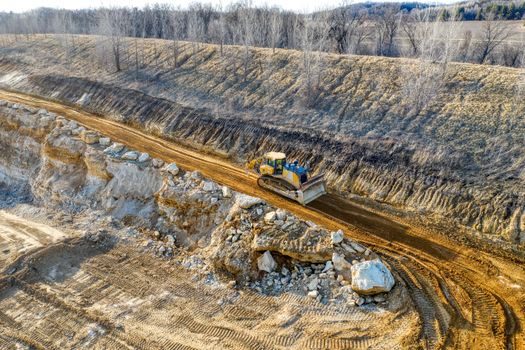
Condensing the decision into a single table, the practical 2026 selection matrix for road construction is class × phase × cost, with the following alignment for engineers writing bid specs: [S3]
• Subgrade prep, clearing, light fill: 13–18 t class, S or SU blade, hydrostatic, 90–130 kW — owned new or 3,000–5,000 h used.<br/>• Embankment fill, long-haul dozing: 20–32 t class, SU or PAT blade, hydrostatic or torque-converter, 160–240 kW — owned new with SALT undercarriage.<br/>• Rock push, ripping, heavy cut: 35–45 t+ class, U or semi-U with single-shank ripper, torque-converter powershift, 300–600 kW — owned new, HDXL undercarriage mandatory.<br/>• Confined urban / utility: under 10 t, PAT blade, hydrostatic, 50–80 kW — owned or short-term rental.
Across all classes the spec lines that must be written into the procurement document are: ROPS/FOPS to ISO 3471/3449, sealed-and-lubricated track, factory A/C, and a documented GET budget for cutting edges, end bits, and ripper tips (A&S Machinery or equivalent) [S3][S4][S5]. The single most common selection error on road jobs remains under-specifying undercarriage for the ground condition, which then over-runs the owning-cost line faster than any other choice. Cab sourcing through specialists such as Jiangsu Benyu has become a parallel workstream on Tier 1 highway projects [S4]. For contractors building a fleet from scratch, pairing a road roller selection exercise with the dozer spec is the practical next step, since the two machines must be matched on speed, width, and cycle time to avoid bottlenecking the compaction train. Brand selection across the OEM top tier — Caterpillar, Volvo, John Deere, Wirtgen, Sany — has narrowed to a near-tie on total cost of ownership when the undercarriage and GET budget are correctly costed [S1][S2][S3].<p>Closing paragraph: The next trackable signal for 2026 H2 is OEM announcements on electrified 20–30 t class dozers, with the first units already entering municipal road jobs in Europe; a second signal is the Sany and Xuzhou-Unique export push into Southeast Asia and Africa, which is widening the aftermarket parts network for low-hour used imports [S1][S2][S3].
Detailed specification references: bulldozer, and pressure transmitter.
This topic is covered further in Multi-Gas Detector Selection for Welding Operations: 2026 Spec Map.