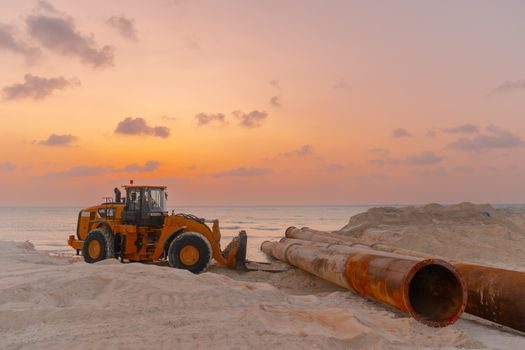
For pipeline right-of-way work in 2026, a 3-tonne class wheel loader with a 2.0-3.0 m³ bucket, articulated frame, ROPS/FOPS cab, and ISO 6162-compliant hydraulic joints is the working baseline [S3][S6].
Pipeline spreads move heavy trench spoil, lift padding stone and pipe bedding sand, load dump trucks side-by-side in a narrow corridor, and feed backfill to the trench box — none of which a compact track loader or skid-steer handles efficiently at production pace. A wheel loader sized to the haul truck (typically 3-5 t payload) is the machine that sits on the spread day in, day out.
Operating Class and Bucket Sizing for Right-of-Way Spreads
Pipeline wheel loaders cluster in the 2-5 t rated-load band, with 1.0-3.0 m³ general-purpose buckets, per active Chinese OEM spec sheets as of July 2026 [S3].
For a typical 30-42 in. mainline spread, the wheel loader's job is bank-run excavation support, bedding handling, padding sand cycles, and ditch-pump assist. The DX320L-2 example from Shandong Pengcheng Dooxin lists a 3 t rated load, 2.2 m³ bucket, 78.6 kN breakout force, 3000 mm max edge-dump height, and a 5710 mm min turning radius — numbers that align it with 4×6 dump trucks used on US/Canada cross-country spreads [S3]. Smaller 1 t class loaders (1.0 m³ bucket, ~50 kN breakout) suit urban gas distribution work where the corridor is paved and the haul truck is a 10-wheeler.
Frame, Steering, and Trench-Crossing Mobility
Articulated wheel loaders (introduced in the 1950s and now the dominant configuration) deliver a turning radius roughly 30-40% smaller than rigid-frame loaders of the same wheelbase, which is decisive on a 15-20 m wide right-of-way [S6].
Pipeline spreads rarely have a turnaround pad; machines must U-turn inside a cleared bell-hole. Articulated steering lets a 3 t loader work inside a single-lane corridor without bottoming the bucket on the trench shield. Rigid-frame machines still dominate hard-rock quarry and stockpile work where straight-line push matters more than agility, but on linear pipeline jobs the articulating hitch is the spec that gets written into the equipment list. When a quarry or borrow pit sits adjacent to the right-of-way, the same articulated frame also handles stockpile feed — see the broader quarry spec map for the high-abrasion side of that duty cycle.
Hydraulic Circuit and Joint Standards (the Leak-Control Story)
Pipeline right-of-way work is environmentally sensitive: a hydraulic oil spill into a wet ditch or across a wetland crossing is a reportable incident under most US state and Canadian provincial spill rules. That is why OEM-published joint specs matter more than peak pump flow. Dooxin's DX320L-2 explicitly cites ISO 6162 flanges, O-ring grooves, and 80% leakage reduction versus non-O-ringed joints [S3]. Buyers should treat "ISO 6162" or "ISO 6164" (4-bolt and 4-bolt high-pressure patterns) as a minimum filter when comparing 2026 model-year loaders, alongside JIC 37° flare fittings for the auxiliary circuit feeding quick-couplers for forks, brooms, and pipe-handling booms.
Engine, Drivetrain, and Emission Tier Mapping
Wheel loaders in the 3 t class typically run 92-125 kW (125-168 HP) diesel engines at 2200 rpm, with water-cooled aftercooling and electronic fuel gauges becoming standard on 2025-2026 production models [S3].
Emission tiering splits the market. For North American pipeline work, EPA Tier 4 Final (40 CFR Part 1039) with diesel particulate filter (DPF) and selective catalytic reduction (SCR) is mandatory for non-road diesel above 56 kW; for European and many cross-border jobs, EU Stage V (Regulation 2016/1628) applies. Chinese-built loaders frequently ship in EPA Tier 2 / EU Stage II trim for export to less-regulated markets, and re-tier up to Tier 4 Final / Stage V for North America and EU-bound orders — the engine prefix often reveals the target market (e.g., Weichai WP6 series, Cummins QSB series, Yuchai YC series) [S3].
Cab, ROPS/FOPS, and Operator-Fatigue Specs
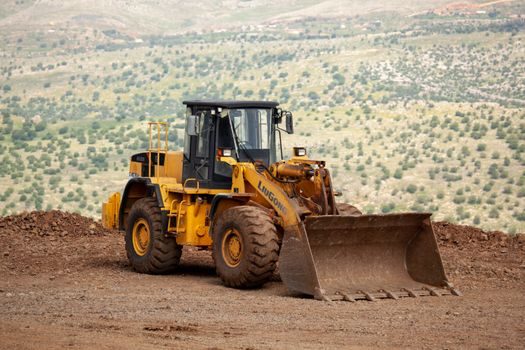
ROPS/FOPS-certified cabs with EU-standard safety glass, UV-blocking green tint, and flame-retardant interior materials are now standard-fitment on mid-range Chinese OEM loaders, not just premium imports [S3].
Pipeline loaders run 10-12 hour shifts in summer heat and winter cold; cab HVAC, suspension seats, and single-handle pilot control directly affect operator retention and trench-side safety. The DX320L-2 spec sheet explicitly lists "optional ROPS/FOPS certified cab," extra-wide view glazing, green UV-blocking glass, and single-handle pilot — a bundle that three years ago was a premium option and is now mid-tier [S3]. Buyers should still verify the ROPS/FOPS certificate (ISO 12117 for ROPS, ISO 3449 for FOPS) rather than the marketing claim, especially for cabs destined for rock-handling or demolition-attachment work.
Where a Wheel Loader Fits on a Pipeline Spread — and Where It Doesn't
Wheel loaders fit the bedding, padding, spoil-handling, and truck-loading roles; they do NOT replace a tracked excavator for trenching or a pipe-layer sideboom for lowering in. [S1]
A typical mainline spread runs: (1) tracked excavator for trench excavation, (2) wheel loader for bedding sand placement and padding cycles, (3) pipe-layer or sideboom for stringing and lowering in, (4) wheel loader again for backfill and final grading. Trying to substitute the wheel loader for the excavator burns fuel and chews tires; trying to substitute it for the pipe-layer is unsafe. The backhoe loader is a hybrid that handles both ends of a small-diameter distribution job, but for long-haul mainline work, a dedicated loader and a dedicated excavator are the productive pair.
2026 Buyer Decision Matrix: 4 Criteria Against the Main Loader Types
The four criteria that actually drive a pipeline-spread wheel loader purchase are rated load, bucket capacity, joint standard, and emission tier, compared across 1 t / 3 t / 5 t classes. [S3]
1 t compact loader — rated load 1 t, bucket 0.5-1.0 m³, ISO 6162 available on premium trims, Tier 4 Final common. Suits urban distribution and tie-in work. 3 t mid-size — rated load 3 t, bucket 2.0-2.5 m³, ISO 6162 standard on 2025-2026 production, Tier 4 Final / Stage V typical. The pipeline-spread workhorse. 5 t large — rated load 5 t, bucket 3.0-4.5 m³, ISO 6162 standard, higher ground bearing pressure that boggs down in soft right-of-way soils. Suited to borrow-pit and stockpile feeding, not in-trench work. The skid-steer loader is sometimes substituted for sand-pad work inside a fenced urban job, but its radial-lift geometry and lower travel speed undercut productivity on linear spreads.
Material-handling attachments matter as much as the host machine. For pipeline right-of-way, the typical attachment list is general-purpose bucket, multi-purpose (4-in-1) bucket, pallet forks for pipe skids, and a brooming head for hard-surface cleanup. Spec the auxiliary hydraulic flow in L/min at the quick-coupler before choosing the attachment package — a 60 L/min aux circuit runs a small broom; 90-120 L/min is needed for a hydraulic breaker on frozen ground.
Limitations, Failure Modes, and Sourcing Signals to Track
The three recurring failure modes on pipeline wheel loaders are hydraulic-hose leaks at non-O-ringed flanges, tire failures from sidewall cuts on rocky right-of-way, and DPF regeneration interruptions during short-cycle padding work. [S1]
Hydraulic leaks are addressed by the ISO 6162 spec above. Tire failures favor solid or foam-filled tires for rocky sections, accepting the ride-quality penalty. DPF regen issues are a duty-cycle problem: a loader that does 200 short padding cycles per shift never gets the exhaust hot enough to regenerate, and parked regen cycles eat productive time. Operators address this by scheduled mid-shift high-load work (e.g., one truck-loading cycle at full throttle per hour) to trigger passive regen. For buyers sourcing from Chinese OEMs via Made-in-China and Alibaba channels — including suppliers like Lei Shing Hong Machinery, Pengcheng Dooxin, Sinomtp, and Ten-League — the verifiable signals to track are: ISO 6162 written into the spec sheet (not just "high-quality hydraulic fittings"), ROPS/FOPS certificate numbers, Tier 4 Final or Stage V engine model codes, and a written warranty on the powertrain and hydraulics that names both coverage period and geographic service network [S1][S2][S3][S4][S5]. The cross-border price band for a 3 t Tier 4 Final articulated loader in mid-2026 sits broadly in the US$22,000-45,000 FOB range for Chinese OEM units, with premium Japanese and US brands commanding 2-3× that figure [S8].