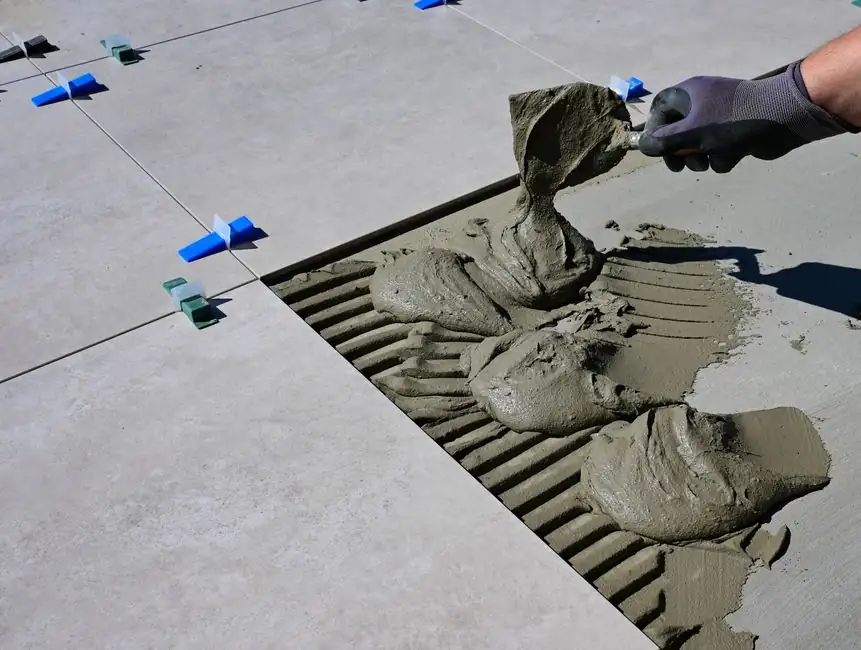
C2TE S1 tile adhesive has at least 2.5 mm transverse deformation capacity, while C2TE S2 reaches at least 5.0 mm under the cited EN 12004 classification framework [S2][S7].
The comparison covers cementitious adhesive performance, reduced slip, extended open time, movement tolerance, application suitability, and product-selection limits for indoor and outdoor tiling systems.
C2TE S1 and C2TE S2 Codes Decoded
C2TE S1 and C2TE S2 are cementitious adhesives with improved adhesion, reduced slip, extended open time, and different deformability classes [S1][S3]. In the code, “C” identifies cementitious adhesive, “2” identifies improved adhesion, “T” identifies reduced slip, “E” identifies extended open time, and “S1” or “S2” identifies transverse deformation performance [S1][S2].
The adhesive designation does not describe a decorative grout or a flexible membrane. It applies to the cured bond layer, whose deformation behavior helps it accommodate controlled movement between the tile and prepared substrate. Tile-adhesive classifications are standardised performance codes, and formal tile-adhesive standards were not introduced in the UK before 1980 [S2].
The S class is additional information, not a replacement for C2, T, or E. A supplier datasheet may add additional characteristics, but the declared adhesive class should remain traceable to the product performance declaration [S1][S5].
Deformability Difference Compared
S1 denotes a deformable adhesive that flexes at least 2.5 mm, while S2 denotes a highly deformable adhesive that flexes at least 5 mm [S7]. S7 states the class thresholds as “at least 2.5 mm” for S1 and “at least 5.0 mm” for S2 [S7].
The practical decision is not whether S2 is “better.” S2 is the stronger choice when the required movement class exceeds the S1 range, while S1 is the rational specification where 2.5–5.0 mm capacity satisfies the design. Adhesive strength and deformation must be considered separately: S1 does not mean “stronger adhesion,” and S2 does not authorize installation over an unstable substrate [S1].
Adhesion, Slip, and Working-Time Criteria

C2 denotes an improved cementitious adhesive with higher adhesion performance, while C2S1 is a C2 adhesive that has also demonstrated a defined level of deformability [S1]. The “T” characteristic denotes reduced slip for vertical installation, while “E” denotes extended open time [S1][S2].
These values explain why C2TE S1 and C2TE S2 share the same C2, T, and E characteristics, leaving deformation as the defining difference.
Application compatibility still controls the specification. For non-absorbent porcelain or homogeneous tiles, a higher-strength single-component adhesive such as the cited C2TE or C2TE S1 examples is directed [S6]. The bond must also match the tile size, substrate, fixing method, grouting system, and exposure condition.
Where C2TE S1 Fits
C2TE S1 is suitable where C2 adhesion, reduced slip, extended open time, and 2.5–5.0 mm transverse deformation satisfy the project requirements [S1][S2]. Typical movement sources include temperature changes, heating and cooling cycles, differential expansion, moisture-related dimensional change, vibration, and large tile dimensions [S1].
S1 is a sensible specification for many interior floors, heated-floor installations, and selected exterior or large-format applications where the substrate and tile movement have been assessed. The C2 portion supplies improved adhesion compared with C1, while S1 adds controlled movement capacity that plain C2 does not declare [S1][S2].
S1 is not a universal minimum for every tile installation. C1T remains an economical option for straightforward interior wall and floor work, and C2TE without an S class can be appropriate where deformation is not a governing requirement [S5]. Do not upgrade to S1 solely because a product is described as “flexible”; verify the declared class and the manufacturer’s application limits.
When C2TE S2 Is Justified

C2TE S2 should be selected when the design requires more than 5.0 mm transverse deformation or when the specified tile system identifies highly deformable adhesive as necessary [S2][S7]. Its advantage over C2TE S1 is confined to deformation class, because both codes retain C2 improved adhesion, T reduced slip, and E extended open time [S1].
Potential S2 applications include large-format tile installations, surfaces exposed to greater thermal or structural movement, and demanding external systems where the adhesive declaration, tile format, substrate preparation, and joint layout form one performance system [S1]. Movement conditions must be evaluated rather than inferred from tile size alone.
C2TE S2 is not suitable as a substitute for structural movement joints, water management, or substrate stabilization. S1 does not make movement joints unnecessary, and neither S1 nor S2 can correct an unstable substrate [S1]. For pools, facades, heated floors, and exterior paving, use the complete manufacturer-approved system rather than selecting the classification in isolation.
Installation Limits and Failure Prevention
Deformability supplements, but does not replace, correct substrate preparation, adequate mortar coverage, appropriate joint spacing, and curing conditions. Movement between tile and substrate can arise from seven identified mechanisms: temperature change, heating and cooling, differential expansion, substrate deflection, moisture-related dimensional change, vibration, and large-format geometry [S1].
A classification can also be misread as a universal performance guarantee. The cited manufacturer guide warns that C1T and C2TE are unsuitable for every installation and identifies C2TE S1 as the combination of high bond strength, deformability, and water-immersion resistance for its stated use case [S5]. That is a product-specific selection, not proof that every C2TE S1 product suits pools or facades.
For ceramic tile and porcelain tile specifications, check the product declaration for the complete EN 12004 class, declared adhesion values, deformation class, slip characteristic, open time, coverage, and approved substrates. Confirm the manufacturer’s tile dimensions, application surfaces, and environmental restrictions before accepting either class.
Specification Decision and Documentation
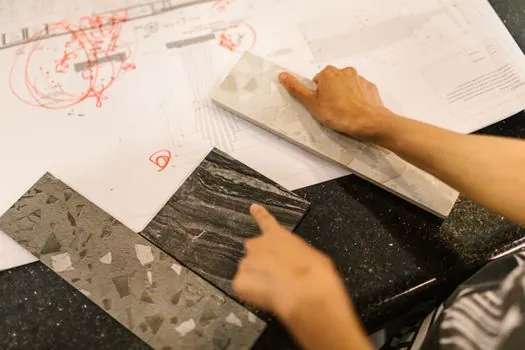
Specify C2TE S2 only when the movement assessment or system design requires S2 performance; otherwise specify C2TE S1 where its 2.5–5.0 mm deformation range is adequate. C2TE without S1 or S2 remains a separate option for controlled environments where deformation is not critical [S1][S2][S5].
Record four items on the specification schedule: complete adhesive class, required transverse-deformation class, tile and substrate combination, and exposure condition. The broader C1 vs C2 tile adhesive selection guide covers the distinction between normal and improved adhesion characteristics, while this comparison resolves the S1 versus S2 decision after C2 performance has been established.
A trackable sign that the system is being coordinated correctly is a single approved submittal linking the adhesive declaration to the specified tile format, substrate, movement-joint layout, grout, and exposure condition. Reject a submittal that lists “flexible” without the C2TE S1 or C2TE S2 code, because such wording does not establish a measurable deformation class [S1].