
GFRP reinforcement can replace steel in corrosion-prone concrete when its lower stiffness, thermal limits, and connection details are addressed during design.
The decision depends on exposure, member geometry, code acceptance, bending radius, and fire resistance rather than tensile strength alone.
Where GFRP Is a Credible Steel Replacement
Glass-fiber-reinforced polymer bars combine longitudinal glass fibers with a polymer resin matrix and are particularly suitable where chloride exposure, deicing salts, moisture, or electrical conductivity make steel corrosion costly [S3][S5]. The referenced article focuses on slabs-on-grade, house foundations, and driveways [S4].
Installation resembles deformed steel reinforcement, but lower weight reduces handling, transport, and storage problems [S1]. One manufacturer specifies Grade III GFRP at one-quarter the weight of steel and reports a 75% reduction in carbon footprint, although that environmental figure applies to that product system rather than every GFRP bar [S2].
For conventional steel rebar, corrosion resistance depends on concrete cover, chemistry, coatings, and maintenance. GFRP removes the metallic rust mechanism, but it does not make every structural-design issue disappear.
Strength Does Not Equal Structural Equivalence
A published study reported a GFRP rebar tensile strength of 593 MPa [S1], while a commercial Grade III product guarantees tensile strength greater than 1000 MPa [S2]. In a tested 12.5 mm bar produced with unsaturated polyester resin and 1% MEKP, tensile strength reached 593 MPa and bend strength 760 MPa [S1].
The commercial Grade III product has a Young's modulus greater than 60 GPa [S2]. A commercial Grade III product specifies Young’s modulus above 60 GPa, ultimate strain above 1.7%, and transverse shear strength above 220 MPa [S2]. Its lower modulus means greater elastic strain, deflection, crack-width implications, and serviceability checks cannot be copied from steel details.
The manufacturer describes its GFRP reinforcement bar as one-quarter the weight of steel, non-corrosive, and three times stronger than steel [S2]. Steel remains the simpler material where stiffness dominates the design and corrosion exposure is controlled.
Foundations, Slabs, and Driveways Need Serviceability Checks
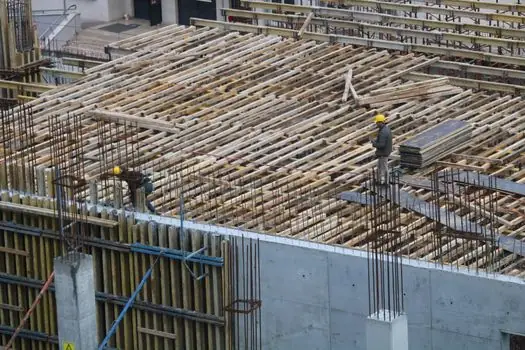
Foundations and slabs-on-grade are established GFRP use cases, but replacement is conditional on the member, loading, detailing, and local approval [S4].
Those values are not a universal prescription. They belong to a particular product aid, and GFRP steel mesh must be evaluated separately for opening size, placement, load transfer, and support. For slabs, tensile capacity does not eliminate the need to control shrinkage cracking, joints, cover, and load paths.
Bond, Bending, and Connections Control Detailing
Concrete bond is acceptable enough for GFRP reinforcement, but the surface, development length, and bend geometry must be treated as product-specific properties [S5]. In the 12.5 mm experimental bar, coarse sand was added to the surface to improve bond [S1]. The commercial Grade III specification reports minimum bond strength of 20 MPa and straight-portion bend strength above 900 MPa [S2].
Bent Grade III bars are specified with a minimum bend radius of four times bar diameter and bend-part strength above 600 MPa [S2]. That is a meaningful constraint for cages, hooks, stirrups, and congested corners because GFRP cannot be bent on site in the same way as mild steel.
Connections also require a separate design. Mechanical couplers, anchoring heads, lap splices, and contact with dissimilar metals need qualified products and installation procedures; tensile strength alone does not validate a joint.
Heat, Fire, and Electrical Requirements Exclude Some Uses

GFRP’s resin matrix limits high-temperature performance, making fire resistance a separate design issue rather than a material-strength footnote.
The manufacturer describes its deformed GFRP reinforcement bar as non-conductive, non-magnetic, and UV-stable [S2]. These properties are advantageous near electrical equipment and in marine work, but they also mean designers cannot treat the bar as a steel thermal conductor or rely on magnetic inspection methods.
Fire-rated beams, columns, and other members normally require an engineering evaluation that accounts for the resin matrix, protective concrete cover, fire exposure, and applicable code provisions. A comparison with stainless steel rebar is not simply corrosion versus no corrosion, because steel grades differ in alloy content, strength, modulus, cost, and structural detailing.
Selection Criteria for Engineers and Buyers
GFRP is a strong candidate when exposure is aggressive, access or lifting is restricted, minimum weight matters, and the engineer can accommodate reduced stiffness. It is a poor substitute when fire resistance governs, very tight deflection limits apply, conventional field bending is essential, or the design depends on steel’s established ductility and standardized connections. [S2]
For material procurement, verify the bar’s certified diameter, tensile strength, modulus, bond strength, bend strength, minimum bend radius, and environmental limits rather than accepting a generic “fiberglass rebar” description [S2]. The manufacturer’s table covers nominal sizes from 10 mm through 32 mm, including 13 mm at 132 kN minimum tensile load, 16 mm at 202 kN, 20 mm at 285 kN, 25 mm at 499 kN, and 32 mm at 792 kN [S2].
Do not select by nominal bar size alone. Compare steel pipe and other steel components by function, not by label, and maintain a traceable mill certificate or equivalent product compliance record. The ACI 318-19 Grade 100 rebar specification map is useful for the separate decision between steel grades, but GFRP remains a different material system with different stiffness and connection rules.
Cost and Service Life Need a Project-Based Comparison
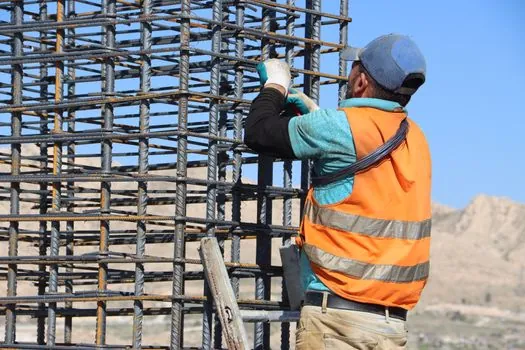
GFRP may carry a higher initial purchase cost than conventional steel, but the installed comparison must include material quantity, support, handling, transport, placement labor, corrosion protection, repair, and service life [S5]. A lifecycle model should use the actual exposure and maintenance plan rather than a generic 50–75-year or 100-year service-life label.
One supplier claims a 75% carbon-footprint reduction and three-times-stronger Grade III reinforcement, but those values require product-specific verification before use in an environmental declaration or structural comparison [S2]. Concrete mix design, bar diameter, spacing, cover, loading, and the quality of the delivered GFRP product can change both quantity and performance.
Trackable approval signals include the applicable design standard, certified product data, qualified bend and coupler details, and an approved project-specific calculation. A complete substitution package should close those four items before a steel plate or steel reinforcement take-off is replaced with GFRP.