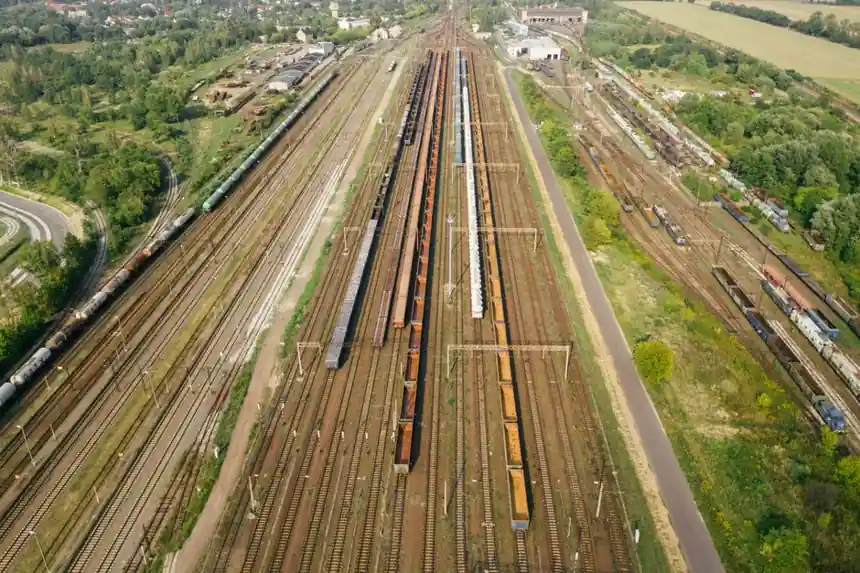
CFRP composites can cut railway bogie mass by up to 50% and carbody mass by approximately 40% versus conventional steel structures, according to a 2026 peer-reviewed review of composite materials in railway vehicles [S1]. The same study reports that nano-scale additives have raised CFRP tensile strength by up to 92.1% over neat composites, reframing carbon fiber not as a luxury upgrade but as a structural baseline for next-generation rolling stock [S1].
Rail procurement teams now face a more crowded shelf: standard-modulus PAN fibers (T300/T700 class), intermediate-modulus (T800/T1000), high-modulus pitch-based grades, and emerging noncircular-geometry fibers from a DOE-funded design program published 2026-05-20 [S4]. Selection criteria must reconcile mechanical targets, EN 45545-2 fire-smoke-toxicity limits, fatigue under bogie vibration, and total cost per kilogram of saved mass.
Why carbon fiber over glass, aramid, or hybrid stacks
CFRP outperforms glass-fiber laminates on specific stiffness and fatigue, the two properties that drive rail carbody and bogie frame design, with the 2026 review confirming carbon and aramid as the dominant reinforcement choices for structural railway components [S1]. Where cost dominates, glass-carbon hybrids remain common in non-structural interior panels, while aramid (Kevlar/Nomex class) is reserved for impact-prone zones such as driver cab fronts and crash-energy management structures.
The review's data table places carbon fiber at the top for specific modulus and specific strength, with the caveat that compression strength after impact (CAI) and through-thickness electrical conductivity still require deliberate laminate design [S1]. For under-floor equipment frames and pantograph base components, where the 2026 industrial supplier literature specifically lists rail as a target sector, carbon-fiber mold-grade prepregs are now being processed on matched-metal tools and autoclave-equivalent ovens to meet EN 45545-2 HL3 ratings [S5].
Fiber grade, tow size, and modulus: matching to the rail part
For carbody shells and side panels, standard-modulus 12K and 24K PAN-based fibers (T700-class, tensile modulus ~230 GPa) dominate because they balance cost, availability, and drapability over large aerodynamic surfaces. Bogie frames and primary suspensions represent a strong case for composite substitution, as literature data indicate that composite materials can achieve weight reductions of up to 50% in bogies [S1].
For current collectors, insulators, and high-speed pantograph horns, the 2026 industrial literature on railroad carbon and graphite notes that engineered graphite, not CFRP, is the workhorse material: dry-film lubricity, weather resistance, and consistent friction control from rain to freezing temperatures are the load-bearing requirements [S2]. This is the point where procurement teams confuse material categories: a carbon-fiber-reinforced composite is a structural laminate, whereas carbon/graphite graphite is a solid tribological material specified for switch plates, slider pans, and pantograph carbon strips [S2].
Manufacturing route and tooling: prepreg, RTM, or compression molding
Selection of the manufacturing route is governed by part size, annual volume, and surface finish: autoclave-cured prepregs remain the default for Class A exterior carbody panels, while resin transfer molding (RTM) and high-pressure compression molding (HP-RTM) are taking share for structural inserts with cycle times under 10 minutes [S5]. The 2026 tooling guide specifies that precision carbon fiber molds must hold cavity tolerance across repeated thermal cycles up to typical epoxy cure windows of 120–180°C, with surface finish and fiber orientation both validated by CMM and ultrasonic NDT before series release [S5].
Drilling and machining CFRP for fastener holes, bonding prep, and trim remains a yield-limiting step: a 2026 review of laser drilling of CFRP summarizes the influence of laser mode, wavelength, power, and scanning strategy on delamination, heat-affected zone, and hole taper, with pulsed fiber lasers in the ns-to-μs regime showing the best balance for rail stack-ups [S3]. Mechanical drilling with diamond-coated tools is still common for thick bogie laminates, but laser is gaining share for stacked CFRP-aluminum hybrid joints where delamination control is critical.
Cost reduction: DOE noncircular fiber and high-throughput lines
The principal cost barrier to wider rail adoption has always been fiber price, with aerospace-grade PAN precursor historically above $30/kg. The DOE-funded Carbon Fiber Design project, publicised 2026-05-20, targets fibers with noncircular cross-sectional geometry optimized for compression performance, scaled through commercial partners on high-throughput lines [S4]. The strategic point for rail specifiers is that noncircular geometry is not a marketing claim but a compression-strength lever, and rail bogie frames are compression-dominated, so cost-down without modulus loss is the metric to track [S4].
For procurement teams mapping the 2026 landscape, a side-by-side comparison is essential: standard-modulus PAN (T700, ~230 GPa, ~4.9 GPa tensile) delivers the lowest cost per kg of saved mass on carbody panels; intermediate-modulus PAN (T800/T1000, ~294–324 GPa) doubles the cost premium but enables the 50% bogie mass-saving case [S1]; high-modulus pitch (M-series, >500 GPa) is reserved for suspension links and leaf springs where stiffness per gram, not strength, sets the design point. Compare these options on four rail-specific decision criteria:
1. Specific stiffness (modulus/density): high-modulus pitch > intermediate PAN > standard PAN > glass<br>2. Compression-after-impact (CAI): standard PAN > intermediate PAN > pitch; needs toughened matrix for bogie duty<br>3. Fire-smoke-toxicity per EN 45545-2: matrix-driven, not fiber-driven; phenolic and epoxy with intumescent additives reach HL2/HL3<br>4. Cost per kg of mass saved: standard PAN wins at high volume; noncircular DOE fibers may shift the curve by 2027 [S4]
Standards, fire-smoke, and qualification gates for rail
Fire behavior is the gating standard in rail interiors, and fiber choice is downstream of matrix selection: EN 45545-2 sets hazard levels HL1 to HL3 for materials by vehicle category, and the 2026 composite review explicitly flags fire/smoke as a critical qualification axis for rail composites [S1]. Mechanical qualification still rides on EN 12663 (rail vehicle structural requirements) and the fatigue envelope of the relevant bogie or carbody load case, typically 10^7 cycles for primary structure.
For solid carbon/graphite components in friction and current-collection service, the 2026 industrial supplier pages state the performance envelope directly: dry-film lubricity, resistance to washout in rain and snow, stable friction from sub-zero to high summer temperatures, and corrosion resistance on steel switch plates [S2]. These are not structural-composite properties; they are tribological properties, and the specifier should keep them on a separate drawing from the carbody CFRP stack-up.
Who should specify carbon fiber in rail, and who should not
CFRP pays back fastest on high-speed trains, metros with aggressive energy targets, and any bogie program where unsprung mass reduction is on the table; the 50% bogie mass reduction figure is the headline business case [S1]. It pays back slowest on regional and freight rolling stock where tare-weight savings are valued but certification cost is amortized over small fleets. For non-structural interiors and trim, glass-fiber SMC or phenolic GRP usually meets the duty at a fraction of the cost, and aramid hybrid stacks remain the right answer only where impact and crash-energy management dominate the design brief [S1].
Adjacent spec maps worth reading alongside this one cover the same fiber-grade decision tree in different load environments, including the marine and aerospace selection guides already on the site, which carry the same modulus-vs-cost trade-off curve under different fatigue and moisture envelopes. Cross-reference them when a rail program also supplies ferries or airport people movers, since the same intermediate-modulus PAN grade often reappears across all three.
Next signals to track: first commercial shipments of DOE noncircular-geometry fiber (the program page puts the milestone on a 2026-2027 scale-up with commercial partners [S4]), and any revision of EN 45545-2 that formally recognises CFRP-specific test coupons, since most current HL2/HL3 data sits on neat-resin plaques rather than full laminate stacks. Procurement specs for 2027 high-speed bogie programs are the right place to require both data points in the bidder questionnaire.
Spec-level background on the components involved: carbon steel.
See also our earlier report, Carbon Fiber Selection for Marine Engineering: 2026 Spec Map.