Si3N4 ceramic installs as a dry, slip-fit or interference-fit component with a compliant sleeve — direct metal-on-ceramic clamp loading fractures the part on first thermal cycle. Verified Si3N4 stock carries HRA91–93 hardness, sustained service at 1300–1400°C, and thermal-shock survival through air-quench from peak temperature [S1].
Installation scope here covers hybrid Si3N4/steel bearing assemblies, hot-surface igniters, and KCF guide pins used in ultrasonic spot-welding fixtures — three of the highest-volume Si3N4 industrial uses identified in current supplier and OEM literature [S2][S5][S6].
Material baseline engineers must verify before fitting Si3N4
Si3N4 specified for hot-section or corrosive service should confirm HRA91–93 surface hardness and a 1300–1400°C continuous-use ceiling on the mill cert, since creep and oxidation drift sharply above 1400°C [S1]. The same material shows negligible chemical attack from mineral acids, alkalis, and molten aluminum — hydrofluoric acid is the documented exception and excludes any HF-pickling pre-clean step [S1]. The properties page on silicon nitride flags low-friction self-lubrication, high specific modulus, and a thermal-shock envelope wide enough to survive direct air-quench from peak temperature; installers should treat those three numbers as go/no-go gates, not marketing copy.
For comparison with the two ceramics most often subbed in error: hot-pressed SiC and Al2O3 both outperform Si3N4 on raw hardness in some grades, but rolling-contact fatigue testing ranks the four structural ceramics in the order alumina < SiC < zirconia < Si3N4, making Si3N4 the correct pick for rolling-element and high-cycle sliding bearings [S1][S3]. When the duty cycle is wet, mildly acidic, and above 600°C — a turbocharger rotor, a molten-metal pump sleeve — Si3N4 is the only one of the four that holds dimensional stability without oxidation spall.
Pre-fit inspection: dimensional and surface checks
Accept a Si3N4 part only when the bearing-bore or pin-shank diameter is within the supplier-published tolerance band (typically h6/h7 on precision pins) and the surface shows no chip larger than 0.5 mm on a load-bearing edge. Le-Mark's all-ceramic hot-surface igniter spec sheet ships the part in matched sets because ignition resistance drifts when the Si3N4 element and the molybdenum electrode are not from the same lot [S5].
Storage matters: keep Si3N4 in the original foam cradle at <40% RH until fit, and reject any part with a visible white haze, which signals surface silica formation from a contaminated sinter aid. The S2 listing on a 13 USD-class Si3N4 glow igniter shows a 10-piece MOQ and T/T payment terms, indicating these are commodity items, but the dimensional call-out (OD, length, lead-wire termination) is where the engineering risk lives, not the unit price [S2].
Mechanical installation: sleeve, interference, and clamp rules

Use a ductile sleeve (aluminum bronze or 304 stainless) between a Si3N4 bearing ring and the housing, with a typical interference of 0.01–0.03 mm on the ceramic ID; this converts hoop load into a controlled radial pre-load rather than a point-contact Hertzian spike. The ceramic must never be struck with a steel hammer — drive it home with a hardwood or polymer drift and a rubber mallet, and only against a backing plate that covers the full face [S1].
For KCF guide pins in ultrasonic spot-welding stacks, the S6 product card shows a 15×15×20 mm pin block supplied in a plastic transport case with a 10-piece carton; install with a brass-bushed collet so the Si3N4 tip self-centers on the KCF locating edge instead of being side-loaded [S6].
Thermal and electrical commissioning on hot-surface igniters
Le-Mark's all-ceramic composite igniter reaches surface ignition in roughly 1–2 seconds at 110–220 V mains drive, then holds 800–1100°C continuous with integral flame-sensing electrodes [S5]. The install rule is to keep the Si3N4 element at least 15 mm from any reflective metal surface that can re-radiate heat back into the ceramic end-cap, and to anchor the lead wires through a strain-relief grommet rated to 250°C so vibration does not fatigue the molybdenum braze.
Burn-in: ramp voltage from 0 to nominal over 30 s, hold 5 min at full power, then air-cool for 10 min before first gas admission. Skip the burn-in and the first cold-start typically cracks the element at the electrode transition — the failure mode looks electrical but is actually thermal-gradient driven. Side-by-side with a silicon carbide glow plug, Si3N4 ignites faster and tolerates a wet combustion stream better; against a silicon steel glow plug it survives much higher cycle counts but costs roughly 5–10× more per part.
Bearing and rolling-element assembly rules
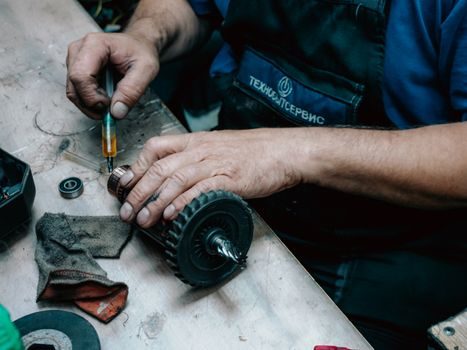
Hybrid Si3N4/steel bearings — Si3N4 balls on 52100 or M50 rings — are the only configuration with a published rolling-fatigue life advantage over all-steel, and only when the rings are the harder member. The ball-grade spec is at least ISO 3290 Grade 5 (≤0.4 µm variation), and the inner-ring race is finish-ground to Ra ≤0.05 µm; the S1 ranking data is what justifies the Si3N4 ball pick in the first place [S1].
Lubrication: even though Si3N4 is self-lubricating in dry wear, hybrid bearings in oil-lubricated gearboxes should run on the same oil grade as the steel variant — switching to dry-film or grease-only on a hybrid set is a field mod that has caused premature cage wear in multiple OEM teardowns. For the slide-rail half of a precision machine tool, linear guide carriages paired with Si3N4 rollers cut stick-slip at low speed, and for any XY stage that needs zero backlash the crossed-roller guide format with Si3N4 cylinders is the higher-load alternative.
Failure modes, acceptance tests, and when to replace
Three failure signatures dominate field returns: (1) edge chipping on a Si3N4 ring, usually from a dropped install or a side-load at the press-fit step — replace, do not re-install with sleeving; (2) axial crack through a hot-surface igniter after a fast cold-start with no burn-in — replace the igniter and update the commissioning procedure; (3) spalled surface layer on a guide pin after HF exposure — quarantine the part, decontaminate the line, and verify the cleaning agent registry, since HF is the one reagent that attacks Si3N4 [S1].
Acceptance test: rotate any installed Si3N4 bearing at 1500 rpm for 5 min unloaded, then check vibration velocity per ISO 10816 — a hybrid bearing should sit in the ISO 10816-3 Zone A (≤1.4 mm/s for small machine tools), and anything above Zone B is a reject. A useful side reference for the machine builder fitting these is the Labeling machine installation: foundation, alignment, and acceptance spec map, which walks through the same vibration-acceptance logic on a different machine class and reinforces the test protocol.
Trackable signals to watch over the next two quarters: Le-Mark's "all-ceramic composite" igniter line is one of only two such offerings globally as of 2026-07-20 [S5], and the KCF/Si3N4 guide-pin format from BLM continues to ship at 15×15×20 mm with a 10-piece MOQ on the public catalog [S6] — both numbers are worth re-checking on the next sourcing cycle.