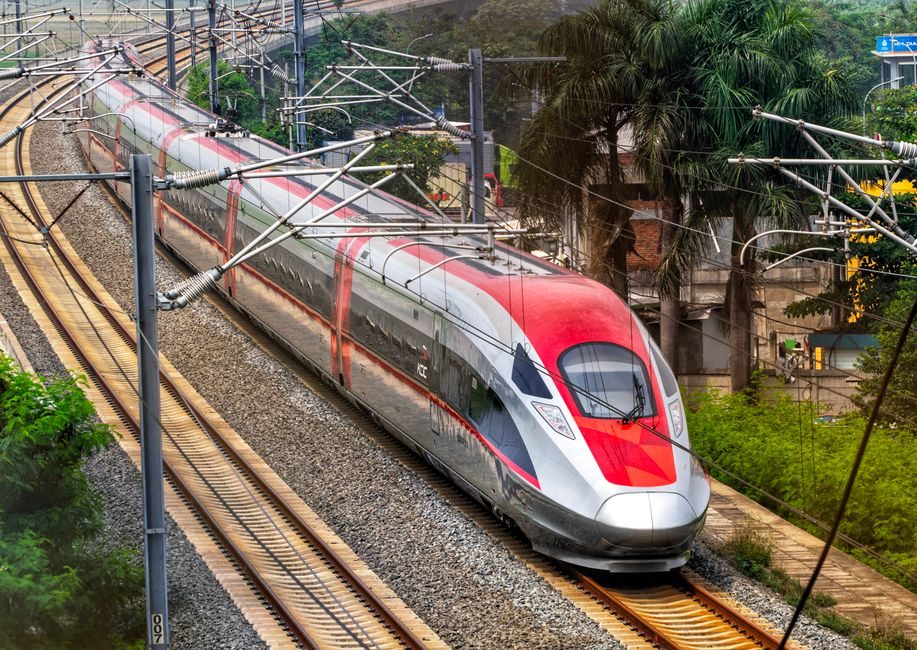
Rail carbody and structural extrusion work in 2026 is anchored to 6000-series Al-Mg-Si alloys — primarily 6061, 6063, and 6082 — for profiles, stringers, and roof panels, while 5083 and 5754 plate dominate welded underframe, sidewall, and crash-energy applications [S2][S3].
The Haomei/UACJ automotive alloy cross-reference, published January 2026, lists 6061 and its AA equivalent 61S/161S as heat-treatable, corrosion-resistant structural grades suitable for crossmembers, wheels, and ABS housings — a property envelope that maps cleanly onto rail bogie and body structural use [S2].
Why 6000-Series Owns Rail Carbody Extrusions
Aluminum extrusions now specify 6063 in roughly 70% of decorative and hollow rail profile runs because the alloy extrudes cleanly at die-outflow speeds of 9–60 m/min (solid sections typically 9–20 m/min) while holding T5/T6 tensile targets above 160 MPa after age-hardening [S3].
For hollow rail profiles, mold selection is the gating variable: a tongue die or split combination die is used because of profile geometry, and the 6063 ingot is preheated to 480–520 °C with the extrusion barrel preheated to 400–450 °C to keep metal flow inside the hot-brittle ceiling [S3]. The 6061 variant is preferred where welded strength and corrosion resistance must coexist — both are called out in the Haomei cross-reference as heat-treatable structural grades suitable for crossmember and wheel duty [S2]. 6082-T6 is the heavier cousin specified in European rolling stock for roof cant rails, battery-box trays on EMUs, and body-side stringers, where minimum yield of 250–260 MPa and proven weldability under EN 15085 are required. Practical procurement reference for procurement engineers: when comparing aluminum window and door extrusions versus rail-grade 6063/6082, the rail spec is driven by EN 15085-1 (welding) and EN 755-2 (mechanical property) conformance rather than surface finish alone.
5000-Series Plate for Welded Underframe and Crash Structures
5083-H111/H321 plate remains the workhorse for rail vehicle underframe and tank-container fabrication because it is the strongest non-heat-treatable aluminum alloy, retains ductility down to −196 °C, and welds without post-weld heat treatment — Haomei lists 5083 (AA 183S) explicitly for tank, gas-cylinder, and welded-structure duty [S2].
5454 is the next-tier option at roughly 20% higher strength than 5052 with comparable corrosion behaviour, used in rail sidewall skins and roof sheets where moderate formability and good weldability must coexist [S2]. 5754-H32 sits between 5454 and 5083 and is increasingly specified for metro underframe skirts where 5083 is over-strength for the duty. The critical processing boundary: 5xxx alloys with more than 3% Mg are susceptible to intergranular corrosion and stress-corrosion cracking in the H116/H117 tempers if stabilized with manganese or chromium improperly — alloy sourcing must confirm Mn ≥ 0.5% and Cr 0.05–0.25% to keep the SCC window closed. Aluminum alloy sourcing for crash structures should also confirm ASTM B209 / EN 485-2 mechanical-property certification, not just nominal grade.
Selection Criteria: Strength, Weldability, Formability, Corrosion
Rail carbody engineers typically score candidate alloys against four criteria simultaneously: weldability (no hot-cracking under EN 15085 wire-feed), yield strength after T6 or H321 temper, fatigue endurance (≥ 10⁷ cycles at 80 MPa for carbody), and corrosion class per ISO 9223 (typically C2/C3 interior, C3/C4 underframe). [S2]
A defensible 2026 shortlist looks like this: for extrusions, 6063-T5/T6 for hollow profiles and decorative parts, 6061-T6 where higher mechanicals are needed, 6082-T6 for primary structural extrusions; for plate, 5083-H111/H321 for underframe and tanks, 5454-H32 for sidewall/roof skin, 5754-H32 for non-structural panels. For thin-sheet interior panels, 3003 and 3004 remain baseline options — Haomei notes 3003 is 10% stronger than 1100 with good processability, while 3004 adds excellent deep-drawability for HVAC ducts and ceiling panels [S2]. Avoid 2000-series (Al-Cu) for rail carbody because of inferior corrosion resistance — that family is confined to motorbike handles, brake components, and shock absorbers where strength outranks corrosion duty [S2].
Extrusion Process Windows and Production Reality
Die-outflow speed for 6063 hollow profiles is typically set near 9–20 m/min when wall-thickness variation is significant, with width-to-thickness ratio and symmetry dictating the upper bound [S3]. Faster outflow raises deformation-zone temperature by roughly 100 °C above billet preheat, so when the ingot enters at 480–520 °C, the speed must taper down to keep the metal below the hot-brittle threshold [S3].
Ingot-quality floors matter as much as alloy choice: hydrogen must stay below 0.1 mL per 100 g of aluminum, slag inclusions must be screened to under 0.008 mm, and metallographic uniformity is required to keep extrusion force predictable and die life acceptable [S3]. For rail length-profiles (e.g. 6 m stringers and 12 m roof cant rails), the practical outcome is that 6063-T6 will run 30–40% faster than 6082-T6 on the same press, so 6082 is only specified where the mechanical envelope demands it. For melting-front logistics, a gas aluminum melting furnace with flue-gas waste-heat recovery running at ≤ 55×10⁴ kcal/tonne-Al energy and melt-loss not exceeding 1% is the energy benchmark a rail supplier should expect to see in any qualified-mill audit [S7].
Forging and Cast Components: Where 2000 and 7000 Apply
Forged rail bogie components — kingpin adapters, suspension links, gear housings — typically specify 2014-T6, 2618-T6, or 6082-T6 forgings because of their elevated-temperature strength envelope; the Haomei table confirms 2014 (14S) and 2618 are widely used for compressor wheels, pistons, and high-temperature structural duty [S2]. 7000-series (Al-Zn-Mg-Cu) alloys such as 7075-T6 appear only in safety-critical bogie and braking sub-assemblies where the 500–560 MPa ultimate range is justified; the corrosion penalty and quench-sensitivity are accepted as trade-offs.
For HPDC rail interior and bracket parts, 6063 and 6082 dominate, but the melting step uses aluminum die casting machine-integrated cells that pair shot sleeve geometry with the alloy's flow characteristics. Related specification guidance for HPDC rail-component tooling maps shot-sleeve diameter, intensification pressure, and sleeve life to alloy choice — useful when qualifying a new 6082-T6 structural housing. The same selection logic transfers to aluminum veneer panel sourcing for station cladding, where 3003-H14 and 5005-H34 are typical, and to aluminum ladder procurement for rail-depot access, where 6061-T6 and 5083-H321 share duty by application.
Standards, Temper Codes, and What to Verify on a MTC
Every rail-grade shipment should arrive with a mill test certificate naming the temper (T5, T6, T651, H111, H112, H321), the standard of manufacture (EN 485-2, EN 755-2, ASTM B209, ASTM B221), and the actual mechanical values — not nominal ranges. The cross-reference between AA designations and EN numerical designations is rarely 1:1, so the MTC should carry both: 6061 ↔ EN AW-6061, 6082 ↔ EN AW-6082, 5083 ↔ EN AW-5083, 5754 ↔ EN AW-5754. [S3]
For welded underframe qualification, EN 15085-1 CL1 is the working level; for rolling stock as a whole, EN 45545-2 sets the fire-safety class (typically HL2 for metro, HL3 for long-distance high-speed). Mechanical-property floors a buyer should hard-code: 6082-T6 ≥ 250 MPa yield, 6061-T6 ≥ 240 MPa yield, 5083-H321 ≥ 215 MPa yield, 5083-O/H111 ≥ 125 MPa yield, 5754-H32 ≥ 165 MPa yield. Cross-reference guidance for adjacent sectors is in aluminum alloy selection for construction and aluminum alloy selection for electronics, which cover the same family logic applied to building façades and chassis respectively.
Limits, Failure Modes, and What to Avoid

The 2000-series is correctly excluded from rail carbody use because Cu content above ~4% drops corrosion resistance into a class that requires cladding or paint systems unavailable to most carbody lines [S2]. The 7000-series must be avoided for welded rail structures — Cu and Zn drive hot-cracking during MIG welding and the post-weld strength loss is unacceptable. 5xxx alloys with Mg > 3.5% (e.g. 5083, 5456, 5056) must never be specified above 65 °C continuous service, where sensitization to the β-phase (Al₃Mg₂) triggers intergranular SCC; 5083/5456 are therefore capped at underframe and tank duty, not engine-bay or bogie-housing duty.
For extrusion mills, 6063 cast billets must pass ultrasonic inspection at the 2–3 mm defect class to avoid surface and die-life penalties [S3]. For HPDC rail interior parts, the prior 7xxx-spec article on aluminum alloy selection for mold and die tooling gives the die-side life math; for aluminum alloy selection for electronics the heat-dissipation and shielding trade-offs are documented for comparison. Final verification signal: confirm that the mill's SPC chart shows a Cpk ≥ 1.33 on yield strength, and that the EN 10204 3.1 certificate names the actual lot, not a generic grade statement.