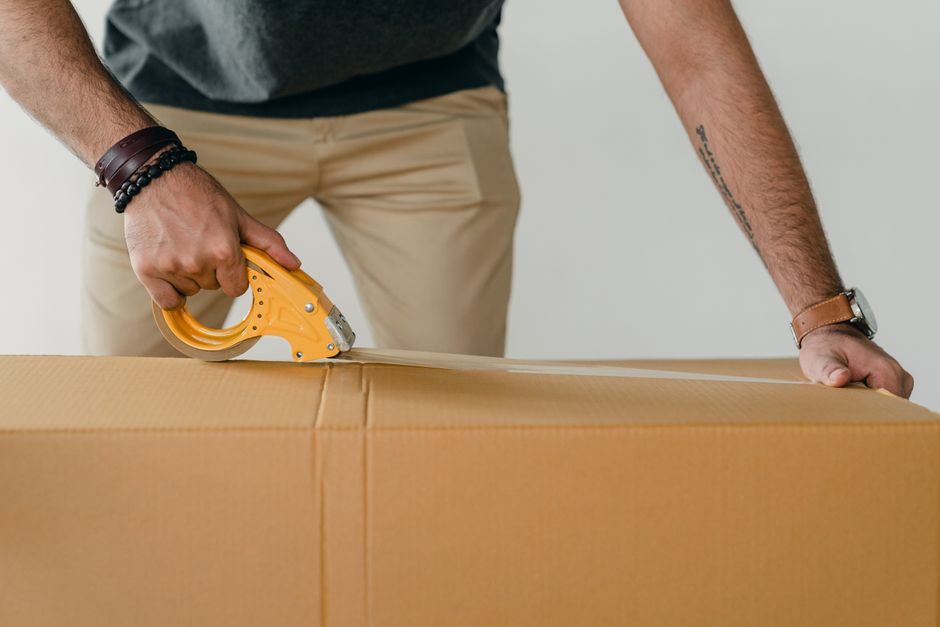
Corrugated carton boxes in 2026 typically carry unit loads of 5–25 kg with a 4-ply single-wall ECT-32/BCT specification, while FIBC big bags are routinely rated 500–1500 kg with a 5:1 or 6:1 safety factor per ISO 21898 and built from woven polypropylene 140–230 g/m² [S4][S6].
The two formats sit in different volume tiers and almost never substitute for each other; mismatched spec'ing shows up as crushed master cases on pallets or, worse, a bulk bag rated too low for the sloop hooks of a 1-ton bulk line.
Unit load and material baseline
Standard corrugated carton box stock for e-commerce and FMCG retail runs single-wall ECT-32 (edge crush test 32 lb/in, ≈ 5.6 kN/m) at 3-ply or 4-ply, with double-wall ECT-44–48 for master cases weighing 18–25 kg. Board grade breaks down to B-flute 3 mm, C-flute 4 mm, and BC-flute 6–7 mm as the practical choices in current catalog offerings [S2].
FIBC bulk bags (also called jumbo, big bag, or 1-ton bag) use 140 g/m² woven polypropylene as the baseline fabric, 160–200 g/m² for food-grade, and 230 g/m² for heavy/mining duty, with UV stabilisation typically rated 6–12 months of outdoor exposure. Inner liner options include food-grade PE liner 50–100 µm, conductive liner (surface resistivity <10¹¹ Ω) for combustible dust, and oxygen-barrier foil liners for oxygen-sensitive powders [S4].
Capacity, stacking and freight geometry
Carton box case dimensions cluster around 400×300×250 mm, 600×400×400 mm and 600×400×300 mm as the FMCG workhorses, with a 600×400 footprint being the most reusable across euro-pallet 1200×800 mm. Stacking limits in the field are typically 4–6 tiers of 25 kg master cases before deflection dominates. [S1]
FIBC bulk bags come in 90×90×100 cm, 90×90×120 cm, 100×100×100 cm, 100×100×120 cm and 105×105×120 cm footprints as the standard catalogue — every one of them is engineered to sit on a 1100×1100 mm or 1200×1000 mm pallet base. Top-spec construction lets a single bag hold 1500 kg of dry bulk, with 2000 kg variants sold by Chinese suppliers at roughly US$ 3.86–4.86 per piece at FOB tier [S4].
The 1:1 stacking geometry question rarely overlaps between the two products: carton master cases almost never use the same pallet footprint strategy as a 1000 kg bulk bag, and an FIBC is never run through a carton erecting machine line.
Cost per kg of contained product

Per Made-in-China listings [S4], AD virgin-PP 1-ton FIBC bulk bags are priced at US$ 2.5–3.8 per piece, and reusable PP FIBC variants are also offered on the same platform. At 1000 kg net payload the packaging cost works out to US$ 0.0025–0.0040/kg.
Corrugated carton box board cost lands an order of magnitude higher per kg carried. A 4-ply 600×400×400 mm master case weighs 0.5–0.7 kg and runs US$ 0.80–1.60 per piece; carrying 20 kg that is US$ 0.04–0.08/kg, plus a turnover box or pallet cost underneath. The unit-economics gap is the reason FIBC dominates dry-bulk flows above ~250 kg per order and the carton format dominates anything retail-facing.
Which one for which job
Use a corrugated carton box when: the unit is retail, the product needs printed branding, the consumer is the next handler, the load is ≤25 kg, and stacking is a feature rather than a workaround. Use a FIBC bulk bag when: the unit is industrial dry bulk (minerals, plastic pellets, grain, cement, fish meal, fertiliser), the payload is 500–2000 kg, the next handler is a forklift or hoist, and the bag will be discharged via a bottom spout or full tip. [S2]
Do not use a carton box for: 500+ kg of free-flowing material, Class II–III combustible powders, or anything that needs 12 months of outdoor exposure. Do not use a FIBC for: retail-presented goods, anything smaller than 250 kg net, or applications where the consumer needs a re-closable consumer pack. A decade resistance box is a calibration enclosure, not a packaging container — a confusion that comes up surprisingly often in spec sheets mixing the two product families.
Standards, safety factors and compliance
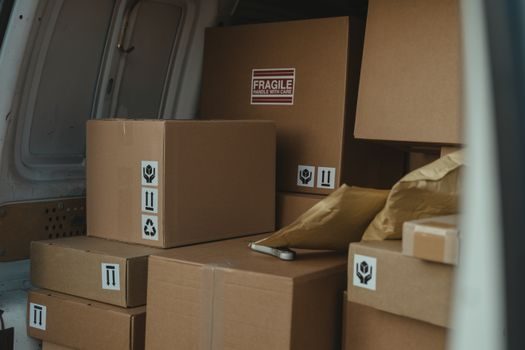
FIBC construction references ISO 21898 for the 5:1 single-trip / 6:1 reusable safety factor wording; UN packaging approvals (UN 13H1/Y…/Z…) are the cut-off for hazardous-dry-bulk fills including Class 1.4S through Class 9. Conductive / Type C / Type D antistatic bags follow IEC 61340-4-4 for the resistivity thresholds that govern flammable atmosphere use [S4].
Carton box spec is governed by FEFCO catalogue codes for case style, TAPPI T 804 for the edge crush test, and ISO 2234 for stacking tests; food-contact applications need to meet FDA 21 CFR 176.170 (US) or EC 1935/2004 (EU) on the inner liner.
Failure modes that the catalogue hides
The most common carton failure is vertical compression loss after humidity cycles — a 32 ECT case is 32 ECT dry; a 90% RH week will drop effective stacking strength 40–60%, which is the most common reason warehouse stack collapse is not a "load rating" problem but a "moisture creep" problem [S2].
The most common FIBC failure is fabric tear at the lifting loop / cross-corner seam, not the bag body. The loop material is typically 25–30 mm woven PP webbing, stitched with a chain-stitch or zigzag pattern; the load on the four loops at 1000 kg payload is 250 kg per loop, and a 5:1 factor puts the break threshold near 1250 kg per loop on a properly stitched bag. Skipping the pre-use visual inspection on reused FIBCs is the dominant single-trip fail path in the field [S6].
Automation, throughput and handling context
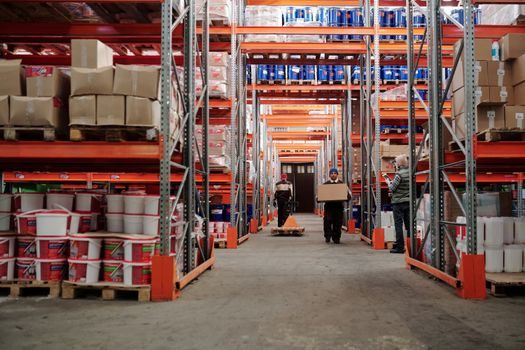
Carton lines run on carton erecting machines at 20–60 cases/min for standard workhorse models, with case erectors taking flat blanks, gluing/tab-locking the base, and feeding a sealer downstream. Wrapping and palletising for the carton side commonly uses stretch-wrappers like the N600F when case dimensions sit in the 400–600 mm range [S3][S2].
FIBC lines are radically different: a single bag cycle on a fill station takes 60–120 seconds, and a 1-ton bag is the discrete handling unit rather than a "case" within a pallet. The upstream of an FIBC line is a big-bag filling machine with a weigh scale, the downstream is a stretch-wrapping or palletising station for the loaded bag on its pallet base.
Procurement levers specifiers actually control
For cartons, the four levers are: board grade (3-ply vs 4-ply, ECT target), print (1-colour flexo vs 4-colour), MOQ (a 1000-piece run costs meaningfully more per piece than a 50 000-piece run), and die-cut complexity. The fibre cost is roughly 60–70% of the delivered carton cost in 2026. [S3]
For FIBC, the four levers are: fabric weight (140 vs 200 vs 230 g/m²), safety factor (5:1 single-trip vs 6:1 reusable), liner choice (none vs PE vs foil vs conductive), and lifting loop configuration (4-loop cross-corner, 4-loop corner-to-corner, single-strap duffel-top, or spout-top with spout-bottom). Chinese FOB tier pricing clusters at US$ 2.50–3.80 for 1-ton virgin-PP single-trip and US$ 3.86–4.86 for the 1500 kg PP heavy variant [S4].
How the two compare against decision criteria
Lining the two formats up against four real decision criteria: (1) typical unit load — carton 5–25 kg, FIBC 500–1500 kg; (2) cost per kg of contained product — carton roughly US$ 0.04–0.08/kg, FIBC roughly US$ 0.0025–0.0040/kg; (3) handling consumer — carton is consumer/retail, FIBC is forklift/hoist; (4) returnable / reusable economics — carton is single-trip (or, with a turnover box frame, reusable 50–200 cycles), FIBC reusable 5:1 bags can be re-tripped 3–5 times before UV and abrasion end-of-life; (5) automation line fit — carton lines run 20–60 cases/min, FIBC lines run 30–60 bags/hr. [S4]
The 10× cost-per-kg gap and the 50× payload gap are why the two formats coexist in the same warehouse rather than competing head-to-head. A bulk bag in this comparison is never a "cheap replacement" for a carton — it is a different tier of containment altogether.
When a hybrid pack is the right answer
For unit loads of 25–250 kg, the specifier is in an awkward middle band that neither format handles well. The two practical answers in 2026 are: (a) a corrugated bulk bin / Gaylord box (heavy-duty 7-ply corrugated 1000×1200 mm with a 4-way entry pallet base, rated ~250–400 kg, supplied via dedicated brokers [S6]); or (b) a smaller "mini-bulk" FIBC at 250–500 kg rating.
Operators who try to bridge the 25–250 kg band with 4-ply master cases on a carton box format usually pay the price in crushed stacks and product damage; operators who try to bridge it with a 1000 kg FIBC overfilled to 300 kg waste the cost-per-ton advantage and pick up handling issues.
The decision tree is simple: <25 kg retail-facing → carton; 25–250 kg inner-packs within a pallet → Gaylord or master-case stack; 250–2000 kg dry bulk → FIBC. The hybrid "small FIBC" tier at 250–500 kg is where the most spec'ing energy goes wrong, since the per-bag cost advantage of the 1-ton variant does not scale down linearly.
For related coverage, see Valve Limit Switch Box Price & Cost Guide: 2026 SKU Bands, MOQ Levers and Sourcing Reality.