
End-of-line case packers fall into six mechanical families — top-load, side-load, wrap-around, robotic, horizontal form-seal, and vertical form-seal — with throughput envelopes running from roughly 10 cases/min on semi-automatic units to 200–300 cases/min on continuous-motion top-load and wrap-around systems [S1].
Yes Pack, a Hunan-based OEM with 12 years in case packaging equipment, lists carton erecting, packing, sealing, strapping, conveying, and palletizing as the six station-types that make up a complete packaging line, serving auto parts, food, beverage, hardware, electronics, chemicals, personal care, pharmaceuticals, and dairy end markets [S1].
Top-Load vs Side-Load: The Two Workhorse Formats
Top-load case packers drop products vertically into an erected RSC (regular slotted container) case and dominate the 60–200 cases/min band for bottles, cartons, jars, and pouches; side-load units push products horizontally into a case and are the standard for flow-wrapped bars, tray-packed items, and bundles where drop damage is a concern [S1].
Both formats rely on a separate case erector feeding blanks at 15–30 cases/min (semi-automatic) up to 50–80 cases/min (automatic, bottom-folding), with the erected case then transferred by servo or cam-driven lug conveyor to the loading station [S4]. SpeedPack's product range explicitly covers semi-automatic bottom-folding case erectors, automatic case openers and staplers, and multi-station case openers, confirming the erector–packer–sealer split that defines most Asian line-build practice [S4].
Wrap-Around and Robotic Case Packing
Wrap-around packers form a blank around a product collation and glue or tape the case in one motion, cutting corrugated usage by 15–25% versus pre-erected RSCs and running at 25–120 trays/min in typical beverage and tissue conversions [S1].
Robotic case packers use 4- or 6-axis arms with custom end-effectors to pick collations and place them into erected cases, hitting 20–60 cycles/min with the flexibility to handle mixed SKUs, retail-ready trays, and unstable product patterns that defeat mechanical loaders [S1]. Yes Pack pairs these robotic cells with downstream robot palletizers, which place finished cartons onto pre-arranged pallets and replace manual stacking at line speeds above roughly 10 cases/min [S1].
Horizontal Form-Fill-Seal Case Packing
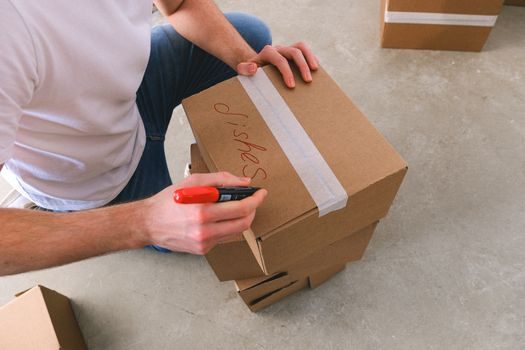
Horizontal form-fill-seal (HFFS) case packers build a tray or wrap from a flat blank, load product horizontally, and seal the case in-line, eliminating the need for a separate erected-case supply and running at 30–150 packages/min for confectionery, bakery, and medical disposables [S1].
This family overlaps with stick-pack and sachet packaging machinery built by vertical OEMs such as Guangzhou Western Packing, whose continuous-motion VFFS range covers 3-side seal, 4-side seal, back-seal, gusset, pyramid tea, and irregular-shaped bag formats at speeds typically quoted between 30 and 80 bags/min per lane [S3]. Western Packing's machine families — powder, liquid, granule, tea-bag, and tube-filling/sealing — feed directly into the collation stage of a horizontal case packer when the end format is a retail box rather than a primary pouch.
Selection Criteria: Speed, Case Style, Product Geometry
Buyer-side selection breaks down to four numerical gates: required cases/min, case style (RSC, wrap-around, tray, HALF-SLOTTED, display), product stability on collation, and footprint. Lines targeting 100+ cases/min in FMCG almost always pair an automatic bottom-folding case erector with a top-load or wrap-around packer and a uniform tape or hot-melt case sealer; lines below 30 cases/min can run semi-automatic erectors with a single-operator side-load station [S1][S4].
Material handling upstream of the packer is set by the filling machine selection — piston fillers for viscous liquids, auger fillers for powders, gravity or volumetric fillers for free-flowing granules — and the collation pattern downstream is dictated by the case packing machine format chosen. Lines that produce stick packs or sachets typically route through a servo coding machine before reaching the collator, so batch and date coding land on every primary pack before it is grouped into a case [S3].
Integration, Sealing, and Compliance

Case sealers split into uniform tape sealers (3" or 2" BOPP tape, 20–35 cases/min) and random-size hot-melt or tape sealers with automatic flap-folding that adjust to varying case dimensions on the fly, and they sit on the same lug conveyor as the packer so case-pitch is preserved through the line [S1][S4].
Strapping machines wrap plastic bands around packed cases to secure the load for palletizing, and palletizers — typically 4-axis robot arms with layer-forming end-effectors — complete the cell. Buyers exporting to the EU and North America should look for CE, EMC, LVD, FCC, and UL marks at the machine level, since palletizer safety circuits and e-stop loops are covered under the same machinery directive as the packer [S1].
Limitations and Common Failure Modes
Top-load packers struggle with very tall or unstable product patterns because the drop distance must be controlled to prevent tip-over; side-load packers need a square collation face and do not accept nested or irregular shapes; wrap-around formats require a stiff blank and a reliable hot-melt or glue applicator, adding consumable cost; robotic cells trade throughput for flexibility and are not economic below roughly 20 cycles/min [S1].
Common failure points across all six families are blank magazine starvation, hot-melt tank temperature drift, vacuum cup wear on robotic heads, and servo-conveyor synchronization faults at changeover — all of which are addressed by the 2-year warranty and online-support model that Asian OEMs including Yes Pack now ship as standard [S1]. For plants planning a greenfield line, the upstream core machine selection and downstream cutting machine integration should be locked before specifying the case packer, since the packer's collation pitch and infeed height must match the surrounding line geometry.
Track three signals before specifying: ask the OEM for measured OEE at 30, 60, and 90 days under your actual SKU mix; request a changeover time matrix covering every case-size variant you will run; and confirm CE/UL certification scope covers the entire integrated cell, not just the packer head [S1].
Related analysis: Tapered Roller Bearing TCO: Cost Drivers, Lifecycle Math, and Sourcing Specs.