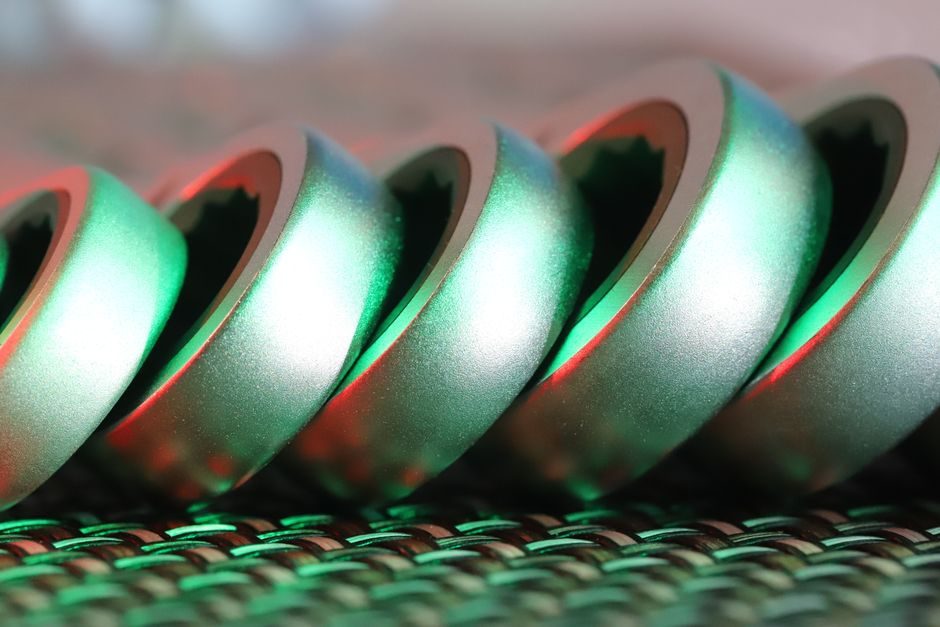
A properly framed tapered roller bearing total cost of ownership model treats the bearing as a system whose purchase price is typically 10–30% of its 5–10 year lifecycle cost, with the remainder consumed by lubricants, labour for mounting, alignment tooling, downtime, and scrap [S1].
Industrial buyers in mining, heavy truck, gearbox, and railway axle applications are pushing TCO clauses into RFQs because single-cup TS and double-row TDO variants from suppliers like Timken and Chinese OEMs differ in mounting clearance, case-hardening depth, and grease compatibility, all of which move operating cost more than sticker price [S2][S4][S5].
Anatomy of a Tapered Roller Bearing and Why Geometry Sets the Cost Curve
A single-row TS tapered roller bearing separates into a cone (inner ring + rollers + cage) and a cup (outer ring), giving separable mounting that simplifies installation and replacement [S2][S5].
That separability, however, forces the user to set endplay or preload at assembly, and the cost of getting that adjustment wrong is the single largest hidden TCO driver: under-adjustment causes skidding and raceway spalling, over-adjustment burns lubricant and overheats — both cut L10 life geometrically [S1][S2].
TCO Formula and Where Each Term Actually Hits the Wallet
The USPS supply manual codifies the lifecycle formula as TCO = P + Present Value of (O + T + M + W + E − S), where P is purchase, O is operating, T is training, M is maintenance, W is wasted/rework, E is environmental/disposal, and S is salvage [S1].
Training (T) is small in dollars but large in variance: crews trained on shim adjustment, induction heaters, and hydraulic mount/dismount sleeves routinely achieve 2–3× bearing life over crews using hammer-and-socket methods, because impact mounting brinells races and is the most common cause of premature L10 failure in tapered roller bearing service [S1][S2].
Cost-Driver Comparison: Single TS vs Double TDO vs TTHD Thrust
On four decision criteria — purchase price, radial load capacity, mounting complexity, and suitability for combined axial-plus-radial loads — single-row TS is the lowest cost and simplest to mount but carries combined loads only when paired and adjusted against a second bearing; TDO doubles radial capacity and handles moment loads in one envelope at roughly 1.5–1.6× the unit price and a moderate increase in mounting labour; TTHD tapered roller thrust bearings are specified for heavy axial loads (gearbox pinion, rolling mill screw-down) and require strict perpendicularity of the shaft to the housing face, adding setup cost [S2].
On lubrication interval, the TTHD and TDO types typically run hotter due to higher contact stress and demand more frequent re-lubrication or oil-bath circulation; TS units in well-sealed pillow blocks can run 8,000–20,000 hours on premium synthetic grease before re-pack, versus 2,000–6,000 hours for TTHD under similar load [S1][S2].
On supplier-tier risk, single TS imperial series (e.g.
Operating-Cost Levers: Lubrication, Contamination, Alignment
Sealed-for-life TS units eliminate the re-greasing cost line but cap operating speed and temperature; open-type units with external lube systems cost less to buy but introduce a maintenance labour line that the TCO model must price at the actual burdened rate — typically $45–$120 per hour in North American heavy industry [S1].
Laser shaft alignment to within 0.05 mm at the coupling is the single highest-ROI maintenance action in roller bearing service: a 0.2 mm misalignment at 1,500 rpm can cut bearing life by 50% or more, and the alignment job itself pays back inside one avoided unplanned stoppage on any asset over 50 kW [S1].
Selection Criteria: Who Needs a TCO Model and Who Does Not

Plants running 24/7 with high hourly downtime cost (steel mills, paper machines, continuous-process chemical lines, large wind turbine gearboxes) should always run a TCO comparison between premium and budget tapered roller bearing suppliers, because the W (wasted/downtime) term dwarfs P [S1].
Operations with cheap downtime, long mean-time-between-overhaul windows, and easy access — farm equipment, low-duty conveyors, intermittent-duty motors — can legitimately optimize on purchase price and skip the full TCO exercise, because the M and W terms collapse to negligible fractions of lifecycle cost [S1].
OEMs building equipment that ships under warranty should model TCO for the warranty period specifically (3–5 years) rather than the full design life, because warranty replacement cost is a direct liability and shifts the optimal supplier choice toward higher-priced parts with demonstrated premium-process pedigree [S1][S5].
Sourcing and Standards Discipline for RFQs
Buyers evaluating Chinese OEM tapered roller bearing suppliers should require material certificates (through-hardening vs case-carburizing steel, typical 100Cr6 / GCr15 / 52100 chemistry), heat-treatment records (austenitizing and tempering temperatures), and ABMA/ISO dimensional conformance on bore, OD, and cup width to avoid early spalling and cage fracture [S4][S6].
For applications under heavy shock or vibration, specify case-hardened variants with retained austenite control; for high-speed gearbox pinions, specify through-hardened variants with tighter raceway surface finish — and never mix the two specifications in adjacent bearing positions on the same shaft, because their thermal growth coefficients differ [S2].
Logistics and packaging deserve a line in the TCO model: tapered roller bearings ship in VCI-treated wrap with desiccant, and a supplier that fails here is delivering a pre-corroded part whose L10 is already reduced before installation — the S (salvage) credit should be adjusted downward to reflect real resale value, not catalogue [S4][S5].
Two trackable signals for the next 90 days: monitor whether major bearing suppliers publish updated ABMA/ISO life-calculation spreadsheets with the new lubrication-contamination adjustment factors, and watch for revised tariff schedules on Chinese-sourced 100Cr6 forgings that would shift the P term enough to change the TCO ranking between domestic and imported single-row TS parts.
The underlying component specifications are covered under total station.
This topic is covered further in Dynamometer Price and Cost Guide: 2026 Driver Map and Sourcing Specs.