
For DN125 (4.8 in) concrete pump boom and lay-down lines, the practical split is straightforward: cast hardened elbows (single wall cast, twin wall with chrome carbide insert liner, or dual-layer composite) carry the high-wear zones, while fabricated pipe bends carry the geometry-driven transitions where no standard cast angle exists or where a custom radius is required [S2][S3][S4].
Mix design, pumping pressure, and line layout drive the call more than price. A 90 degree cast elbow at the boom tip and a 30 degree fabricated bend halfway down a deck run are not competing parts; they are different tools in the same line, and the wear data published in 2026 makes that boundary sharp [S4][S7].
Why elbow wear dominates pump line lifecycle cost
Elbows fail several times faster than straight pipe because centrifugal force in the bend throws coarse aggregate against the outer wall, concentrating abrasion in a narrow arc rather than spreading it across a cylinder [S4]. That mechanism is independent of pipe diameter and pressure, which is why DN125 (4.8 in), DN117 (4.6 in), and DN112 (4.4 in) boom elbows are all offered as wear-rated components, not commodity pipe [S3].
OSHA does not ban any particular elbow geometry, but 29 CFR 1926.702(e) requires pipe supports rated for 100 percent overload, and § 5(a)(1) of the OSH Act obligates employers to address recognized hose-whipping hazards; that combination is why heavy cast elbows at the end of a delivery hose are flagged as a mass-injury risk by ACPA even when they are not prohibited by code [S1]. The wear-life problem is the production problem; the mass problem is the safety problem, and the two should not be solved with the same component.
Cast hardened elbow options on the market in 2026
Three cast families are in active production. Single wall cast elbows use one solid casting, typically in high-manganese or chrome-iron grade, and are stocked in 20 degree, 30 degree, 32.5 degree, 45 degree, 50 degree, and 90 degree angles in the DN125 size class as the default offering [S5]. Twin wall cast elbows add a chrome carbide insert (CCI) liner at the wear face and at the coupling joint, and Con Forms publishes these in DN125/5, DN117/4.6, and DN112/4.4 system sizes for boom applications [S2][S3].
Dual-layer composite elbows, pioneered in China by Ma'anshan Haitian Heavy Industry and documented in field data published in April 2026, separate the duties: an outer layer of Q235 or Q345 structural steel carries pressure and impact, while a high-chromium cast iron inner liner (with Cr7C3 chromium carbide microstructure) carries the abrasion, delivering 3 to 5 times the service life of conventional alloy-steel single-layer elbows in the same line position [S4]. The 60,000 m3 published service figure is a real jobsite number, not a lab extrapolation, and it is the benchmark any cast elbow should be measured against in 2026 [S4].
Where fabricated bends actually make sense
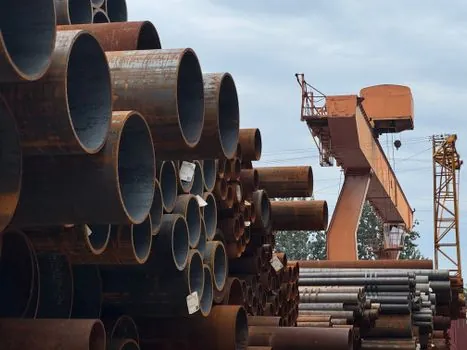
Fabricated bends are not a worse version of a cast elbow; they solve a different problem. Custom pipe bends, hardened or non-hardened, can be ordered in virtually any angle or end configuration from suppliers such as Con Forms, which is the practical answer when a job needs an angle that is not in the standard cast catalog or a non-standard centerline radius [S2]. A 4 in x 90 degree bend with an 18 in centerline radius and heavy-duty ends is a standard stocked fabricated SKU, illustrating the geometry flexibility that no cast foundry can match at low volume [S5].
RM Wearparts also offers single-wall fabricated bends with thickened walls at the high-wear points, produced in different diameters and angles for exactly this geometry-driven segment of the market [S6]. For lay-down lines, deck runs, and tunnel placers where the line shape is set by the structure rather than by standard catalog angles, fabricated bends are the right call, and pairing them with a single heavy-duty cast elbow at the boom tip is the common production pattern [S2][S6].
Decision matrix: cast hardened vs fabricated
Compare on the four criteria that actually move cost and downtime: wear life, angle availability, lead time, and unit price. Cast hardened elbows (single wall cast, twin wall CCI-lined, dual-layer composite) deliver the longest wear life, with 3 to 5 times the service life of single-layer steel in published 2026 data, but are limited to the stocked angles (20, 30, 32.5, 45, 50, 90 degree) and stocked sizes (DN112, DN117, DN125, DN150) [S4][S5].
Fabricated bends offer essentially unlimited angle and radius options, faster lead time on non-standard geometry, and a lower unit price (a 4 in x 90 degree heavy-duty fabricated bend listed at $205.74 vs a DN125 chrome-carbide twin wall 20 degree cast elbow at $219.82 in the same catalog, illustrating that price alone is not the differentiator) [S5]. Wear life is the trade: fabricated single-wall bends wear faster than twin-wall cast units, so the right rule is to put the cast hardened elbow where aggregate impacts the outer wall, and the fabricated bend where geometry is the constraint.
Standards, safety, and end-of-hose configuration
OSHA's 2010 interpretation of 29 CFR 1926.702(e) is still the controlling US reference for concrete pumping pipe supports and is the citation for any boom-pipe engineering package; it does not prohibit any specific elbow geometry but does require supports rated for 100 percent overload and addresses hose-whipping under the OSH Act general duty clause [S1]. ASME B30.27-2009 § 27-1.9 limits boom-tip slewing speed to 5 ft/sec (1.5 m/s) and is the practical engineering control that allows heavy cast elbows to be used at the boom tip without creating a recognized hazard [S1].
For the end of the delivery hose, ACPA explicitly does not recommend a double S-bend (Rams Horn) shut-off elbow, not because any standard bans it, but because the mass of a hardened cast elbow at the hose end amplifies hose-whipping injury severity, and the OSHA letter treats the operator's safe-work-practice compliance (boom slewing speed, support rating) as the actual control, not the elbow choice [S1]. The right read for 2026: use the cast hardened elbow upstream where wear life matters, and keep the hose-end geometry light.
Failure modes and what the data does not cover
Cast elbows fail by liner erosion at the outer wall or by coupling-joint wear when the chrome carbide insert is missing at the weld end; the published failure mode is uneven wear concentrated on the outside of the bend, which is why dual-layer and CCI-lined designs target exactly that zone [S3][S4]. Fabricated bends fail by wall thinning at the same outer-wall zone, but with a different wear curve because the parent pipe is usually a single grade of heat-treated steel rather than a composite liner [S6].
The 2026 dual-layer service-life figure of 3 to 5 times conventional alloy steel is published for boom elbows in high-abrasion mixes, and the 60,000 m3 benchmark is from concrete pump truck field operation; the equivalent long-term number for fabricated bends in the same duty is not in the research material, so any direct wear-life comparison between a cast hardened elbow and a fabricated bend in identical service should be treated as qualitative [S4]. For a process engineer specifying a line, the safe rule is: cast hardened at every standard-angle wear zone, fabricated bend at every geometry-driven transition, and a single heavy-duty cast elbow at the boom tip with the hose-end kept light per ACPA guidance [S1][S2][S7].
Trackable next signals to watch: any 2026 update to ASME B30.27 affecting boom-pipe support or slewing-speed language, and any revised ACPA technical bulletin on end-of-hose shut-off devices, since the OSHA interpretation explicitly notes ACPA's position as the industry consensus that OSHA will rely on in future enforcement [S1]. For the concrete pump line wear side, the practical spec boundary in 2026 sits at the Q345/High-Cr dual-layer composite elbow, with the cast iron inner liner and a structural steel outer pipe as the documented reference design [S4].
For the relevant spec sheets and selection criteria, see truck mounted concrete pump.
See also our earlier report, ASTM D1418 VMQ for High Consistency Silicone Rubber: Spec Boundaries and Selection Logic.