
Ordinary Portland Cement (OPC) and factory-blended dry-mix mortar sit on the same hydration chemistry but diverge sharply in factory dosing, jobsite handling, and performance envelope [S2].
OPC is delivered as a single-component binder (CEM I 42.5 R / CEM II 32.5 N per EN 197-1 families) and combined with site-sourced sand, water, and admixtures; dry-mix mortar is a pre-engineered blend of binder, graded aggregate <4 mm, and chemical additives, mixed at the plant and dosed on site only by water addition [S2].
Selection turns on volume, tolerance control, and labour profile: a 1 m³ plaster job with hand-mixed OPC + sand tolerates ±10-15% strength scatter, while a tile-adhesive or self-levelling underlayment fails the same way at that scatter, so a dry-mix product is the safer spec. For typical structural concrete (foundations, columns, slabs) the answer still points back to site-batched ready-mix concrete or OPC + aggregate + admixture, not to a bagged mortar.
Composition and Factory-Dose Gap
OPC manufacture is a pyro-process: limestone + clay/clinker meal is fired to ~1450 °C in a kiln, then interground with 3-5% gypsum to control flash set; the output is a single powder with PSD typically 1-100 µm and a specific surface of 300-400 m²/kg (Blaine) for CEM I 42.5 R [S2].
Dry-mix mortar manufacture is a cold-blend process: the binder (OPC, calcium aluminate cement, or a blend with special cement such as calcium sulfoaluminate) is weighed against 0-4 mm graded silica or limestone sand, with 0.5-5% redispersible polymer powder, cellulose ether, and accelerator/retarder dosed to ±0.1% by weight, then homogenised in a ribbon or paddle mixer and packed in 25 kg bags, 1 t big-bags, or 10-30 t silo loads [S3][S4]. The 0.1% additive tolerance is what makes dry-mix performance reproducible batch-to-batch in a way site-mixed OPC mortar cannot match [S2].
The Chinese equipment supply chain is dominated by Weifang Longji and similar OEMs offering 5-50 t/h dry-mortar production lines with twin-shaft paddle mixers (60-180 s batch time), bucket elevators, and cement-packing skids [S4]. Per-product categories listed on Made-in-China.com include automatic dry-mix mortar plants for tile adhesive, wall putty, gypsum plaster, and cement plaster, typically quoted in 5-30 t/h modules [S3].
Spec Range and Performance Envelope
OPC strength classes per EN 197-1 span CEM II 32.5 N (≥32.5 MPa 28-day, lower early), CEM I 42.5 N (≥42.5 MPa, mid), to CEM I 52.5 R (≥52.5 MPa 28-day, high early); the 28-day compressive strength of neat OPC paste (w/c 0.40) sits at 50-65 MPa, while site-mixed 1:3 OPC:sand mortar typically lands at 10-20 MPa [S2].
Factory dry-mix mortar products are tailored to use: C1/C2 tile adhesive ≥0.5/≥1.0 MPa tensile adhesion after 28 d, GP/CS IV cement plaster at 6-15 MPa flexural and 25-50 MPa compressive, and self-levelling underlayment CT-C30-F7 reaching 30 MPa compressive / 7 MPa flexural at 28 d [S2]. The 1-2 MPa adhesion bond on C2 tile adhesive is unattainable with site-mixed OPC + sand + PVA, where adhesion typically peaks at 0.3-0.5 MPa.
On sustainability, published R&D work has explored partial OPC replacement with Fly Ash, Rice Husk Ash, and Ground Granulated Blast Furnace Slag in dry-mix formulations [S2]. That same replacement ratio is far harder to control on a jobsite, because each supplementary cementitious material has its own PSD, loss-on-ignition, and reactive silica content that must be batched with the same 0.1% precision a factory mixer delivers.
Selection Criteria: When Each Wins
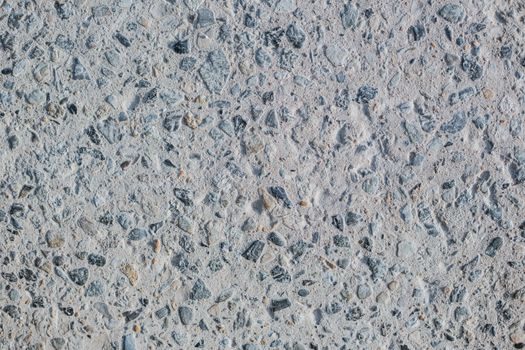
Use OPC (delivered as bagged cement or via ready-mix concrete truck) when: structural concrete is being placed (foundations, columns, beams, slabs); masonry mortar is being mixed in volume >2 m³/day and the sand source is consistent; the spec calls for a specific cement class such as CEM I 42.5 R for early-strength stripping; or the binder is part of a multi-component system where the contractor wants direct control over water/cement ratio, additive type, and sand grading. Site batching wins on raw-material cost: bagged CEM I 42.5 R trades at 80-150 USD/t in most markets, while an equivalent dry-mix tile adhesive lands at 300-600 USD/t [S3].
Use factory dry-mix mortar when: the application is thin-bed tile adhesive, wall putty, plaster, grout, self-levelling screed, thermal-insulation adhesive, or repair mortar; the jobsite lacks a weigh-scale, paddle mixer, or QA lab; batch-to-batch colour and strength reproducibility matters (facade plaster, exposed concrete repair); and the total volume is small enough that a 25 kg bag or 1 t big-bag handles it. Dry-mix's real economic argument is not material cost, it is reduced rework, fewer QA failures, and lower skilled-labour hours on site.
Do NOT use dry-mix mortar in place of structural concrete: even the strongest CT-C30-F7 self-levelling screed at 30 MPa 28-day compressive is an underlayment product, not a primary structural element; do not pour it into a column or beam. Conversely, do not use site-mixed OPC + sand for thin-bed tile adhesive on a 600×600 mm porcelain panel: the open time, sag resistance, and 1 MPa adhesion spec will not be hit without the factory-dosed cellulose and redispersible polymer.
Comparison: OPC, Dry-Mix Mortar, Ready-Mix Concrete
Three options, four decision axes (composition, on-site labour, tolerance, application): [S1]
Composition: OPC = single-component binder dosed with site-sourced sand + water; Dry-mix mortar = multi-component binder+aggregate+additive blend dosed with water only; Ready-mix concrete = binder+coarse aggregate+fine aggregate+admixture+water batched at a plant and delivered in a truck. On-site labour: OPC is highest (weighing, sand handling, mixing), dry-mix is lowest (open bag, add water, mix), ready-mix is moderate (chute/pump placement). Application fit: OPC = structural concrete + general masonry; dry-mix = thin-bed adhesive, plaster, putty, grout, screed, repair; ready-mix = any structural pour >1 m³.
Equipment, Storage, and Jobsite Handling
Bagged OPC and bagged dry-mix share the same shelf-life constraint: 6-12 months in dry storage, with bag-stack height ≤10 layers to avoid compacting the powder; silo-stored dry-mix and OPC extend shelf life and remove bag-handling labour but require a 10-30 t silo with level sensors and a screw conveyor [S3][S4].
For dry-mix plants, a typical 10 t/h automatic line includes a 50-100 t cement silo, a 30-80 t sand silo, twin-shaft paddle mixer (60-180 s cycle), bucket elevator, finished-product silo, and a valve-bag packer at 8-12 bags/min [S4]. The same equipment stack is also sold as a tile-adhesive-specific line with an additional dry-powder additive dosing skid for redispersible polymer and cellulose ether [S3].
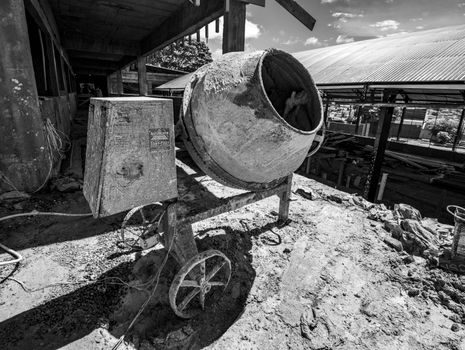
For OPC-only or dry-mortar prep on a small site, the realistic hardware list is a 100-200 L drum mixer, a 50 kg platform scale, and a measuring jug for water; this delivers ±5% batch tolerance, fine for masonry mortar and non-structural plaster, not fine for thin-bed adhesive.
Standards, QA, and Failure Modes
Key reference standards: EN 197-1 for cement composition and strength class; EN 998-1 for factory-made rendering/plastering mortar (GP, LW, CR, OC, R, T categories); EN 12004 for tile adhesive (C1, C2, D1, D2, R1, R2 classes by tensile adhesion); EN 13813 for screed materials (CT-C30-F7 and similar). For epoxy-resin mortar overlays and patches on hydraulic structures, the Chinese power-sector code [S1] DL/T 5193-2004 governs composition, performance, and testing of epoxy mortar used on dam concrete and turbine parts.
Top failure modes by product: site-mixed OPC mortar — sand grading shift, additive overdose, low adhesion; dry-mix tile adhesive — wrong water ratio (1 L water overshoot drops adhesion 0.2-0.4 MPa), substrate not primed, open time exceeded; ready-mix concrete — slump loss in transit, late placement, poor curing in the first 7 days. Spec discipline plus a tested MTC trail is the cheapest insurance against all three.
For procurement leverage and grading discipline, the steel-reinforcement buying guides translate the same QA logic: see Steel Strand vs Welded Steel Mesh: Function, Spec, and Selection for the spec-driven selection frame that applies to any bagged or bulk construction input.
Trackable signals for the next cycle: (1) supplementary-cementitious-material dry-mix formulations with 40-50% OPC replacement reaching EN 998-1 GP class IV at industrial scale [S2]; (2) the Chinese dry-mortar equipment supply chain continuing to push 10-30 t/h semi-automatic plants into Southeast Asia and Africa at sub-200 k USD FOB price points [S3][S4]; (3) revision activity on EN 12004 adhesive classes and EN 13813 screed classes as polymer-dosage ceilings move.