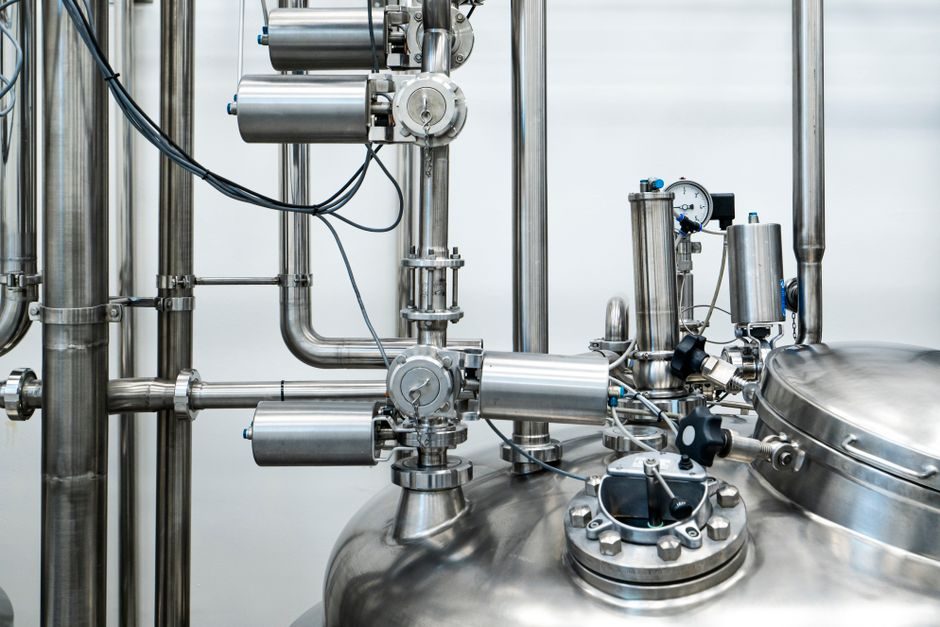
Field installation of steel pipe is governed by pipe-specific standards: AWWA M11-2004 (the 9.41 MB water-transmission guide) for waterworks, API 5L for oil and gas line-pipe, and project-specific epoxy/galvanic coating specs for corrosion control [S3][S1].
A 5-inch API 5L seamless line-pipe currently ships in 25 m.t. minimum orders at 1000 m.t./month supply capability out of Tianjin, the practical baseline for typical hydrocarbon service installations [S1]. Hot-dip galvanized pipe from integrated Tianjin producers remains the dominant above-ground water and structural choice in 2026 [S2].
Receiving Inspection: Mill Cert, Dimension Check, Handling
Every seamless steel pipe shipment must arrive with a mill test certificate (MTC) cross-referenced to the API 5L heat number, with verified OD, wall thickness, and chemical composition [S1]. The seamless variant is formed by drawing a solid billet over a piercing rod to create the hollow shell — no weld seam means no seam-defect risk in pressure service, which is why seamless historically carried the higher-pressure rating [S1].
Receiving acceptance typically gates on three checks: visual for surface defects (gouges, laminations), dimensional for OD/wall tolerance, and document for MTC traceability. Pipes handled with bare slings cut into the coating; end caps must stay on until the joint is made to keep the bore clean for hydrocarbon service [S1].
Route Survey, Trench Geometry and Support Spacing
Route staking should freeze pipe centerline, grade, and trench width before excavation. Trench width generally clears the pipe OD by 200-300 mm each side to permit compaction of the embedment against the barrel; bell holes at every joint are required for steel pipe couplings and flanges so the joint bears on the barrel, not the socket. [S1]
Above-ground runs follow a different rule set: support span is a function of diameter, wall, fluid weight, and allowable deflection — and AWWA M11-2004 remains the engineering reference that project engineers reach for first on water-transmission steel pipe, with the document still listed as 现行 (current) on the standard-portal record [S3]. The 9.41 MB guide covers design and installation in a single volume, which is why it persists as a desk reference for transmission main design even outside the AWWA membership [S3].
Joining Methods: Welding, Flanged, Mechanical Coupling
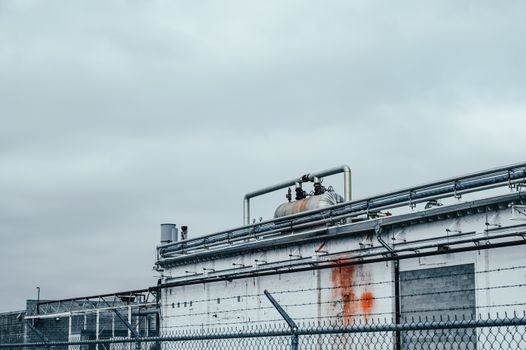
The seamless shell eliminates the longitudinal seam variable, so the welder is qualifying only the girth weld against the API 5L chemistry [S1].
For waterworks galvanized runs, flanged joints or mechanical couplings (Victaulic-style or equivalent) are common because the hot-dip coating must be protected from the heat of in-place welding; galvanized line-pipe producers in the Tianjin cluster ship to both welded and grooved-end customers [S2]. Comparison of the three joining routes on the dimensions that matter:
Joining-method comparison for 5-24 inch steel pipe:
- Welded (butt / lap): highest pressure rating, requires qualified welders + NDE, slower, no disassembly. Best for buried transmission mains and hydrocarbon service [S1].
- Flanged: easy alignment, easy disassembly, lowest pressure ceiling, heaviest in-line weight, requires torque-controlled bolting. Best for plant piping, pump headers, valve tie-ins [S2].
- Mechanical coupling (grooved or sleeve): fastest install, accommodates small angular deflection, coating-friendly (no field weld heat). Best for galvanized water, fire-protection mains, and above-ground plant [S2].
Corrosion Protection: Galvanizing, Epoxy Lining, CP
Hot-dip galvanizing to ASTM A53/EN 10255 standards is the default shop-applied coating for water, structural, and fire-protection pipe; producers like Tianjin Yusheng — founded 2002, integrated producer/trader/processor based in Xinxing Industrial Park, Daqiuzhuang Town, Jinghai County — supply both bare and hot-dip galvanized tubular to construction and metallurgy buyers [S2].
For buried service, the layered system is shop epoxy + field joint coating + cathodic protection. The standard gate that drives all of this is the project specification: AWWA M11-2004 for water, API 5L line-pipe coatings for oil and gas [S3][S1]. For aggressive produced water or CO2 service, the line-pipe spec escalates to CRA-lined or solid-corrosion-resistant alloy — see the spec mapping in Steel Pipe Types and Classifications: A 2026 Spec Reference for the full grade and coating table.
Backfill, Bedding and the Buried-Pipe Rule
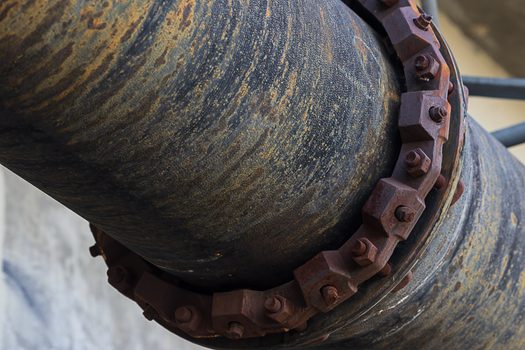
Backfill procedure is the single largest source of buried-pipe failures, and AWWA M11-2004 is explicit: granular embedment from 150 mm below the barrel to 300 mm above the pipe, compacted to a controlled density, before native backfill is allowed on top [S3].
Two field rules worth burning in: never drop large stones directly on the barrel, and never use wheeled compaction equipment directly over the pipe until cover exceeds 1.0 m. The pipe is designed for the internal pressure, but the embedment stiffness is what keeps the ring from deflecting under soil and traffic load — see the field-welding and bedding discipline laid out in the Cast Iron Installation Guide: Bed Plate, Guide Pillars and Field Welding Rules for adjacent large-bore handling practice that translates directly to steel.
Hydrostatic Test and Acceptance
Field hydrostatic test at 1.5 × design pressure (typical for water transmission per AWWA M11 guidance) held for 2 hours is the standard acceptance gate; leak rate is measured by make-up water, not by pressure decay alone [S3]. For API 5L line-pipe in hydrocarbon service, the project hydrostatic test pressure and hold time are set by the pipeline code referenced in the project spec, not by the line-pipe standard itself [S1].
Records to retain: pressure-vs-time chart recorder strip, calibrated gauge certificates, test water source (potable, dechlorinated, or chemically inhibited depending on service), and visual sign-off on every joint. If the test fails at a field-welded girth, the repair cycle is cut-out, re-weld with the original WPS, re-NDE, then re-test — there is no patch-and-go on a pressure-containing weld [S1]. For non-circular product categories on adjacent specification work, the Pallet Rack Installation: Site Prep, Anchoring and Commissioning Gates reference covers the same accept-and-gate logic for storage structures.
Common Failure Modes and What to Watch For
Three failure modes cover most field incidents: coating damage during backfill (uncatalogued holiday → external corrosion cell), insufficient embedment stiffness (ring deflection → buckling under traffic load), and welded-girth defects missed by incomplete NDE. Each is preventable at the gate written into the spec — the spec, not the field, is the actual quality system. [S2]
A fourth category, more subtle, is galvanic incompatibility at the joint: a stainless flange against a galvanized steel pipe run without an isolating gasket creates a corrosion cell that consumes the galvanized coating within months. Dielectric unions or isolating gaskets at every transition are the cheap fix; the project spec must call them out [S2].
Closing reference: the Tianjin-sourced API 5L seamless supply pipeline (25 m.t. MOQ, 1000 m.t./month capability) and the integrated Tianjin galvanizing mills define the 2026 baseline of availability, while AWWA M11-2004 remains the design bible for water-transmission steel pipe work [S1][S2][S3].
For component-level specifications, see linear guide.