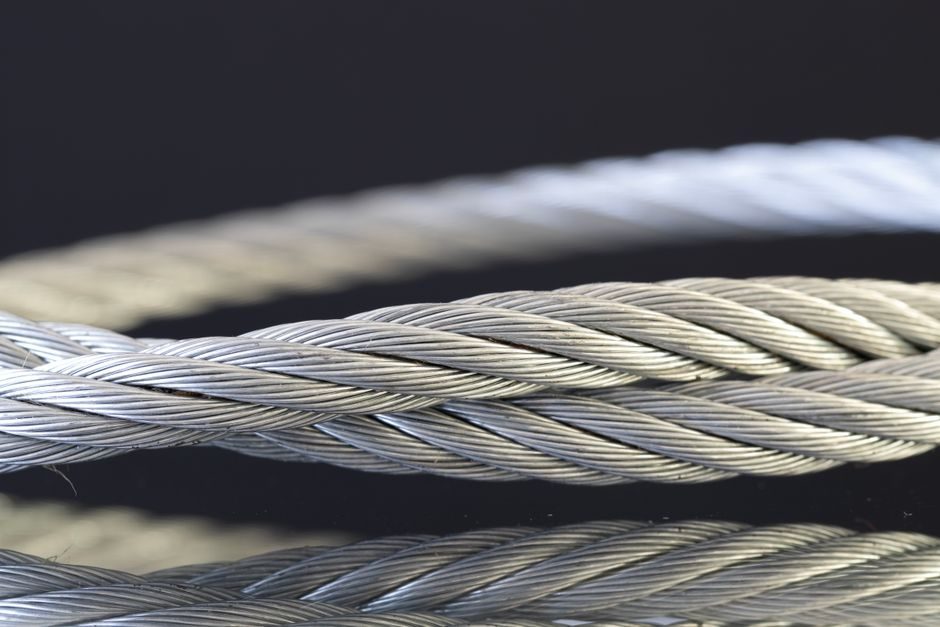
Prestressing strand installation in precast and post-tensioned concrete is anchored by three governing references: BS 5896:2012 for the product itself, ASTM A1081 (formally adopted from the NASP pullout test) for bond qualification, and the AASHTO LRFD / ACI 318 transfer-length equations that predict end-slip behaviour after release [S2][S3].
The default US configuration is 12.5 mm (0.5 in.) diameter, Grade 270 seven-wire low-relaxation strand, tested under the large block pullout test (LBPT) and the North American Strand Producers (NASP) test; the two showed a strong correlation (R² = 0.93) in the Arezoumandi et al. study on self-consolidating concrete (SCC) [S2]. In the UK market, plain and indented strand to BS 5896:2012 is the parallel reference, supplied through independent stockholders rather than mill-direct [S3].
Product Scope: Wire, Strand and Indented Variants
BS 5896:2012 covers both indented prestressing wire and plain or indented seven-wire strand, and is the product standard most often cited on UK stockholder datasheets [S3]. Grade 270 is a minimum ultimate tensile strength designation (270 ksi, ≈ 1860 MPa) — the numerical label, not a yield figure, and a frequent source of confusion in cross-border procurement.
For installation, the practical distinction is between <strong>pretensioning</strong> (strand stressed against an abutment before concrete placement, common in precast plants) and <strong>post-tensioning</strong> (strand stressed inside a duct after the concrete has cured, common in bridge and slab construction). prestressing strand selection between the two paths drives ducting, anchor head, and grout choices downstream.
Bond Performance: NASP vs LBPT and the SCC Question
The NASP test is now formally adopted as ASTM A1081 and, in the Arezoumandi et al. dataset, passed all three concrete types while the LBPT passed only one of three — meaning LBPT tends to be more conservative when rejecting or accepting strand against set bond limits [S2]. For relative comparison between strand sources, both tests are rated "fairly accurate"; for absolute acceptance, the NASP/ASTM A1081 protocol is the more permissive gate [S2].
Statistical analysis in the same study confirmed that self-consolidating concrete (SCC) mixes produced <strong>higher</strong> bond strength than conventional concrete (CC) — addressing the long-standing industry concern that SCC's reduced coarse-aggregate content and high admixture loading would compromise strand bond [S2]. This matters for precasters evaluating SCC mix changes, since bond directly governs transfer length and development length. For an overview of the steel substrate used to draw the wire, see the steel strand reference page.
Transfer Length, End Slip and the Induction-Heating Variable
Measured transfer lengths on modern strand have run significantly longer than AASHTO LRFD-10 and ACI 318-14 equations predict, and the prevailing hypothesis points to the production process: today's strand is typically heated by induction, whereas the original process used convection heating at much higher temperatures, which is thought to have improved surface condition and bond [S2]. This is a process-quality variable that standard equations do not yet capture.
End slip at release is the field symptom of inadequate bond. Acceptance thresholds are typically expressed as a fraction of strand diameter (commonly ≤ 6 mm for 12.5 mm strand under standard release conditions), but the exact pass/fail value must come from the project-specific drawing and the relevant AASHTO LRFD or Eurocode 2 clause — not from a generic rule of thumb.
Handling, Dispensers and Site Storage
Megasteel's UK stockholder model uses a strand dispenser system and labels "Handling & Safe Prestressing Information" as a first-class product page alongside the strand itself — a signal that field handling is treated as part of the deliverable, not an afterthought [S3]. The performance logic stated on that page is direct: "In prestressing applications, performance is governed by the weakest wire, not the average strength," which is why reducing within-coil variation matters more than chasing peak tensile numbers [S3].
For site crews, the practical handling gates are: (1) keep coils off the ground on timber battens or the supplier's rack; (2) unroll only with a purpose-built dispenser, never by hand from a stationary coil; (3) inspect for surface corrosion, oil contamination, and broken wires before stressing; (4) re-check the stressor's calibration certificate — hydraulic jack drift is a common hidden cause of under-stressing. For a comparison of how steel forms stack up against plate and pipe in structural applications, see Steel Plate Advantages and Disadvantages: A 2026 Spec Reference.
Common Failure Modes and When to Reject, Not Repair
Three failure modes dominate field call-backs: (a) <strong>excessive end slip at release</strong>, root cause usually inadequate bond or under-stressing — corrective action is to re-pull and verify jack pressure, or to abandon the bed and recast if the slip exceeds the project's specified limit; (b) <strong>wire breaks during stressing</strong>, root cause typically a damaged or corroded wire at the anchor zone — replace the strand, do not attempt to splice or weld; (c) <strong>long transfer length with visible cracking at member ends</strong>, root cause often low concrete strength at release — hold the release until cylinder breaks confirm the design release strength, typically 28–32 MPa for standard pretensioned members. [S2]
Do not attempt field repair of any strand that has yielded, kinked, or lost more than 5% of its cross-section to corrosion. Cut out and replace the affected length; the cost of a splice failure in a prestressed member is structural, not economic. For projects that move from prestressed concrete into adjacent steel-pipe or rack-installation scopes, the Steel Pipe Types and Classifications: A 2026 Spec Reference page covers the matching material-grade gates.
Specification Comparison: Pretension vs Post-Tension Install
Decision criteria for the two installation paths: <strong>Anchorage system</strong> — pretension uses bulkheads and chucks in the casting bed, post-tension uses multi-strand anchors and wedges inside a duct; <strong>concrete strength at stressing</strong> — pretension requires release strength (typically 25–35 MPa), post-tension requires the design 28-day strength before stressing; <strong>corrosion protection</strong> — pretension relies on concrete cover and crack-width control, post-tension adds grouted duct or greased/sheathed strand for additional protection; <strong>field tolerance</strong> — pretension is factory-controlled and dimensionally tight, post-tension allows geometry correction on site but introduces duct-injection quality as a separate acceptance gate. The mechanical-engineering overlap with rack and frame installations is covered in Pallet Rack Installation: Site Prep, Anchoring and Commissioning Gates. [S2]
Trackable signals to watch over the next review cycle: any revision of BS 5896 (current 2012 issue) that tightens indented-wire geometry, and any AASHTO LRFD update that revises the transfer-length equation to account for induction-heated strand surface condition [S2][S3].
Spec-level background on the components involved: linear guide.