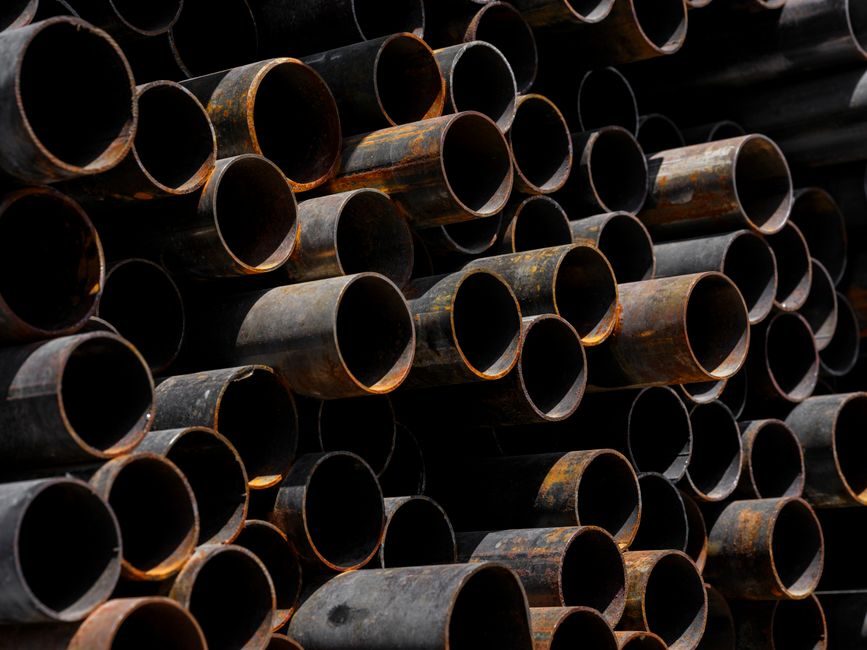
TCO in pipework follows the same envelope as IT asset TCO [S4]: purchase, use, maintenance, support, disposal — applied per linear meter of installed line. The dominant cost line shifts with the service: above-ground process water is material-light, while buried water injection or sour hydrocarbon lines are dominated by anti-corrosion measures and inspection labour [S4].
The 5 Cost Lines in a Steel Pipe TCO Model
A defensible pipe TCO splits into five buckets [S4]: acquisition (material + factory test), fabrication (cutting, beveling, bending), installation (stringing, welding, NDT, lifting), operation & maintenance (inspection, repair, internal treatment, external coating maintenance, leak loss), and end-of-life (decommissioning, scrap credit). Acquisition is the only line a procurement officer can read off a quote; the other four require service-condition inputs and a design life assumption, typically 20-30 years for process piping and 30-50 years for transmission mains [S4].
For a DN500 process water line in mild climate, the rough split is acquisition 30-35%, fabrication + install 35-40%, O&M 20-25%, end-of-life 5-10%. For a DN300 buried sour crude gathering line, the split inverts: acquisition 25-30%, fabrication + install 30%, O&M 35-40% (driven by NACE MR0175 / ISO 15156 material upgrades, corrosion inhibitor injection, and intelligent pigging), end-of-life 5%. The contrast is why seamless steel pipe is mandatory in high-pressure hydrocarbon service, not an upgrade.
Material Choice Drives Acquisition AND Downstream Cost
Carbon steel (ASTM A106 Gr.B, API 5L X42-X65) is the cost baseline; stainless 304/316 raises acquisition roughly 4-8x, duplex 2205 another 1.5-2x, and super-austenitic / nickel alloys (Alloy 825, 625) 8-15x over carbon. The TCO question is payback: a line carrying chlorides above 200 ppm at 60 °C will perforate carbon steel in 5-10 years, so the 5x material premium is recovered in avoided downtime and avoided environmental cleanup. [S1]
PE pipe (PE100, PE4710) enters the comparison at roughly 30-50% of the installed cost of carbon steel for non-pressure or low-pressure water and gas, but its 50-year design life, fused-joint integrity, and zero external corrosion budget make it the TCO winner for municipal water and gas distribution up to PN16 (SDR 11). Beyond PN16, or above 60 °C service, steel-plastic composite pipe bridges the gap with a steel core for pressure rating and a polymer liner for chemical resistance.
Selection Criteria: Service Environment First, Then Schedule, Then Price
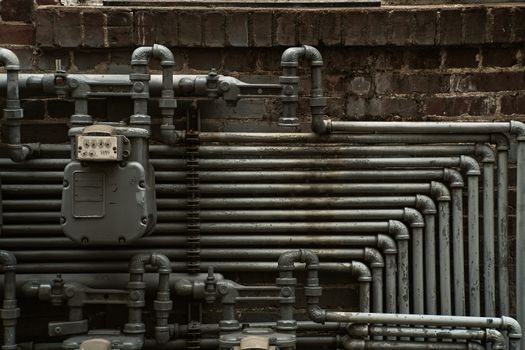
Engineers should rank five criteria before reading any quote [S4]: (1) internal fluid — temperature, pressure, chemistry, solids content; (2) external environment — buried, submerged, atmospheric, sour (H₂S), coastal; (3) design life — 20, 30, or 50 years; (4) regulatory regime — ASME B31.3, B31.4, B31.8, EN 13480, or water/gas utility standards; (5) inspection regime — visual, UT, RT, intelligent pig, or none. The lowest unit price that fails criterion 1 or 2 is the most expensive choice over the design life [S4].
A direct comparison for DN300, 5 km, 30-year design life in three services: | Service | Material baseline | TCO driver | Typical winner | |---|---|---|---| | Municipal water PN16 | PE100 / carbon steel | Install + joint count | PE100 PE pipe | | Process steam 250 °C | A106 Gr.B / P11 | O&M + inspection | A106 Gr.B with planned replacement | | Sour crude gathering | L360 / carbon + inhibitor | O&M + NACE compliance | L360 with chemical program | For a 30-year arithmetic, the steam line is essentially an A106 baseline; the municipal water line is a PE100 baseline; only the sour line requires genuine TCO modelling because each failure mode (HIC, SSC, external corrosion under disbonded coating) carries a quantifiable downtime and product-loss cost [S4].
Who TCO Modelling Is For — and Who Should Skip It
TCO modelling pays back when the design life exceeds 15 years, the line is buried or difficult to access, the service fluid is corrosive or high-purity, or regulatory inspection is mandatory. Above-ground low-temperature water or air lines under 100 m rarely justify a TCO spreadsheet — the procurement price dominates and O&M is essentially zero. [S2]
Above that, the per-meter TCO delta between carbon, stainless, duplex, and PE typically exceeds the engineering cost of the model within the first 500 m of installed length.
Failure Modes That Invalidate a Low-Ball Quote
Three failure modes consume TCO budgets when a line is underspecified: (1) external corrosion under disbonded FBE coating on buried carbon steel — typically 0.2-0.5 mm/yr, requiring recoating or replacement at year 15-20; (2) internal corrosion / erosion in wet sour service, where carbon steel can lose 1 mm/yr without chemical inhibition; (3) fatigue / vibration at small-bore branches and pipe clamp supports, where unsupported spans drive year 5-10 leaks. Each is preventable at acquisition with a 5-15% material or design premium, but unrecoverable once the line is commissioned and buried. [S3]
A 2026 reference guide to the available material families is laid out in the Steel Pipe Types and Classifications: 2026 Spec Reference companion article.
Standards, Sourcing and Audit Trail
Specifying TCO without anchoring to standards leaves the model open to challenge. The governing references by service: ASME B31.3 for process piping, B31.4 for liquid hydrocarbons, B31.8 for gas transmission, EN 13480 for European pressure piping, AWWA C200/C203 for water steel pipe, API 5L for line pipe, ASTM A106/A53 for seamless and welded carbon, ASTM A312 for stainless, NACE MR0175 / ISO 15156 for sour service, and ISO 3183 for pipeline transportation systems. Each fixes the material, test, and traceability expectation that the acquisition line of the TCO must meet [S4].
Sourcing signals to track in the next procurement cycle: published mill test certificate (MTC) per EN 10204 3.1 or 3.2, third-party inspection by an IACS member body, and documented welding procedure specification (WPS) per ASME IX or ISO 15614. A total station survey of installed alignment at handover closes the as-built gap that drives year-3 stress-corrosion failures on field-bent pipe.
For peer comparisons on lifecycle cost methodology, the LPDC TCO: Five Cost Lines That Drive a 10-Year Spend reference applies the same five-line envelope to plastics processing, and the Skid Steer TCO: How Engine, DPF and Hydraulics Decide Real Lifecycle Cost article covers the mobile-equipment analogue.