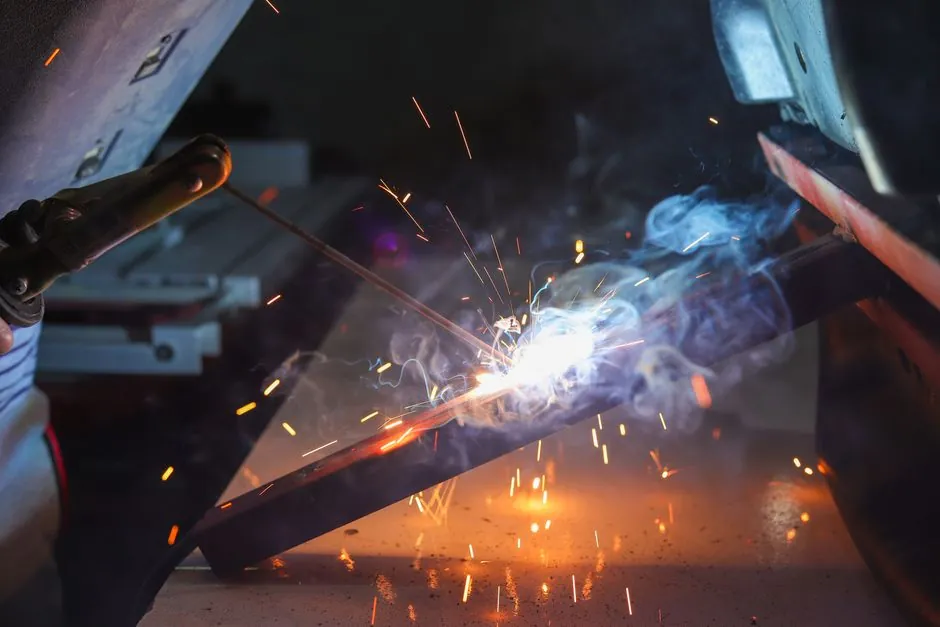
Drawn arc stud welding with a ceramic ferrule is the standard process for studs from roughly 3 to 25 mm diameter, run at welding currents up to about 3,000 A and weld times up to about 3,000 ms, with the workpiece on the positive pole of the power source [S1].
The ferrule is a single-use tool: a refractory ceramic ring is placed around the stud, and after the arc collapses the ring is removed by striking and discarded, so every weld consumes one ferrule [S1][S6].
What the ferrule actually does during the arc
The ferrule performs four overlapping jobs in the few hundred milliseconds the arc is live. First, it acts as a physical mould: the ring-shaped cavity confines the molten metal so the bead does not spread into a messy, low-fusion fillet [S2][S4]. Second, it is an oxygen barrier, shielding the weld pool from atmospheric contamination that would otherwise drive porosity and lower ductility [S2][S4][S7]. Third, it concentrates the arc heat inward toward the stud tip and parent plate, which lets the process run at the high currents that drawn-arc work demands [S3]. Fourth, it reduces UV and spatter ejected into the surrounding area, which matters on site where operators work in line of sight of the gun [S2][S4].
Dynamic Ceramics describes the same four-effect envelope as "concentrates the heat generated from the welding gun, prevents oxidation, and retains the molten metal in the weld zone", with arc shields specified as single-use consumables [S3]. Refractory formulations also slow cooling slightly, which reduces solidification cracking risk on the fillet [S7].
Step-by-step: how the ferrule is loaded, used, and removed
The operator slides the stud into the welding gun chuck and, where specified, drops the ceramic ferrule over the stud so it sits on the parent plate [S1][S5]. A lift mechanism in the gun raises the stud a few millimetres, drawing a low-current pilot arc, after which the main high-current arc is struck between the stud tip and the workpiece [S1][S5]. At the end of the set welding time the stud is plunged into the weld pool, the power source switches off, the pool solidifies, and the ferrule is then knocked off the stud by striking it; the ring fractures and is discarded [S1][S6].
KÖCO's published sequence is identical in five steps: place stud on plate, lift and draw arc, melt stud tip and parent plate, plunge stud into the pool, and end with a cross-sectional joint [S1]. The discarded ferrule is the visible tell that a weld was made under a shield rather than under gas.
When a ferrule is required, and when it is not
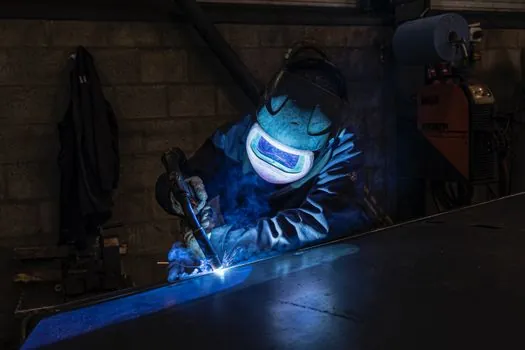
Ceramic ferrules are tied to the drawn-arc process, not to stud welding as a whole. The ring is used particularly often above about 10 mm stud diameter, where the higher current and longer arc time would otherwise throw metal out of the joint [S1]. Short-cycle stud welding runs shorter arcs at lower current and replaces the ferrule with inert shielding gas, since the molten pool is too small to need mechanical containment [S2][S4]. Capacitor-discharge (CD) stud welding uses a fast electrical discharge and contact ignition, so there is no sustained molten pool at all and no ferrule is fitted [S2][S4].
Because the ignition tip geometry on a ferrule-style stud is different from a gas-shielded stud, the two are not interchangeable, and switching between them requires changing the stud, not just the consumable ring [S1]. For process engineers weighing the two, ceramic rings tend to be the more robust site choice because they tolerate a little more surface contamination and wind, while shielding gas needs clean delivery and tighter fit-up [S1].
Ceramic ferrule vs shielding gas vs no shield: a decision comparison
On four real decision criteria, the three options line up as follows. Arc containment: ceramic is best (mechanical mould), gas is good for small pools, CD is unnecessary. Stud diameter range: ceramic is the workhorse above 10 mm, gas suits short-cycle below about 12 mm, CD typically handles small-diameter fasteners under about 10 mm [S1][S2][S4]. Site tolerance: ceramic forgives minor surface dirt and drafts, gas needs clean delivery and shielding geometry, CD is the most forgiving on fit-up because there is no sustained pool [S1][S2][S4].
The same logic is why a related structural joining reference flags sealant versus adhesive choices for load-bearing joints, where the wrong consumable silently downgrades capacity: in stud welding, picking the wrong shield mode produces the same class of failure, a weld that looks fine but underperforms in a bend test [S1].
Quality control, common defects, and limits
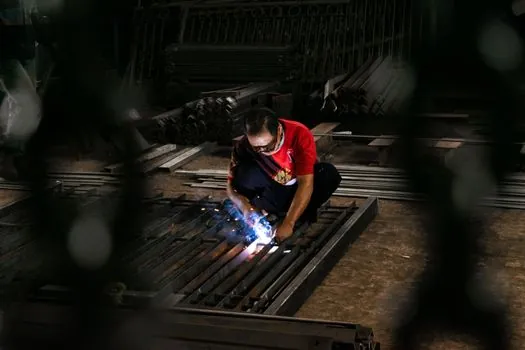
The most common defects in ferrule-shielded drawn-arc welds are not current or time errors, but a wrong ferrule size and dirty parent-plate surfaces [S1]. KÖCO's published guidance is explicit: if the bead is not closed all the way round, first check the fit of the ceramic ring and the cleanliness of the component, only then adjust current and time [S1]. Routine quality verification is visual inspection of the fillet plus, depending on the application, a bend test on sample studs [S1].
There are hard limits. A ferrule is single-use; reusing a cracked or partially fused ring destroys the mould geometry and the shielding. A ferrule will not compensate for an inadequately cleaned or oily surface, and it cannot rescue a mis-set current/time combination. As a rule of thumb, if the process runs stably with a ferrule on a given stud and joint, it is usually more robust on site than swapping in shielding gas, which adds a gas regulator, hose, and flow check to the setup [S1].
Manufacturing, materials, and supply notes
Ferrules are pressed and fired refractory ceramic parts, typically run through in-house clay preparation, pressing, and kiln firing to control geometry [S3]. The bodies are formulated to withstand the thermal shock of a ~3,000 A arc for up to ~3,000 ms without cracking prematurely, while still being brittle enough to break away cleanly after the weld cools [S1][S3][S7]. Major drawn-arc stud suppliers ship the ferrule matched to the stud diameter as standard, so the consumable choice is bundled with the fastener rather than specified separately [S2].
For larger studs above 10 mm, where shielding gas becomes less practical, the ferrule essentially defines the joint fillet geometry, which is why most OEM datasheets list a specific ferrule part number per stud size rather than a generic "ring" [S1][S2].
Trackable signals to watch: AWS D1.1 structural welding code updates that touch stud-welding inspection frequency, and any OEM move to ship matched ferrule/stud kits as the default rather than an optional accessory.
The underlying component specifications are covered under arc welder, stud welder, and o ring.
Background reading: Why a sealant cannot replace a structural adhesive in load-bearing joints.