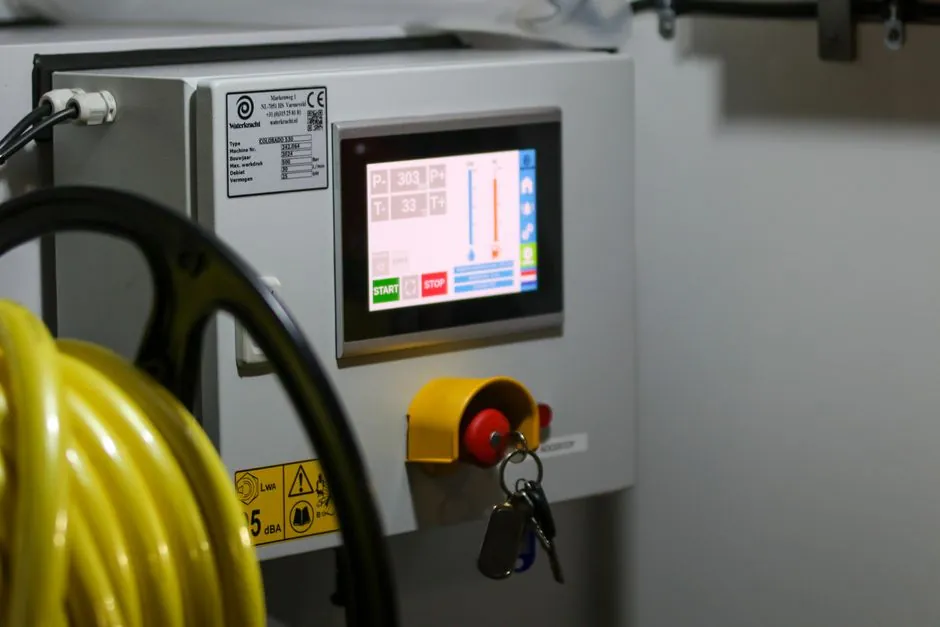
A complete wet-mix spraying setup is the integration of a concrete pump, a spraying arm with nozzle, an additive (accelerator) pump, an air compressor, a carrier chassis, and a control system, all electrically and hydraulically linked so that flow, accelerator dosage, and boom position stay in lockstep [S1][S2]. Each of these sub-systems can be sourced or specified separately, but in production they behave as one machine, and a weak link in any one of them limits the entire rig's output rate and lining quality [S1].
The same functional split applies to dry-mix equipment, except that the pressure vessel and the dry-mix gun (or gunite machine) replace the concrete pump, and a predampener is added between the gun and the nozzle to condition the mix before it leaves the hose [S3]. Wet-mix dominates mechanised production work because the pump delivers a homogeneous, pre-mixed concrete at a controlled rate, which is the basis of the low-pulsation flow that reduces rebound and supports consistent layer thickness [S2].
Concrete Pump: Double-Piston Flow for Low-Pulsation Output
Wet-mix shotcrete rigs use double-piston pumps as the standard architecture, chosen specifically because the two pistons can be timed to overlap their discharge strokes and flatten the flow curve at the nozzle [S2]. The design target is "low pulsation for a constant concrete flow", because any pulsation at the hose end shows up as uneven layer thickness and as rebound spikes, and both effects eat into the rated output of the machine [S2]. In Putzmeister's mechanised line, the concrete pump is built in-house and is "specially designed for concrete spraying, guaranteeing high performance, low pulsations and a long life for the wear parts" [S1].
For dry-mix systems the equivalent hardware is a pressure vessel plus a dry-mix shotcrete gun, sometimes still marketed as a "gunite machine", which meters the dry material into a compressed-air stream at the gun body and pushes it down the hose to the nozzle, where water is introduced by the nozzleman [S3]. This is why dry-mix rigs remain a lighter, simpler option for repair, slope stabilisation, and remote-site work where the project scale does not justify a full piston-pump spread [S5].
Spraying Arm and Nozzle: Reach, Geometry, and the Air/Nozzle Match
The spraying arm positions the nozzle at the work face and, on modern mechanised units, delivers a vertical spraying reach up to 17 m, which removes the need for scaffolding or telescopic elevating platforms in the heading [S1][S2]. Concrete, accelerator, and compressed air are mixed in the spraying head and ejected through the nozzle, and the nozzle diameter, spraying distance, and air supply are interlocked, not independent variables [S2].
The single most cited sizing example in the underground-machinery literature is the air/nozzle pairing: 12 m3/min of compressor air through a 65 mm nozzle does not deliver enough kinetic energy, whereas the same 12 m3/min through a 35-40 mm nozzle at a 1-2 m spraying standoff does, and the difference shows up directly in compaction quality and rebound rate [S2]. Get that match wrong and the operator sees rebound rise, density drop, and the pump being asked to push more material than actually ends up on the wall, which is why a shotcrete machine is specified as a system, not as a pump alone.
Additive (Accelerator) Pump: Synchronised Dosage for Early Strength
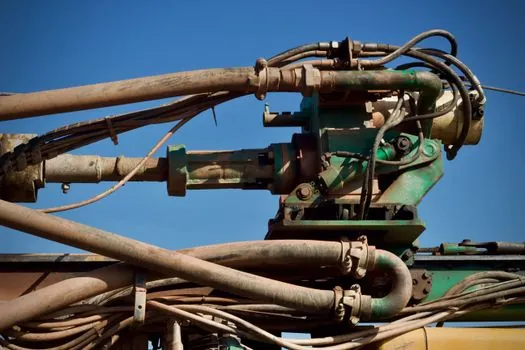
The accelerator pump is a separate, smaller metering pump, most commonly a peristaltic unit, that injects the set-accelerator into the concrete stream at the nozzle [S1][S2]. Its function is to "obtain the early resistance" required for ground-support and lining work, and its dosage must stay in a fixed ratio to the concrete flow, which is why the additive pump is electronically synchronised with the main concrete pump rather than set by hand [S1][S2].
On the dry-mix side, the equivalent dosing step is the water ring at the nozzle, controlled by the nozzleman rather than a pump, which is one of the operational reasons dry-mix remains a smaller-scale, more labour-intensive choice [S3]. In wet-mix production, by contrast, a mis-tuned accelerator pump will either under-dose (slow set, sloughing on slopes) or over-dose (flash set, plugged hose), and the control system is the only thing watching that ratio in real time [S1].
Air Compressor: Kinetic Energy, Not Just Volume
The on-board air compressor supplies the kinetic energy that carries the concrete from the nozzle to the substrate and compacts it on impact; without that energy the wet-mix stream would just fall off the wall [S1][S2]. Putzmeister's mechanised chassis offers an integrated compressor option, which makes the rig "autonomous" on a heading because it no longer needs a separate tow-behind compressor and the associated umbilical plumbing [S1].
Specifying the compressor by m3/min alone is the classic mistake, because the figure only has meaning when paired with a nozzle diameter and a standoff distance; the same 12 m3/min is insufficient at 65 mm and sufficient at 35-40 mm [S2]. Operators reading the same reference data also learn that spraying distance should sit in the 1-2 m window to keep that kinetic energy usefully transferred into compaction rather than wasted as overspray and dust [S2].
Chassis and Carrier: Underground Duty, 4WD/4WS, High-Altitude Option
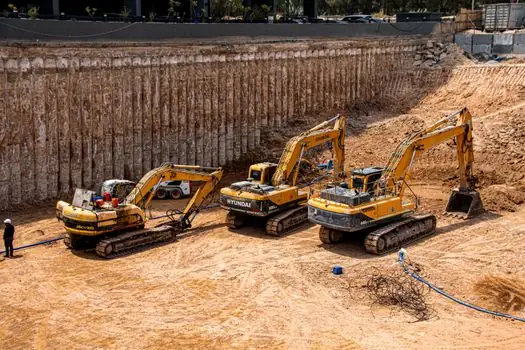
The chassis is not a truck frame, it is an underground-rated carrier built from high-resistance steel, with 4-wheel drive, 4-wheel steering, and a crab mode for tight headings, and it is rated for high ground clearance and steep off-road climbs typical of mine access drifts [S1]. On the transport side, low-profile concrete mixers feed the rig and bring features such as Automatic Altitude Compensation (AAC) for high-altitude mines and an Integrated Continuously Variable Drive (ICVD) that keeps engine torque and speed matched to reduce fuel burn and noise [S1].
For larger site installations the same functional split shows up in construction machinery and equipment fleets, where the chassis, boom, pump, and compressor each come from a different OEM and are integrated by the contractor or the sprayer maker; the boom and pump pair is the only combination that has to be engineered as a unit, because the boom has to absorb pump pulsation without shaking the nozzle off the target line [S1][S2].
Control System and Remote: The "Brain" Plus a Safe Operator Station
The control system on a modern mechanised rig has three jobs: monitor the accelerator-to-concrete ratio, manage pump safety (over-pressure, stroke-end, wear), and log spraying data for QA download [S1][S2]. Putzmeister's control system is explicitly described as "the equipment's brain", with a remote control (wireless or cabled) that lets the operator adjust concrete flow, additive dosage, boom position, and nozzle orientation from a safe standoff, which is the entire reason mechanised wet-mix spraying exists in underground work in the first place [S1][S2].
The same logic is why spraying units fall under the broader lighting equipment and electric lamps and power-distribution discipline on a heading: the rig's controller, the heading's ventilation and lighting, and the anti-static equipment for accelerator handling are all tied to the same power and bonding scheme, and a failure in any of them halts the spraying cycle. The remote-control link is normally a cable in tunnels, because radio dropouts in a rebar-and-shotcrete-lined drift are common, and the cable is the safer default [S2].
Component Comparison: Wet-Mix Mechanised vs Dry-Mix Gunite
The cleanest way to read a spraying-setup spec sheet is to line the two architectures against the same duty criteria. Wet-mix mechanised (double-piston pump, boom arm, additive pump, compressor, chassis, controller) handles high-output underground and civil work, with 17 m vertical reach and the lowest rebound at production rates; dry-mix gunite (pressure vessel, gun, predampener, hose, nozzleman-controlled water ring) handles repair, slope stabilisation, and remote-site work with a "comparatively simple operating setup" but lower output and higher rebound [S1][S2][S3][S5].
On the same four criteria, wet-mix scores higher on output rate and lining quality because pump pulsation is engineered out and accelerator dosage is automatically synchronised, while dry-mix scores higher on capital cost and mobilisation speed because the pressure vessel is a one-piece unit and there is no boom or pump truck to stage [S2][S3][S5]. The Sika Sprayed Concrete Handbook breaks the same choice down at the material level, separating dense-flow and thin-flow processes and showing that equipment selection is driven by aggregate grading, fines content, and accelerator chemistry, not just by output target [S4]. For a contractor weighing pneumatic actuator sizing on the boom's slewing drive, the wet-mix boom's duty cycle is essentially continuous and so pushes the actuator toward higher duty-class selections, while dry-mix booms cycle in shorter, more intermittent bursts [S2].
Market Signal: Where the Demand Is Pulling the Component Mix
Demand for mechanised wet-mix rigs is being pulled by underground-mine CapEx and by government-funded tunnelling, with the global shotcrete spray machines market valued at USD 2 billion in 2025, projected at USD 2.14 billion in 2026, and forecast to reach USD 3.84 billion by 2035 at a 6.8% CAGR (2026-2035); the top five players, SANY/Putzmeister, Epiroc (Meyco), Zoomlion/CIFA, Normet, and MacLean Engineering, held 41.5% of the market in 2025, and SANY/Putzmeister led with over 15.0% share [S5].
The verifiable signals to watch next are the underground-mining CapEx line of the top 20 mining companies, which reached USD 79.4 billion in 2025, and the government-agency share of shotcrete-machine demand at USD 440 million in 2025, both of which are the upstream drivers of new orders for mechanised wet-mix component sets [S5]. A contractor specifying a new rig should track those two numbers alongside the NDT equipment spend on the same headings, because lining-quality acceptance (core testing, early-strength needle penetration) is what locks in the value of the wet-mix system over its service life [S4][S5].
See also our earlier report, Pneumatic Actuator Datasheet Parameters: Air Supply and Torque Sizing.