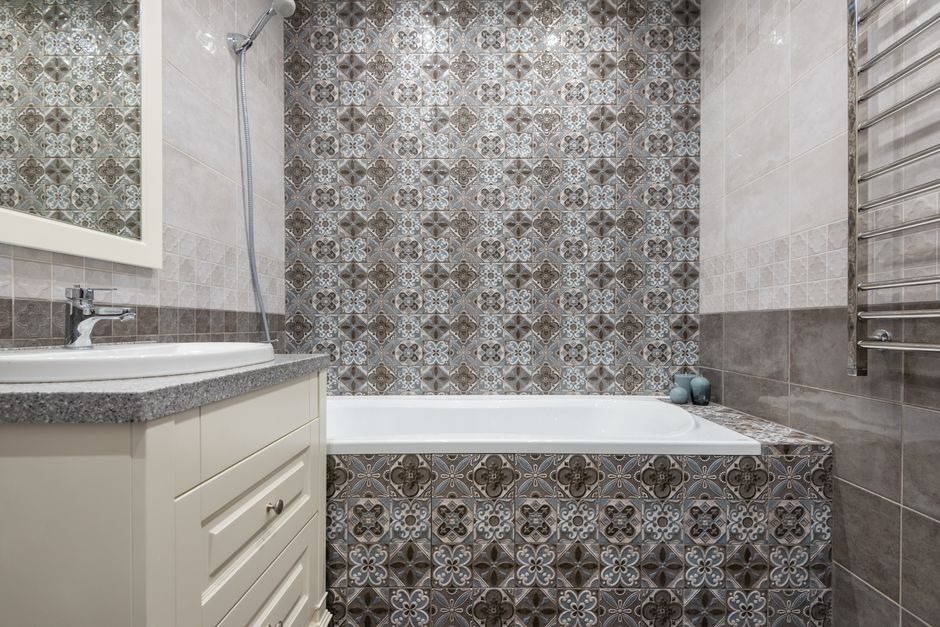
Selection of ceramic tile for any commercial or residential build reduces to three filtering numbers applied in order: water absorption per ISO 13006 (which assigns the tile to groups BIa through BIII), PEI wear class per EN ISO 10545-7, and Dynamic Coefficient of Friction (DCOF) per ANSI A137.1 Section 9.6, with the 0.42 threshold as the commonly cited minimum for level interior floors [S1].
Colour and brand become the last decision, not the first — a deliberate inversion of how most procurement sheets are still written.
ISO 13006 Water-Absorption Bands Drive Body Type and Application
ISO 13006 classifies ceramic tiles by water-absorption (E) range and pressing method. The four primary groups are BIa (E ≤ 0.5%, fully vitrified porcelain), BIIa (3% < E ≤ 6%, semi-vitreous stoneware), BIIb (6% < E ≤ 10%, non-vitreous earthenware), and BIII (E > 10%, highly absorbent wall tile) [S1]. Each band correlates with mechanical strength, frost resistance, and suitable substrate: BIa is the only group that is inherently frost-proof and the only group rated for exterior freeze-thaw exposure in most North American and European specifications [S1].
For floor tile in commercial interiors, the practical floor is BIa with E ≤ 0.5% or, at minimum, BIIa with E ≤ 3%. Anything above E = 6% is, by ISO 13006 logic, a wall product and should not be specified for foot traffic regardless of how a supplier's catalogue lists it. Procurement should always request the ISO 10545-3 test report and read the vacuum-method result, not the boil-method result, for compliance.
PEI Wear Class and Abrasion Resistance per EN ISO 10545-7
PEI (Porcelain Enamel Institute) class 1 through 5 is the rotation-rub abrasion rating adopted in EN ISO 10545-7, and it applies to glazed tiles only — unglazed through-body porcelain is rated on a different test (deep abrasion, ISO 10545-6, with a maximum 175 mm³ volume loss for BIa). PEI 1 is residential barefoot wall and bath; PEI 2 is light residential floor; PEI 3 is residential and light commercial; PEI 4 is commercial and medium industrial; PEI 5 is heavy commercial and industrial foot traffic [S1].
Specifying PEI 2 on a hotel lobby or PEI 3 on a hospital corridor is one of the most common under-spec errors. A defensible rule: any space with street shoes, rolling loads, or sand tracked in needs PEI 4 minimum, and any unglazed body in that space should carry a documented ISO 10545-6 result under 175 mm³.
DCOF, R-value and Slip: ANSI A137.1 vs EN 16165
ANSI A137.1 Section 9.6 sets the DCOF AcuTest threshold of ≥ 0.42 for level interior floors expected to be walked on when wet, measured with the BOT-3000E tribometer under a 0.05% sodium lauryl sulphate water film. Surfaces intended for barefoot wet use (pool decks, showers) typically require a higher DCOF in the 0.55–0.65 band, and inclined surfaces need a further multiplier defined in the standard [S1].
Europe references a different but parallel system: EN 16165 (the successor to DIN 51130) yields R9–R13 ratings for inclined barefoot or shod use, with R10 widely accepted as the commercial-kitchen floor minimum and R11/R12 typical for food-processing and external paving. The two systems are not numerically convertible, so a DCOF 0.50 tile and an R11 tile are both considered "slip-resistant" by their respective markets but were not measured the same way. Cross-border projects should call out both numbers and not assume parity.
A side-by-side criteria view of the three body families actually delivered to site in 2026 looks like this. Vitrified homogeneous (unglazed porcelain, often called "technical" or "through-body"): the same BIa chemistry as glazed porcelain but with no surface glaze, rated on deep-abrasion volume loss rather than PEI; common in transit terminals and food production [S1][S2].
For a decision matrix: (1) wet or exterior — must be BIa, glazed or unglazed; (2) heavy commercial foot traffic with rolling loads — prefer unglazed BIa with ISO 10545-6 ≤ 175 mm³; (3) light commercial / residential floor with design priority — glazed BIa or BIIa, PEI 4; (4) wall only — BIII is acceptable and saves weight and cost; (5) budget residential floor with low traffic and dry conditions — BIIa PEI 3 may be defensible. The matrix forces the body family before the catalog page is opened.
Production-Line Reality and What It Means for Batch Consistency
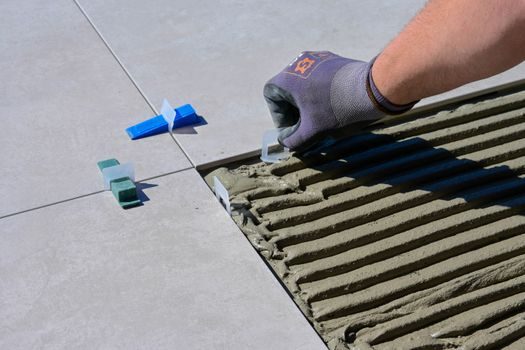
Press capacity and kiln length set the production line's nominal output — typical 2026 lines are quoted in the 8,000–25,000 m²/day band for a single kiln, with multi-layer 3D blank-storage modules inserted upstream of pressing to buffer body feed [S3].
For the specifier, the relevant consequence is shade and calibre (dimensional) consistency within a lot. EN 14411 / ISO 10545-2 splits tiles into precision grade (≤ ±0.5% deviation from work size) and commercial grade. Precision-grade tiles are required for rectified, tight-joint installations; commercial-grade tiles need wider grout joints (3 mm+) to absorb calibre spread. A polished porcelain bought at a sharp price is often commercial grade, and the jointing tells on the floor within a year. Sorting lines on a new-generation production line typically run vision-system shade and dimension checks on every piece, but that is a line-option, not a default [S2][S3].
Standards Reference List for the Specification Sheet
Procurement language should require the supplier to furnish test reports keyed to these standard numbers, not generic "complies with ISO" statements. A practical clause reads: "Tiles shall comply with EN 14411 Group BIa, E ≤ 0.5% (ISO 10545-3), bending strength ≥ 35 N/mm² (ISO 10545-4), PEI ≥ 4 (ISO 10545-7) for glazed, deep abrasion ≤ 175 mm³ (ISO 10545-6) for unglazed, DCOF ≥ 0.42 wet (ANSI A137.1 §9.6)." That single sentence filters out roughly half the catalogued options before a sample is even ordered.
Limits, Failure Modes, and Common Mis-Specifications

The most common field failure on ceramic tile is not the tile itself but the substrate: cementitious screed that has not cured the 28 days minimum, or uncoupled substrates that move under point load. Tiles rated ISO 13006 BIa with > 35 N/mm² bending strength still crack when the substrate deflects more than L/360, so the tile spec must be paired with a substrate spec (concrete strength, screed type, decoupling membrane) — a concrete admixture guide frequently drives the screed mix design that the tile warranty ultimately depends on. A second failure mode is polished porcelain specified for an exterior ramp: the polishing step closes surface micro-pores, drops DCOF below 0.42, and creates a slip hazard under wet conditions; specify an external-grade textured or bush-hammered finish instead. [S1]
Third, body type mismatch: BIII wall tile (E > 10%) installed on a floor will crush under a 1-tonne rolling load. Fourth, rectified (precision-cut) porcelain installed with 1.5 mm joints on an uneven substrate telegraphs every substrate wave; rectified is a cutting precision, not a flatness guarantee. For a project also specifying wall systems, the same rule of pairing tile spec with system spec applies to suspended ceiling tiles, where the grid tolerance and the tile tolerance must be co-ordinated against a single flatness reference.
For a 2026 procurement decision: lock the three filtering numbers (E, PEI, DCOF) in writing against the ISO 10545 test methods and ANSI A137.1 §9.6, require a sample of ≥ 1 m² from the actual production lot not a showroom piece, and verify the production line's grading and sorting capability before signing the PO. Trackable signals to watch over the next quarter are the EN 16165 pendulum test gaining ground over the older DIN ramp rating in European specifications, and tighter DCOF audit thresholds (some North American specifiers are now requiring ≥ 0.50 wet rather than the 0.42 floor) — both are moving the catalog and the project specification together.
For component-level specifications, see ceramic tile, alumina ceramic, and ceramic bearing.