
Three independent line items drive every suspended ceiling budget: the exposed grid (main runners, cross tees, wall angle), the infill panel (mineral fibre, gypsum, or aluminium), and the labour to hang, level, and finish the assembly [S1]. Specifiers who quote one of the three and assume the other two are "about the same" routinely under-run the BOM by 25-40%.
Across surveyed channels, the China-FOB grid + aluminium-panel combination is being offered at roughly US$10.00-20.00 per square metre at 100 m² MOQ on Made-in-China.com [S4], with finished-ceiling installation services in mature markets such as Australia posting median rates near US$55/m² (range US$30-85) for plaster-style work [S5]. Knowing which segment of the supply chain you are pricing — material FOB, delivered landed, or fully installed — is the first decision a buyer has to lock down.
Grid Systems: Main Runners, Cross Tees and Wall Angle
Hot-dip galvanised steel T-bar grid is the structural backbone and normally accounts for 30-45% of the material cost of a suspended ceiling assembly [S1]. The standard exposed-flange profile is a 24 mm or 15 mm T, hung on galvanised soft-steel wire (typically 2.5-4.0 mm diameter) anchored into the structural soffit at centres dictated by tile size — 600 × 600 mm and 1200 × 600 mm modules dominate the commercial spec.
Open-cell aluminium grids — visually a coffered ceiling — are a separate category with higher per-m² cost: Made-in-China.com listings show T-bar open-cell aluminium grid in the US$12/m² band at 100 m² MOQ [S4]. Buyers should treat any quote under US$8/m² FOB for a complete grid (main + cross + wall angle + hangers) as a red flag for sub-standard zinc coating thickness; verified commercial galvanised grid should sit in the US$3-6/m² band on its own.
Tile and Panel Options: Mineral Fibre, Gypsum, Aluminium
Three infill families cover ~95% of non-specialist specifications. (1) Mineral fibre / glass-wool acoustic tiles in 600 × 600 × 12-19 mm, the default office product, sit at the low end of material cost and deliver NRC 0.50-0.70 depending on texture and density. (2) PVC-laminated gypsum tiles with aluminium-foil backing, sold as "suspended gypsum ceiling" on B2B portals, add a vapour barrier and a cleanable face — Okorder lists this composite as a stocked export SKU [S2]. (3) Aluminium clip-in or lay-in panels, typically 0.5-0.7 mm coil-coated AA3003 or AA5052, sit at the premium end and pair with the aluminium grid above [S4].
On criteria, mineral fibre wins on cost-per-NRC and on replacement cycle (tiles are individually demountable for plenum access). Gypsum wins on fire rating (Class A / non-combustible core per the gypsum-plaster formulation [S2]) and on paintability. Aluminium wins on wash-down cleanability, humidity tolerance (kitchens, pools, coastal), and design — at roughly 1.5-2.5× the per-m² cost of mineral fibre at equivalent grid span. The right answer is governed by the room: a cleanroom, food line, or pool deck cannot use mineral fibre, while a back-office open plan cannot justify aluminium.
Installation Labour and Accessory Costs
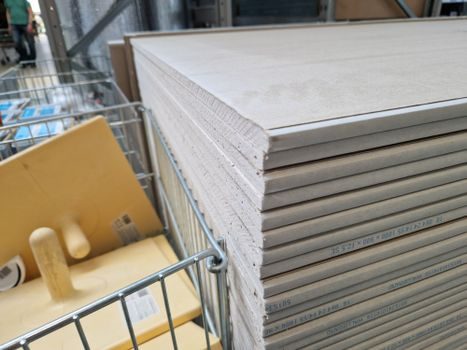
Installation is the line item most often missed at the quotation stage. The Australian cost guide for ceiling plastering — a related but distinct trade — posts a per-square-metre range of US$30-85 with a US$55 median [S5], and a comparable band applies to T-bar + tile hang-and-finish in most mature service markets. Accessories that almost always sit outside the headline "grid + tile" number: galvanised hanging wire, rawl plugs or shot-fired pins, wall angle fixings, hold-down clips for tile retention, and any seismic bracing (a hard requirement in many IBC / Eurocode jurisdictions but rarely itemised by regional subcontractors).
For material sourcing logic and price-lever analysis on a related building-product category, the EPS Board Price and Cost Guide 2026 walks the same "FOB vs landed vs installed" framing for insulation buyers. The cross-product lesson holds: accessories and labour routinely add 20-35% to the headline FOB number once port duties, inland freight, and certified installers are layered in.
Where Suspended Ceilings Are Specified — and Where They Fail
Suspended ceilings are specified when a project needs any combination of: (a) concealed MEP routing in the plenum, (b) acoustic absorption (NRC 0.50-0.70 with standard mineral-fibre tile), (c) integrated lighting / diffuser / sprinkler mounting on a 600 mm module, or (d) rapid demountable access for service [S1]. They are not appropriate where headroom is below ~150 mm clear plenum depth, where the structural soffit already meets acoustic or finish spec, or where a hard, washable, monolithic surface is mandated (food plants, healthcare, labs).
Common failure modes buyers should price in at the spec stage: sagging tiles from humidity (mineral fibre), rust bleed-through on grids in coastal or pool environments (use aluminium grid + aluminium tile), tile displacement under seismic event (add code-compliant bracing), and clip fatigue on lay-in panels in high-touch zones. The SCARA Robot Buying Guide 2026 and the Block & Brick Buying Guide 2026 are both useful cross-reads for the spec-driven, tier-based sourcing logic that a serious ceiling buyer needs to apply.
Sourcing Channels, MOQ Logic, and Price Levers
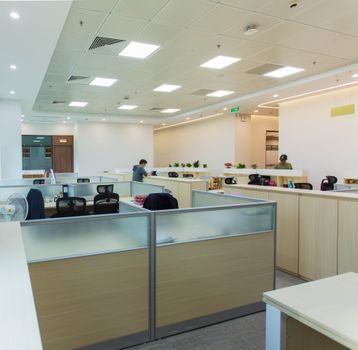
Three sourcing channels dominate: (1) China B2B export portals (Made-in-China.com, Okorder) for grid + aluminium panel at 100 m² MOQ with US$10-20/m² headline FOB [S4][S2]; (2) regional building-products distributors for mineral-fibre and gypsum tile with project-quantity pricing, full technical data sheets, and local acoustic / fire certifications; (3) specialist suspended-ceiling subcontractors for design-assist, integrated lighting layout, and certified installation.
The price levers a buyer can actually pull, ranked by impact: tile specification (mineral fibre vs gypsum vs aluminium can swing material cost 2-3×), grid finish (premium polyester powder-coat over standard galvanised adds 8-15%), MOQ (dropping from 100 m² to a 1000+ m² container-load order typically unlocks a 10-20% price step on Made-in-China listings [S4]), and project location (port duties, inland haul, and certified-installer scarcity drive the largest installed-cost spread between regions). For buyers also weighing adjacent envelope and partition decisions, the Concrete Admixture Buying Guide 2026 and the Modified Bitumen Membrane Price & Cost Guide 2026 carry the same "chemistry / spec tier / channel" decision framework.
Verifiable Spec Anchors and Standards Discipline
Suspense-grid steel products should reference the relevant hot-dip galvanising standard (ISO 1461 / ASTM A653 for the coating) and the relevant steel grade for the formed profile. Suspended-ceiling tile performance is typically reported against ASTM E1264 (classification by material, fire, acoustics) and ASTM C423 (sound absorption / NRC), and the fire classification should be Class A per ASTM E84 for occupied commercial space. Mineral-fibre products should also carry a formal formaldehyde / VOC declaration against the relevant regional scheme (CDPH Section 01350 in California, AgBB in Germany, GB/T 18883 in China). None of these citations should be added to a submittal unless the manufacturer's data sheet actually carries the test report number. [S1]
For component-level specifications, see linear guide, and suspended platform.