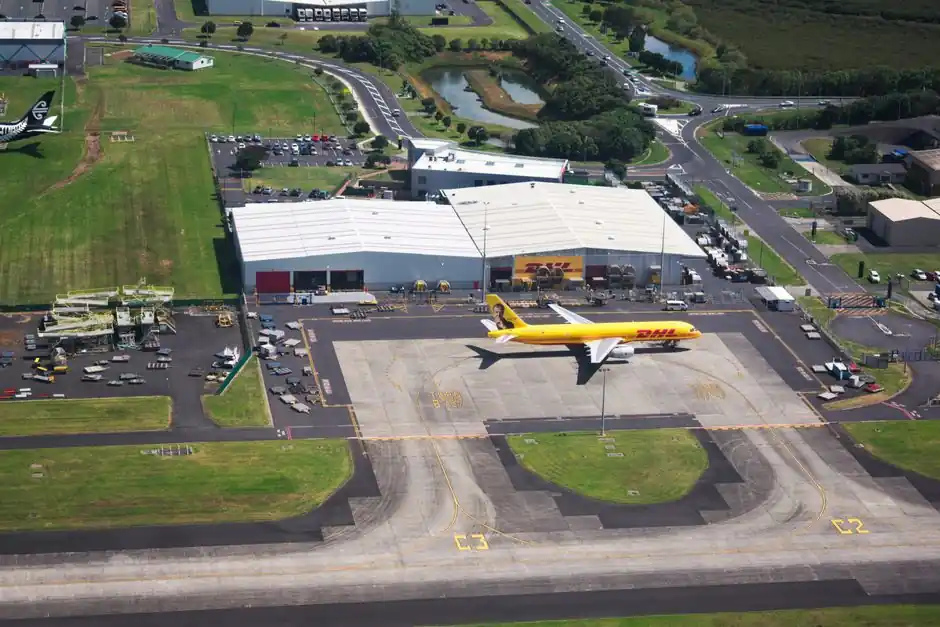
Air cargo terminals specify chain conveyors for horizontal in-house pallet (IHP) transfer between stacker cranes, hoists, and racking, with 1,300 kg per position capacity, 1,750 mm standard length, and a published operating envelope of -30°C to +60°C [S1].
Beyond unit-load service, the same conveyor family handles dry bulk at much higher volumetric rates, with agricultural and industrial chain conveyors reaching up to 2,800 m³/h in the largest configurations and 72 to 1,306 m³/h across the common galvanized RL/RM/RS/RA product lines at chain speeds up to 0.60 m/s [S2].
Two Distinct Duty Envelopes: Unit Load vs. Dry Bulk
Chain conveyors split cleanly into two duty classes. The IHP/air-cargo class carries discrete unit loads on a slat or chain-attached platform, integrates with stacker cranes and racking, and is built around 1,300 kg per position loads with widths matched to 1,000 to 1,700 mm in-house pallets [S1]. By contrast, dry-bulk chain conveyors are enclosed dust-proof trough systems with welded flights on special-steel chain, hardened steel bushes, and plastic cleaning flaps, sized to throughputs from 72 m³/h on the smallest RL/RS models up to 1,306 m³/h on the RM [S2]. Specifying the wrong class is the most common procurement error: pallet transfer chains are not sized for sliding abrasive bulk, and en-masse drags are not sized for discrete 1,300 kg unit positions.
Drag Chain Sub-Types: En-Masse, Scraper, Submerged, Tube
Drag chain conveyors pull material through an enclosed trough using flights or scrapers attached to a continuous chain, in contrast to belt conveyors that carry material on top of a moving surface [S3]. Four sub-types dominate: en-masse (chain runs in the product bed), submerged (return strand runs below the material), tube (circular cross-section for sealed routing), and round-link (forged link chain for heavy abrasive service). En-masse designs use a square cross-section and a centered single-strand chain with flights on both sides, conveying via shear friction in the bulk solid rather than full-flight pushing, which limits cross-sectional fill to around 50% in scraper/paddle styles and drives higher chain weight per ton moved [S4].
Selection Criteria: Material, Throughput, Distance, and Inclination
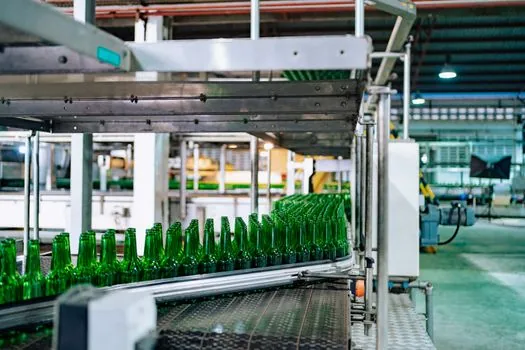
Selection comes down to four core factors: the material being handled, required throughput volume, available layout distance, and the inclination profile [S7]. For dry-bulk service the published envelope is 72 to 1,306 m³/h at 0.60 m/s maximum chain speed, with up to 15° inclination without capacity decrease on trapezoidal-bottom models [S2]. For air-cargo IHP service the critical inputs are pallet weight, pallet footprint (1,000 to 1,700 mm width), transfer height (1,000 to 1,040 mm), and the ASRS interface list: in-feed/out-feed lanes with overweight detection, contour check, barcode ID, and pallet guides [S1].
Options, Integration, and Comparison Matrix
Standard option packages on air-cargo chain conveyors include emergency stops, overload protection, automatic chain tensioning, integrated scales, and full ASRS in-feed/out-feed lanes with bar code identification and on-deck cameras [S1]. Comparing the three most common dry-bulk sub-types side by side: en-masse conveyors are the most efficient for level to moderate-incline service up to 15° on free-flowing bulk, submerged-flight designs handle wet or sticky materials where the return strand must stay clear of the product, and tube/round-link designs win on sealed routing or high-abrasion ore duty. For air-cargo IHP service the choice is essentially binary: roller conveyor for short, light, well-aligned pallet moves, and chain conveyor once run length extends, loads approach the 1,300 kg position rating, or pallet misalignment becomes a frequent event [S1]. The heavy-duty chain runs on guides supporting the pallet evenly along the full transport path, which is what makes chain conveyors the preferred long-distance solution inside the terminal [S8]. For an adjacent engineering decision, see this universal joint selection map for cement plant drivetrains, which covers a related drivetrain durability problem on heavy chain-driven equipment.
Load, Temperature, and ASRS Interface Limits
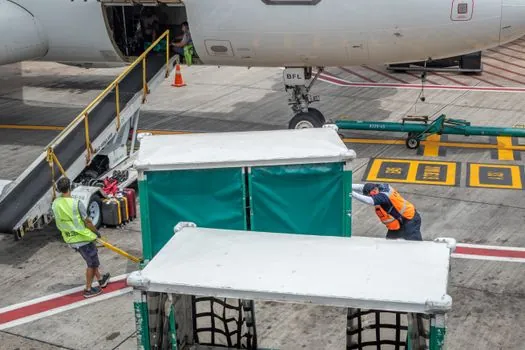
Published operating limits for the air-cargo IHP class are 1,300 kg per position, 1,750 mm standard length per section, transfer height of 1,000 to 1,040 mm, and -30°C to +60°C ambient operation [S1]. Misalignment tolerance is the structural reason chain conveyors beat roller conveyors on long runs: the chain-attached pallet platform maintains its orientation even when the load is not perfectly centered, while rollers can jam on skewed loads. Integration with right-angle and roller conveyors, ASRS in-feed/out-feed lanes, and contour/overweight/barcode checks is factory-engineered rather than field-assembled, which is why procurement teams treat chain conveyor sections as part of the ASRS scope, not a standalone mechanical purchase.
Failure Modes and Maintenance Planning
The dominant failure modes on dry-bulk chain conveyors are chain wear, flight wear, and trough liner wear on abrasive service, and they scale with chain speed and bulk density (Cimbria's bulk-density ceiling is 850 kg/m³ across the RL/RM/RS/RA product lines) [S2]. En-masse designs warn against over-deep fill: if the bulk solid becomes too deep, friction against the side walls slows the upper layers relative to chain speed, which produces slippage, premature wear, and lost volumetric capacity [S4]. On the air-cargo side, scheduled chain tensioning, drive-sprocket inspection, and ASRS interface checks (overweight detection, contour check, barcode reader alignment) are the documented maintenance intervals; the design is sold as maintenance-friendly with long service intervals, but the long-run cost driver is still chain and sprocket replacement under continuous duty [S1]. For a related material-handling reference on adjacent drivetrain components, see this locking assembly selection for material handling drums and pulleys.
Specification Snapshot and Trackable Signals
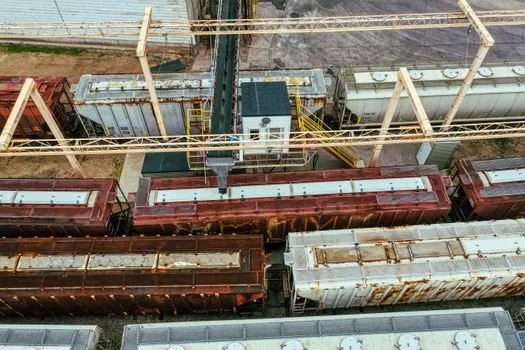
Air-cargo IHP: 1,300 kg/position, 1,750 mm section length, 1,000 to 1,700 mm pallet width, 1,000 to 1,040 mm transfer height, -30°C to +60°C [S1]. Dry-bulk: 72 to 1,306 m³/h (standard product line) up to 2,800 m³/h (top-end configuration), 0.55 to 0.60 m/s chain speed, 850 kg/m³ bulk density limit, up to 15° inclination without capacity loss [S2]. Track on the next refresh: any change to the 1,300 kg per position rating or the 1,750 mm standard length, and any shift in the published RL/RM/RS/RA capacity ceiling, since both anchor the procurement spec for new air-cargo terminal builds.
Spec-level background on the components involved: chain conveyor, conveyor chain, and air pick.