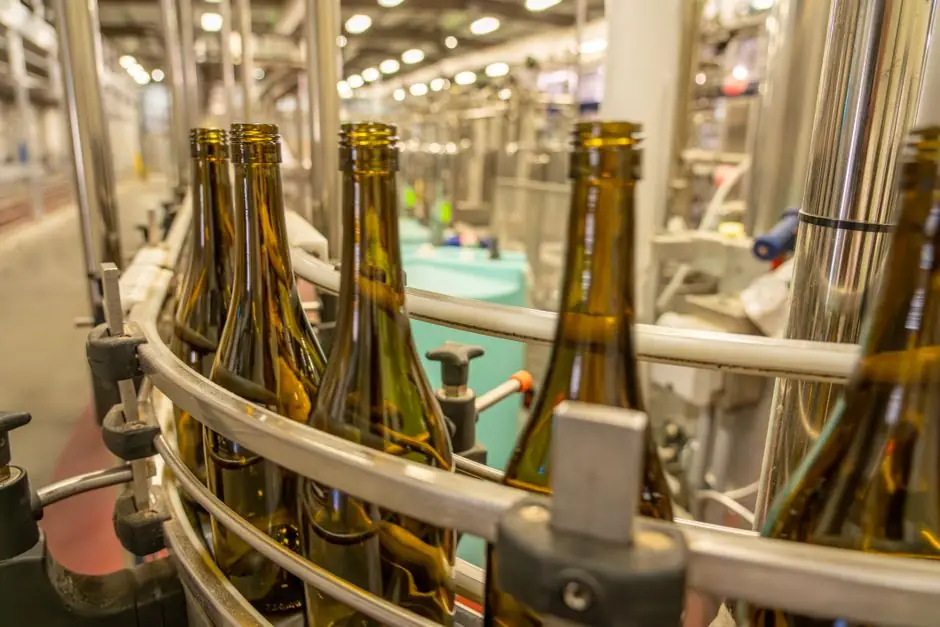
Wire and PTFE mesh belt conveyors are specified where open airflow, drainage, and cleanability outweigh raw tensile capacity, with documented continuous service temperature ratings up to 260°C for PTFE-coated fiberglass mesh [S2] and a wire-mesh segment that includes Flex-Turn, Straight, and Ladder-Flex configurations [S3].
This guide maps the real trade-offs by belt type, temperature, and load, so a process engineer can pick between mesh belt conveyor construction styles, plain belt conveyor alternatives, and stainless steel mesh variants without overpaying for performance the line does not need.
Mesh Belt Types and Construction
Mesh belts fall into three functional families: PTFE-coated fiberglass, balanced weave stainless steel, and modular plastic mesh, each with a distinct load/temperature envelope [S1][S2][S4]. PTFE mesh is the workhorse for food drying, textile heat-setting, and pharmaceutical conveying, with an elongation coefficient under 5‰, a 260°C continuous service ceiling, and resistance to strong acids, alkalis, aqua regia, and most organic solvents [S2]. Balanced-weave stainless mesh, including the Flex-Turn, Straight, and Ladder-Flex product lines, is the typical pick for heavier product, sharper turn radii, and direct food contact wash-down, with a stated advantage of gentle product handling and open-surface cleanability [S3]. Modular plastic mesh belts, pioneered by J.M. Lapeyre in 1970 for shrimp processing, use a positive-drive sprocket engagement that keeps belt tension low and reduces bearing and motor wear versus friction-driven fabric belts [S4].
Operating Envelope: Temperature, Load, and Chemical Resistance
PTFE mesh holds 260°C continuous without emitting harmful vapors, retains non-adhesion against oils, resins, paints, and pastes, and is fire-retardant, a combination rarely matched by any other belt class [S2]. Dimensional stability is the limiting factor: PTFE mesh elongation stays under 5‰, so it can wrap small-diameter pulleys and survive bending-fatigue cycles that would crack a stiffer metal mesh [S2]. Wire-mesh conveyors gain their edge in throughput and turn geometry; a Wire Belt Flex-Turn can execute tight 90° product transfers inside a wash-down enclosure where a straight fabric belt would need an external spiral or a cross transfer [S3]. For high-load bulk, fabric and steel-cord belts still win; modular plastic is positioned in the mid-range, offering positive drive and sanitation but with a lower top-end tensile rating than steel-cord [S4][S8].
Comparison: PTFE Mesh vs Wire Mesh vs Modular Plastic Mesh

On four decision criteria the three constructions diverge sharply. Temperature ceiling: PTFE mesh 260°C continuous, stainless wire mesh limited by alloy (typically 600–800°C for 314/310 grade, lower for 304), modular plastic around 80–100°C [S2][S3][S4]. Chemical resistance: PTFE is essentially inert to strong acids, alkalis, and organic solvents; 300-series stainless handles most food acids but can pit under chloride cleaners; modular plastic resists water and mild chemicals but degrades with strong solvents [S2][S3]. Load capacity and tensile strength: stainless wire mesh and steel-cord fabric carry the heaviest bulk loads, PTFE mesh is restricted to small and medium projects because of limited tensile strength, modular plastic sits in the middle on a positive-drive, low-tension basis [S2][S4][S8]. Cost and abrasion resistance: PTFE mesh carries a price premium and poor abrasion behavior, so it loses on sharp or hard product contact; stainless mesh and modular plastic both tolerate abrasion better, and modular plastic offers fast section replacement without dismantling the full belt [S2][S4][S8].
Failure Modes, Maintenance, and Cleaning
Every belt class has a documented failure mode, and mesh is no exception. Plastic mesh belts contain small modular parts that can break off and contaminate the product stream, which is why the supplier guidance lists it as a key trade-off against fabric and metal constructions [S7]. Fabric belts are prone to belt creep, the slow longitudinal slip that misaligns tracking and burns the drive pulley; mesh belts do not creep in the same way because most metal and positive-drive plastic meshes are sprocket-engaged [S7]. Wire-mesh conveyors are described by the manufacturer as extremely easy to clean and maintain, with open weave that allows wash water and sanitizers to pass through rather than pool under a fabric cover [S3]. For modular plastic, the maintenance win is sectional: a damaged section can be replaced without replacing the entire belt, a feature shared with steel-cord and heavy fabric constructions, and one that directly minimises line downtime [S4][S8].
Selection Criteria by Industry Use Case
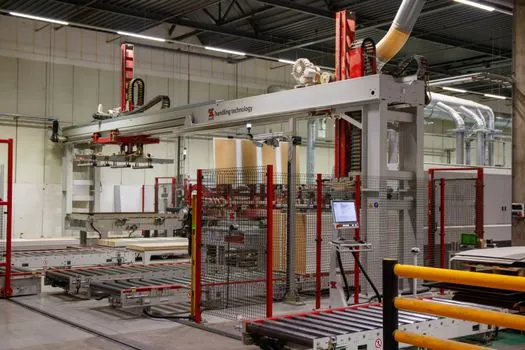
Food and pharmaceutical lines prioritise EU and FDA material compliance, oil/fat release, and wash-down access, which is why the Transbelt guidance lists food and pharma as the settings where mesh-class belts have many advantages and few disadvantages [S5]. Automotive and stamping lines need cut and abrasion resistance with a uniform wear rate, more the domain of reinforced fabric and steel-cord than open mesh [S5]. Recycling plants need rip and abrasion resistance plus compatibility with optical and magnetic separators, again a heavier-duty domain where mesh is sometimes a sorter feed belt but rarely the main haulage belt [S5]. For PTFE mesh specifically, the application sweet spot is textile printing and drying, where the open mesh improves air permeability, reduces heat consumption, and lifts drying efficiency versus a closed-surface fabric belt [S2].
Cost, Limitations, and Where Mesh Is the Wrong Choice
PTFE mesh is priced above standard fabric and PVC belts, which limits its use in low-cost projects and any line where the duty cycle does not require 200°C+ service or chemical inertness [S2]. Its poor abrasion resistance means sharp or hard product contact will cut the coating, so applications handling stamped metal, glass cullet, or mineral aggregate should default to steel mesh, modular plastic, or reinforced fabric instead [S2]. PTFE mesh is also constrained to small and medium conveying projects, since its tensile and load capacity fall short of large-scale bulk haulage [S2]. Portable and temporary conveyor setups benefit from mobility, labour, and space savings, but a portable mesh frame rarely has the rigidity for a high-temperature dryer or a chemical wash-down, so the cost-savings argument there favours lighter fabric or roller conveyors [S6]. For the broader construction machinery and equipment context, mesh belts appear in concrete-curing rooms and aggregate screening, but as auxiliary, not primary, haulage.
Standards, Compliance, and Sourcing Notes
Food-contact mesh belt sourcing should reference EU food-contact and FDA material compliance explicitly, with the supplier confirming compliance for the specific belt grade rather than the generic belt family [S5]. Stainless-steel mesh grades for food and pharmaceutical wash-down typically default to 304 or 316, with 316 selected where chloride-based sanitisers are in use; the alloy choice, not just the weave, drives corrosion performance. PTFE mesh dimensional stability is best specified by elongation coefficient (under 5‰) and continuous service temperature (260°C), with the supplier providing both on the data sheet [S2]. For modular plastic, the original sanitation, tracking, and corrosion problem set was solved for shrimp processing in 1970, and the same positive-drive, low-tension principle is now the default in meat, poultry, and ready-meal lines [S4]. Engineers reviewing motor and drive sizing for any of these belts can cross-check the electric motor raw material sourcing spec map for the steel, copper, and magnet content that drives the drive-motor BOM behind the conveyor, and the electric motor key components BOM spec map for matching frame, shaft, and bearing choices to a mesh conveyor’s positive or friction drive.
Trackable signals to watch over the next procurement cycle: (1) revised food-contact compliance documentation on PTFE mesh datasheets, since EU and FDA material rules continue to tighten around PFAS-class chemistries; (2) modular plastic mesh intrusion into heavy-bulk applications that have historically been steel-cord territory, as positive-drive designs push tensile ratings up; (3) growth of portable mesh belt skids in field-deployable construction machinery and equipment lines, where mobility and rapid redeployment are now specified more often than fixed installation.