Chain conveyors suit heavy, damaged, or irregular pallets because multi-strand chains support the load directly, while powered roller conveyors move stable pallets with lower resistance and precise zone control [S1][S3].
The decision is driven by pallet-bottom condition, load weight, accumulation behavior, line speed, environment, and downstream interfaces; a listed chain-conveyor example supports 250 lb and 2,000 lb per pallet, with speed up to 80 fpm [S6].
Choose by pallet condition and load support
Chain-driven live roller, or CDLR, uses chains and sprockets to drive rollers, so the pallet rolls across several contact points. This arrangement requires a reasonably flat, stable bottom deck and deck boards aligned with the direction of travel [S1][S3].
Drag-chain conveyors directly support loads on strands of chain and can suit pallets with bottom-board orientation issues, uneven bottoms, or skids that do not ride reliably on rollers.
A powered roller conveyor is the stronger choice for regular GMA, CHEP, or PECO pallets with sound bottom decks, especially when the line must release one pallet at a time into a palletizer, stretch wrapper, robotic cell, or AS/RS [S3].
Compare the three practical architectures
Its rollers can measure 1.9 in, 2-1/2 in, 2-9/16 in, or 3-1/2 in and larger, with cited standard sections of 5 ft and 10 ft nominal length and speeds of 30, 45, or 60 fpm [S1][S3].
Drag-chain conveyors carry loads directly on strands of chain, which can make them suitable for uneven or poorly oriented pallets that are difficult to handle with rollers.
On control flexibility, zoned powered rollers win for precise accumulation. CDLR conveyors move pallet-compatible loads across driven rollers, and accumulation behavior is an important consideration when selecting a CDLR system.
The cost and maintenance trade-off follows the contact method: rollers and bearings dominate a powered roller system, while chains, sprockets, take-ups, lubrication points, and chain wear add inspection duties to a drag-chain system [S2][S3].
Match accumulation behavior to the process
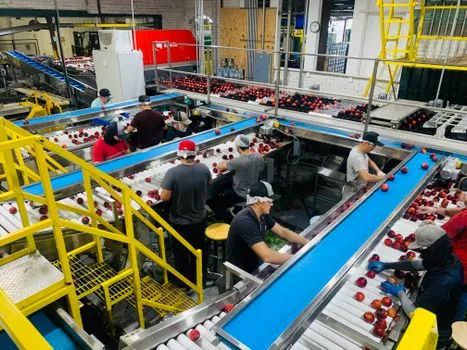
Accumulation chain conveyor is one of five types of conveyor systems using roller chains.
Roller systems can allow items to accumulate on the line where conveyor belts cannot. The cited chain system lists pallet loads up to 250 lb and 2,000 lb, depending on configuration, and a maximum speed of 80 fpm [S6].
Selection should account for whether the load can tolerate contact with the loads ahead of it and the required accumulation behavior.
Fit the line to weight, geometry, and interfaces
The minimum acceptable load includes the empty pallet, product, and any attached skid or container, not the nominal product weight alone. One supplier's accumulating roller-chain conveyor covers 250 lb and 2,000 lb per pallet in separate listed configurations, demonstrating that the selected configuration, not the broad conveyor family, defines capacity [S6].
Check pallet footprint, stringer spacing, bottom-board direction, deck continuity, and load center before choosing chain strand count and spacing. Drag-chain conveyors carry loads directly on strands of chain.
Chain transfer systems are one of three common solutions for pallet-handling applications.
Compare pallet-handling alternatives such as the roller conveyor for regular loads, the chain conveyor for direct chain support, and the conveyor chain when drive-chain selection, sprocket engagement, or wear control is part of the procurement scope.
Account for environment, maintenance, and failure modes
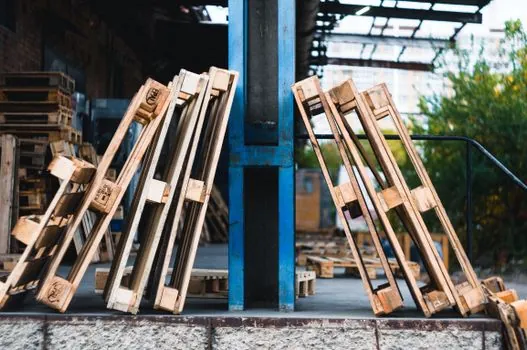
Chain conveyors can handle big loads and are used in industrial applications with heavy materials, although they require maintenance.
CDLR performance depends on pallet condition. A flat, stable deck supports even motion; an irregular or damaged deck reduces contact area and can cause uneven movement or loss of traction. The practical failure mode is therefore poor pallet running quality, not an inherent inability of CDLR to accumulate [S3].
The line-shaft live roller alternative cited in the conveyor guide excludes oily, wet or high-moisture, dusty, corrosive, and abrasive environments. That exclusion is relevant when comparing older shaft-and-O-ring systems, but it should not be transferred automatically to CDLR or drag-chain architectures [S5].
Plan inspection access for roller bearings, drive chains, sprockets, take-ups, sensors, and chain lubrication. If the application includes food processing, specify cleaning and corrosion requirements before accepting a general industrial chain platform [S2][S5].
Use case recommendations and sourcing checks
Specify CDLR for standard pallets in a zone-controlled palletizing or wrapping line when low sliding resistance, repeatable starts and stops, and non-contact accumulation are priorities. Specify drag chain for broken pallets, skids, bottom-board misalignment, or loads that do not travel consistently on rollers, and verify the selected chain assembly against the required pallet weight [S1][S3].
Do not select a drag-chain line solely because accumulation is required. If every pallet has a flat, aligned, undamaged bottom and the application needs low-speed transport through multiple controlled zones, powered rollers offer a cleaner mechanical arrangement and more efficient rolling motion [S2][S3].
At procurement, request the manufacturer's rated pallet load, line speed, drive arrangement, zone count, roller diameter, chain specification, sprocket count, take-up range, sensor method, and control interface. These parameters distinguish a valid accumulating system from a general conveyor description and prevent selection by conveyor family alone [S1][S6].
Track pallet bottom-condition failures and unplanned chain or bearing maintenance during initial validation; either result indicates that the chosen contact method does not match the actual load population or operating environment [S2][S3].