A chain transfer unit changes a pallet’s travel direction by 90° using a lifting transfer surface, enabling a controlled hand-off between adjacent conveyor lines [S1][S2].
How the 90-Degree Chain Transfer Works
A chain transfer unit moves a pallet at a 90° angle between conveyors.
The operating principle is a controlled sequence: position the pallet, engage the transverse transfer surface, move the load laterally, confirm that the pallet is clear, and return the mechanism to its home position [S4].
Unlike a curved conveyor, which carries a load continuously through a bend, a transfer creates a discrete hand-off at an intersection [S1][S4]. A turntable is the appropriate alternative when the load must also rotate about its vertical axis, such as when pallet openings or labels must face a specified direction [S4][S5].
For a broader understanding of transfer equipment, see the transfer conveyor reference for the conveyor family used in fixed material-handling routes.
Chain Lift, Roller Transfer, and Turntable Selection
Chain transfers and roller transfers are the principal mechanisms for a 90° change in conveyor direction, while a turntable is used when pallet orientation must also be preserved or intentionally changed [S5].
The selection decision is not simply lift versus no lift. It depends on load weight, pallet geometry, available line height, required throughput, downstream direction, and whether the pallet must turn as well as translate [S2][S4][S5].
Pallet Geometry and Transfer Surface Compatibility
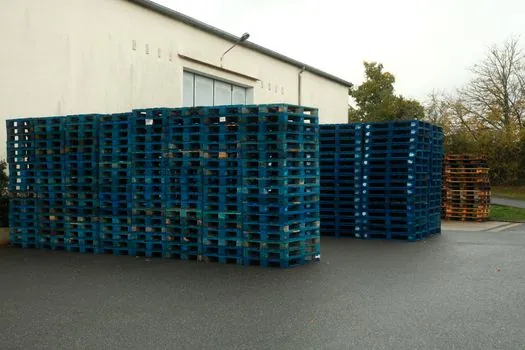
A stable unit load must remain supported throughout the hand-off, and the transfer surface must match the pallet underside [S4]. A mismatched chain, roller, or belt profile can reduce contact, snag runners, or transfer only part of the load.
Because the transfer surface must match the load underside, its contact geometry must be checked against each load style entering the line.
MISUMI No.000216 is identified as a 90-degree pallet transfer mechanism.
Line height also determines whether a low-profile surface can lift the pallet above the main conveyor rollers or chains. A transfer surface that is too low cannot establish reliable engagement; excessive lift increases actuator duty and can disturb neighboring conveyor components [S3][S4].
Capacity, Throughput, and Cycle Time
These ratings are model-specific and should not be transferred to a different mechanism without engineering confirmation.
Heavy-pallet lift cross transfers are designed to accept loaded or empty pallets across multiple sizes, but nominal capacity does not by itself establish cycle time [S7]. Throughput must be checked against the lift, transverse travel, load-clearing confirmation, and return stroke [S2][S4].
A transfer’s practical rate is constrained by more than conveyor speed. The complete cycle includes pallet detection, stop or indexing, lifting, lateral movement, receiving-line clearance, lowering, and reset [S4].
Controls, Sequencing, and Safety
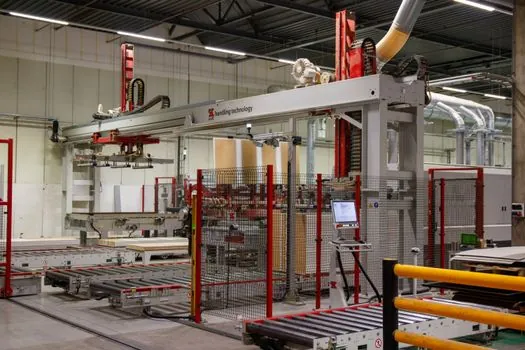
Reliable transfer requires stops, sensors, drives, and downstream permissives to act in the correct sequence, because crossing two conveyors on a drawing does not create a dependable transfer [S4].
The receiving conveyor should confirm that the load is clear before the transfer surface lowers. Loss of that permissive can leave a raised chain mechanism in the pallet path, creating an impact and entrapment hazard rather than a controlled transfer [S4].
Safety design must account for moving lift components, nip points, and blocked-load recovery [S4]. A practical specification should define sensor positions, home and transfer positions, jam detection, emergency-stop behavior, manual reset, and the method for clearing a trapped pallet.
MISUMI No.000216 is identified as a 90-degree pallet transfer mechanism.
Where Chain Transfer Units Fit
Chain transfer units suit fixed production, assembly, packaging, and warehouse routes where pallets must move laterally between fixed paths at a repeatable 90° angle [S1][S4].
Pallet handling equipment is used to transport pallets, while unit loads such as boxes, cartons, and trays can be handled on a smaller scale. Suitable applications include diverting a workpiece pallet to a test cell, routing a loaded pallet from manufacturing to a warehouse lane, and handing pallets to packing or shipping equipment [S4].
This method is not a good fit for continuous curved travel, routes requiring multiple destinations at high rate, or long lateral movements between several lanes. Those requirements point toward a curve, sorter or divert system, transfer car, or shuttle instead [S4].
Manual pallet-handling equipment is also unsuitable when the specification requires repeatable, controlled transfer without operator lifting, rotation, or pushing [S4].
What to Require from a Supplier
A procurement package should request the rated pallet load, pallet footprint range, lift stroke, transfer width, conveyor interface, transfer-surface profile, and confirmed cycle time rather than accepting a general “90-degree transfer” description [S2][S4].
Model codes such as T01C25, T02C25, T03C25, and T04C25 identify documented chain-transfer configurations with either 1,500 lb or 4,000 lb capacity and 1 inch of lift [S5].
The supplier should also identify the drive arrangement, actuator type, sensor set, downstream permissive, home-position function, guarding provisions, and recovery procedure for a blocked pallet. These details determine whether the unit is an engineered transfer station or merely a collection of chains, rollers, and actuators.
Before purchase, verify whether the application requires only a 90° route change or full pallet rotation. A lift-and-rotate unit is required when label direction, pallet openings, or robot access must also change, whereas a conventional cross transfer primarily changes the travel path [S4][S5].
The first trackable design checks are the pallet-to-transfer contact profile and the confirmed lift stroke above the incoming conveyor. If either cannot be demonstrated with the actual pallet geometry and line height, capacity and throughput figures will not resolve the installation risk [S3][S4].