
A closed deck gives food and pharmaceutical lines a broad, wipeable load surface, while an open deck provides greater drainage and airflow with less material and tare weight [S1][S5].
The selection depends on exposure, wash conditions, product contact, drainage, load geometry and handling, not on the words “closed deck” or “hygienic” alone [S1][S4].
Choose by contamination exposure and product contact
Use a closed-deck plastic pallet where the pallet contacts exposed product or primary packaging, enters a wet processing area or high-care zone, or is exposed to condensation [S4]. Its continuous or nearly continuous upper surface reduces top-deck pockets and gives operators a wider area to inspect and wipe [S1][S6].
An open-deck plastic pallet remains appropriate for a dry warehouse moving sealed cartons when drainage, ventilation and manual handling matter more than exposure of the load surface [S4]. Openings let rinse water and debris pass through the deck, but they also create additional edges, cavities and joints that the cleaning procedure must address [S5].
Neither architecture independently establishes suitability. Deck style does not define the underside, fork entries, runners, material, reinforcement, load rating or manufacturing quality, so the complete model must be assessed against the actual lane [S1].
Compare hygiene performance against four criteria
On cleanability, a closed deck is stronger because its broad surface can be wiped with fewer top-deck recesses; an open deck is weaker where trapped residue cannot be reached [S1][S4]. On drainage, open deck wins because its openings allow water to pass through, whereas a closed deck provides limited airflow and more enclosed geometry [S5].
On load support, the closed deck provides a more continuous surface for bags, small cartons, pails and packaged goods, while an open deck can leave gaps beneath loads that do not bridge the openings [S1][S5]. On handling, an open deck normally reduces deck mass, while a closed deck adds material whose value depends on whether the extra weight improves hygiene performance in that lane [S4][S7].
This is a screening comparison, not proof of performance. Two closed-deck pallets can differ because their geometry, material, reinforcement, underside and production tolerances differ, so washability, contact support and equipment compatibility must be verified at the selected model level [S1].
Hygienic geometry is more than polymer grade

A defensible hygienic design combines a closed top deck without open pockets, radiused internal corners, no exposed fasteners or metal inserts, a draining base and a one-piece moulded construction [S4]. These features address physical access and drainage, while the polymer alone cannot prove that the pallet can be cleaned or sanitised in service [S4].
For food and pharmaceutical work, pallet hygiene depends on cleanability, which is described as a physical constraint affected by deck geometry [S4]. The base, underside, joints, corners and damaged areas must therefore be inspected along with the top deck; visible top-surface cleanliness is not a complete release criterion [S1].
For broader handling context, the architecture and compatibility of a plastic pallet affect pallet rack engagement, conveyor support and automated handling, but hygiene selection remains a separate line of evidence.
Specify the washing, sanitation and release process
The RFQ should state the actual wash sequence rather than request a generic “food-grade” pallet. Specify detergent, wash temperature, pressure, rinse conditions, drying method, sanitiser, maximum exposure time and the release procedure [S1][S4]. The selected model must then be validated with the site’s chemistry and equipment rather than accepting the polymer description as proof of performance.
Closed-deck pallets may be worth specifying when the load needs continuous top support or the process benefits from a surface that is easier to see and wipe during inspection [S1].
Food, pharmaceutical and cleanroom users should validate the complete pallet in the designated wash bay. Include underside drainage, fork entries, base cavities and any damaged deck areas, because cleaning the top face alone does not demonstrate that the unit can be released for reuse [S4][S6].
Match deck architecture to the actual load
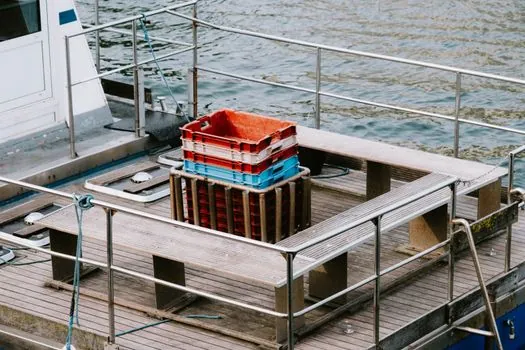
Closed decks are the stronger choice for soft bags, pails, trays, small cartons and irregular bases that need broader support [S1]. A continuous plane can reduce unsupported contact areas, but the buyer must map the real first-layer pattern and permitted overhang because “closed” does not prevent deformation under an unsuitable load [S1].
Open decks are more credible where rigid cartons already bridge the openings, the lane is dry and inspection access is adequate, or rapid drainage is required [S1]. Their advantage disappears if the product blocks the openings or water remains trapped elsewhere in the pallet, which means drainage must be assessed with the actual unit load in place [S1].
Record unit-load weight, footprint, concentrated feet, unsupported corners, floor stacking or racking conditions, and forklift or pallet-jack entry before comparing models [S1]. Deck architecture should not be used as a substitute for checking the pallet stacker interface or verified fork and equipment contact points.
Audit automation, drainage and total operating cost
Open-deck pallets generally carry less deck material than closed-deck versions, which can reduce tare where manual handling and transport weight are significant [S4][S7]. Closed-deck models remain justified when the exposed surface, inspection speed or sanitation result requires that geometry [S7]. The comparison should use complete pallet weight, not estimated deck mass, because the underside and reinforcement can materially change the result [S1].
Closed-deck pallets are often selected for automation because they provide more consistent top-surface support, but the selected model must still be checked for forks, wheels, conveyor sensors, supports, rack span and deflection [S1][S7]. For conveyor or automated-material-handling lanes, payload and support geometry can be screened through chain conveyor pitch selection for pallet weight.
Where an AGV robot or AMR robot transfers the pallet, document the transfer interface and support points rather than assuming deck style guarantees compatibility. Hygiene, automation and structural capacity need separate acceptance records [S1].
Apply a seven-point purchasing gate
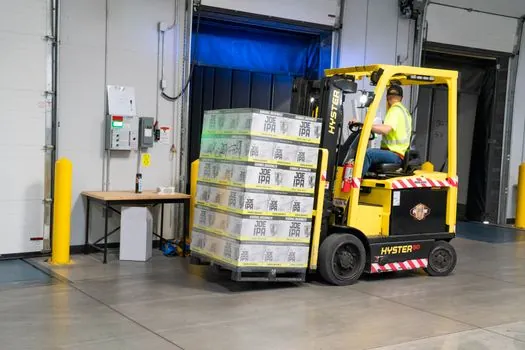
Before release, require seven items: the mapped load-contact pattern; the defined hygiene boundary; detergent, temperature, pressure, rinse, drying and sanitiser details; the model’s material and geometry; complete pallet weight; handling-equipment contact points; and evidence covering static, dynamic and racking use where required [S1].
Closed deck is not automatically hygienic, and open deck is not automatically unsuitable for food handling. The decision is hygienic when the selected model’s geometry, cleaning exposure, drainage, load contact and contamination controls fit the specific zone [S1][S4].
Ask the supplier to identify the exact pallet model, underside design, deck construction and verified operating conditions, then approve that model through a wash trial on the intended line [S1][S4]. Recheck the decision whenever wash chemistry, product exposure, packaging geometry or pallet source changes.