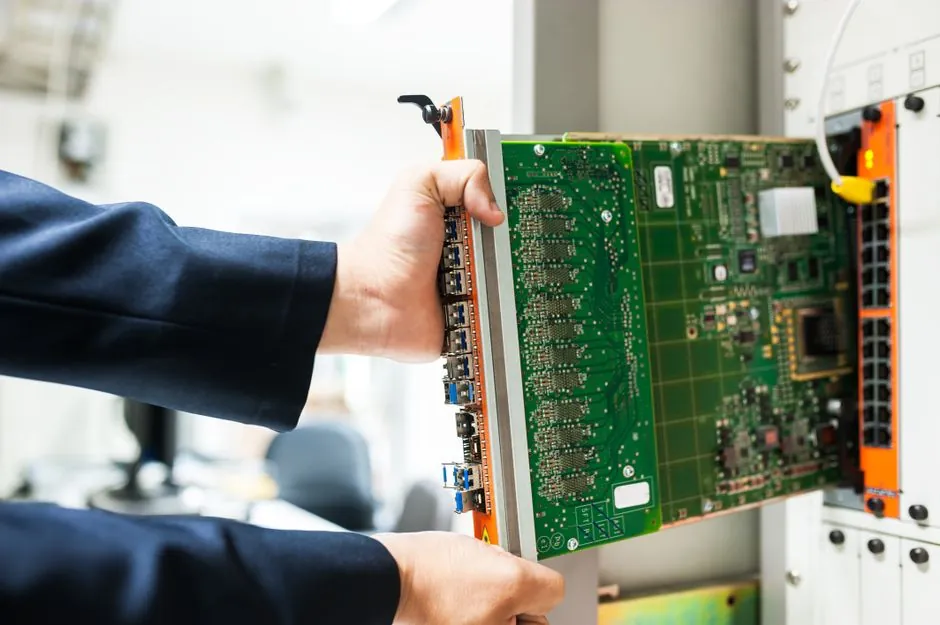
Data center buildouts subject fastenings to a specific set of stresses: continuous low-frequency vibration from CRAH units and cooling fans, tight edge distances on post-tensioned slabs, and pull-out loads from transformer skids, battery racks, and overhead busway supports. Chemical anchors, bonded fasteners that transfer load through a resin matrix along the full embedment depth, dominate these jobs because they impose zero radial expansion stress on the surrounding concrete [S3][S5].
Standard data center cabinet reactions are modest (a single 42U rack rarely exceeds 1.5 kN per caster), but critical infrastructure, such as UPS modules, PDUs, CRAC units, and generator hold-downs, can push shear and tension demands per anchor into the 20–80 kN range, well past where mechanical expansion anchors remain reliable at the reduced edge distances typical of white-space slabs [S2][S5]. For that workload band, the resin chemistry and rod material matter more than the brand label.
Why chemical anchors over mechanical expansion in data center slabs
Bonded chemical anchors transmit tension and shear along the full bonded length, so edge-distance and anchor-spacing reductions that would crack a concrete cone around an expansion sleeve remain serviceable for a resin-fixed stud [S3]. This matters on data center pours where rebar congestion, post-tensioning tendons, and the need to anchor close to slab edges or column faces leave designers little room to honor the c<sub>min</sub> and s<sub>min</sub> values of torque-controlled expansion anchors [S3].
Mechanical anchors, by contrast, develop hold through friction and mechanical interlock at an expansion cone, so a tight edge distance or a near-tendon clearance forces the specifier into a smaller-diameter, lower-capacity fastener or, more often, a redesign of the base plate [S3][S5]. For dynamic loads from rotating HVAC and UPS fans, bonded anchors also damp vibration better because the cured resin mass absorbs cyclic strain rather than transferring it to a preloaded wedge [S5]. The trade-off is cure time: chemical systems need minutes to hours before they can be torqued, while a torque-controlled expansion anchor takes load the moment the wrench clicks [S5].
Resin families: vinylester, hybrid, and pure epoxy
Specifiers generally choose between five resin families: polyester, vinylester, epoxy acrylate, hybrid, and pure epoxy, each with different strength, chemical resistance, and temperature envelopes [S3]. Polyester is the cheapest and the weakest, used mostly in non-structural hollow-masonry work; it is rarely the right pick for a data center. Vinylester and epoxy acrylate hybrids cover the majority of structural concrete anchoring, with load values typically higher than polyester and a cure profile tolerant of damp substrates [S3][S1].
Pure epoxy systems (such as injectable epoxy mortars with ICC-ES and ETA seismic approvals) are the conservative choice for cracked-concrete applications, submerged or water-filled holes, and high-load structural baseplates; they cure slower and require tighter hole-cleaning discipline, but they deliver the highest published design resistances and the broadest chemical-resistance envelope [S1]. Cementitious (inorganic) adhesive anchors exist for fire-resistant rebar connections where the resin would be the weak link under sustained fire exposure, but they are not the default pick for equipment hold-downs [S1]. For most data center slabs, vinylester or hybrid resin is the value-engineered default, with pure epoxy specified where the anchor sits in a wet location, supports a critical life-safety brace, or anchors into lightweight or cracked concrete [S1][S3].
Substrate matching: cracked concrete, post-tensioned slabs, and masonry plinths
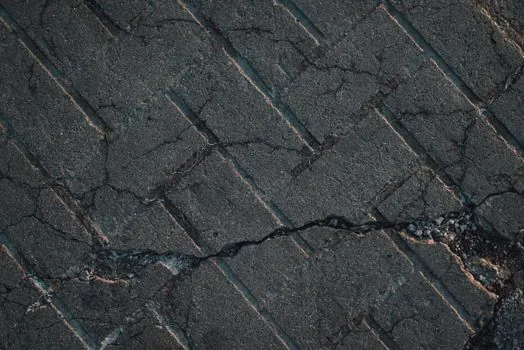
The base material drives the approval path almost as much as the load. A chemical anchor for cracked concrete must carry an ICC-ES, ETA, or equivalent report that explicitly covers cracked-concrete categories; a "concrete" approval alone is not sufficient if the slab is designed as cracked, which most reinforced data center slabs are under service load [S1][S3]. Diamond-drilled holes, common when crews must avoid hitting post-tensioning tendons, are only covered by certain mortar systems; check the approval document for "diamond drilling" or "DD" compatibility before specifying [S1].
Masonry plinths under generator skids or in retrofit white-space builds use a different product line: injectable hybrid mortars approved for solid brick, hollow CMU, multi-wythe unreinforced masonry, and grout-filled CMU, often with a screen sleeve or anchor sleeve in hollow substrates so the resin keys into the wall rather than running into the cavity [S1][S4]. Substrate condition at installation (dry, wet, or water-filled) must match the approval scope; a resin rated for dry concrete only is a rejected submittal on a job site where the slab is still curing or the hole has groundwater seepage [S1][S3].
Rod material and corrosion: zinc, mechanical galvanizing, and SS316
Zinc-plated carbon steel is acceptable for indoor, climate-controlled locations; mechanically galvanized or hot-dip galvanized finishes cover most outdoor generator yards and rooftop plant [S2]. For battery rooms, coastal sites, or anywhere chlorides or sulfuric acid condensate are plausible, stainless steel A4 / SS316 rods paired with a stainless capsule system are the conservative pick [S1].
Threaded rod grade is the second silent failure mode: data center specs should default to ISO 898-1 property class 8.8 or ASTM F1554 Grade 55 minimum, with Grade 105 or B7 specified where the resin's published design resistance exceeds the rod's steel capacity at the chosen embedment depth [S1][S3]. The dual-action anchor concept, an adhesive capsule combined with a screw anchor, is worth tracking for retrofit work where install speed matters but the engineer still wants bonded-anchor performance under seismic load [S1].
Installation discipline: hole cleaning, cure time, and temperature
The single most common field failure of chemical anchors is poor hole cleaning. Compressed-air blow-out plus a proper brush cycle, repeated per the manufacturer's printed sequence, is non-negotiable; dusty holes cut effective bond strength dramatically [S3][S4]. Base-material temperature at installation governs both gel and cure time, and most injectable mortars are approved across a working range from roughly -18 to 104 °F (-28 to 40 °C), with substrate temperatures outside that band requiring either a cold-room or hot-climate grade resin [S1].
Wet holes and water-filled holes require a resin explicitly approved for that condition, often a pure epoxy, and crews should not substitute a "dry" product because the local distributor is out of stock [S1]. Capsule systems remove much of the hole-cleaning sensitivity (the resin, hardener, and aggregate are sealed in a foil or glass capsule that breaks when the rod is driven), but they constrain the specifier to a fixed resin volume per capsule size and limit use in damp or oversized holes [S1]. For data center critical-spans, the safer default is injectable mortar with ICC-ES or ETA cracked-concrete approval, installed by crews trained and certified per the manufacturer's printed procedure.
Selection map: which chemical anchor for which data center load
A short criteria table is more useful than a brand list. For static UPS hold-downs on dry, cracked concrete with edge distances of 100 mm or more, a vinylester or hybrid injectable mortar with ICC-ES cracked-concrete approval, paired with zinc-plated Grade 8.8 rod, covers most designs [S1][S3]. For battery-room racks or coastal sites, the same resin family with SS316 rods is the safe default. For overhead busway and seismic bracing in seismically active regions, pure epoxy with ETA Seismic C1/C2 approval is the conservative pick. For generator plinths on concrete or masonry, injectable hybrid mortar with both concrete and masonry approvals, plus hot-dip galvanized or SS316 rod, is the right envelope [S1][S5].
For detailed resin-and-diameter sizing on similar substrate choices, see this guide to chemical anchor selection in prefabricated construction. For vibration-heavy bolted joints elsewhere in the plant, spring washer selection under DIN 2093 is a useful counter-reference on why chemical anchors are often the better data center choice. Background on chemical anchor resins and bonded anchoring covers the formulation differences in more depth.
Market and supply signals worth tracking

The global chemical anchor market is on a slow, steady growth path: one forecaster pegs 2024 size at USD 1.74 billion with a 3.8% CAGR through 2031, while a second puts the 2034 market at USD 1.57 billion at a 4.17% CAGR over 2026-2034, the spread reflects different scope definitions rather than a contradiction [S6][S8]. What that means in practice: pricing has been stable enough that specifying a higher-grade resin (vinylester over polyester, or pure epoxy over vinylester) is a 5-15% line-item delta, not a budget-buster, and lead times for ICC-ES-approved systems are typically 2-4 weeks through major distributors [S1].
Two signals to watch through the rest of 2026: first, the rollout of dual-action systems that pair adhesive-capsule bond strength with screw-anchor install speed is worth piloting on retrofit and live-data-center work where cure windows are tight [S1]. Second, the broader move toward seismic-approved cracked-concrete systems in regions that historically ignored seismic categories (central and eastern North America, parts of the Middle East) will pull more data center specs into higher resin grades, and designers should confirm their submittals carry the right ETA or ICC-Es Seismic category before bid [S1][S3]. A third reference worth pairing with this article, on picking the right industrial gas for process plant construction, has little direct overlap but illustrates the same spec-first selection discipline that data center anchor schedules should follow.
Component reference pages worth checking: data logger, and expansion anchor.