A busway, also called a bus duct or busbar trunking system (BTS), is a prefabricated, sheet-metal enclosed assembly of solid copper or aluminum bars used to carry and distribute large electrical currents. It replaces bundles of parallel cable on the high-current backbone of a building or plant, running from a transformer or main switchboard to downstream distribution boards. Modern systems span roughly 25 A to 6,300 A and are defined by IEC 61439-6 in the international market and UL 857 in North America.
Where cable terminates at lugs, busway connects through bolted joints, and where cable feeds one fixed point, plug-in busway lets engineers add or move tap-off units along the run. That combination of high ampacity, low voltage drop, and reconfigurability makes busway the default feeder for data centers, automotive plants, high-rise risers, and any facility where load layout changes over time.
Photo: Blacky-CS, CC BY-SA 4.0, via Wikimedia Commons
This guide is written for procurement engineers and electrical design engineers specifying power distribution backbones. It covers 6 chapters from what a busway is, through types and construction, conductor materials, key spec parameters, to the selection decision sequence, with 7 selection FAQs and manufacturer comparisons. All parameters reference the public standards IEC 61439-6, UL 857, NEMA BU 1.1, and CSA C22.2 No. 27.
Chapter 1 / 06
What is a Busway
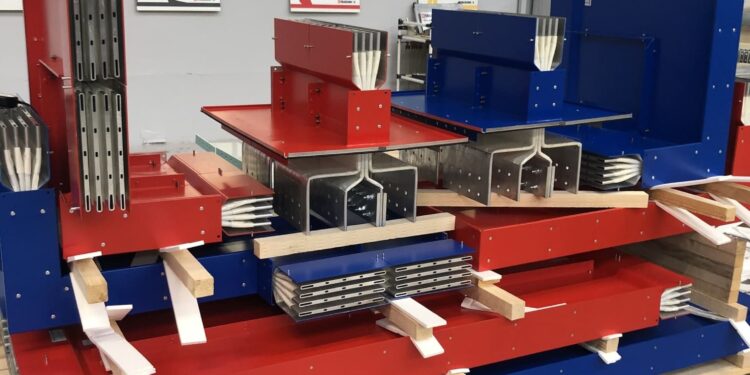
A busway is an enclosed electrical distribution system comprising solid conductors separated by insulating materials, prefabricated in standard straight lengths and fittings that bolt together on site. The IEC term is busbar trunking system, abbreviated BTS, and a single piece, whether a straight length, an elbow, a tee, or a feeder unit, is called a busbar trunking unit, or BTU. In North America the same product is sold as busway or bus duct under UL 857. These names are interchangeable in everyday engineering practice; the standard a project cites, IEC 61439-6 or UL 857, usually signals which term the documents will use.
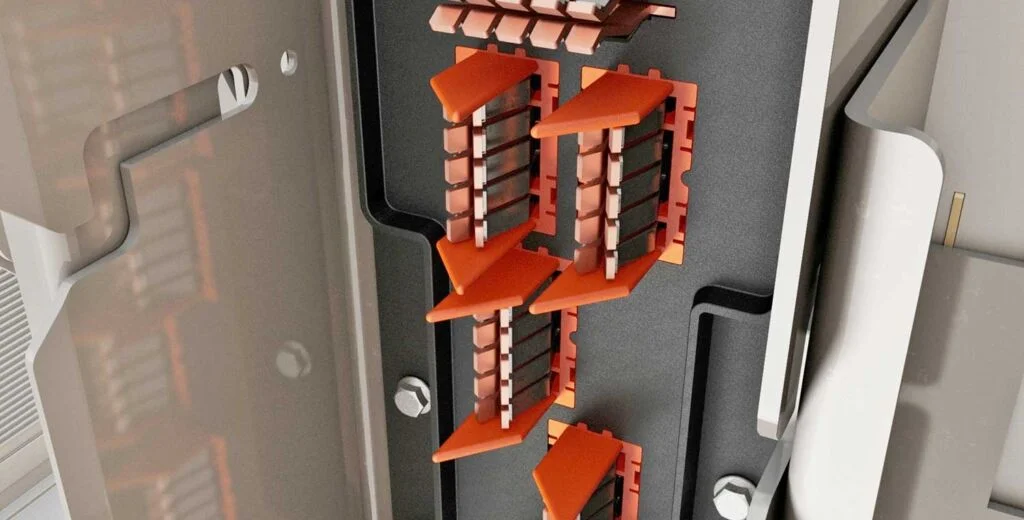
Structurally a busway has three layers. First, the conductors: flat copper or aluminum bars sized for the rated current, arranged as 3-phase 3-wire, 3-phase 4-wire, or 3-phase 4-wire with an oversized neutral. Second, the insulation: each bar is wrapped, sleeved, or coated with a dielectric film, with modern compact systems using an epoxy powder coating electrostatically sprayed onto the bar for a uniform pinhole-free layer. Third, the housing: a sheet-steel or extruded-aluminum enclosure that mechanically protects the bars, dissipates their heat, and in most designs serves as the integral equipment grounding conductor.
The technology dates to the late 1920s, when the United States automotive industry in Detroit asked for a flexible overhead power feed that could be tapped at any point along a moving assembly line, something fixed cable could not provide. Early bus ducts used bare copper bars on porcelain insulators inside a ventilated steel trough. Through the mid-twentieth century the design evolved toward fully insulated, totally enclosed, non-ventilated housings, and from the 1980s the compact sandwich construction, with bars stacked tightly against each other, became the dominant low-voltage form because it cut both size and voltage drop.
Functionally, a busway is a feeder, not a load device. Its purpose is to move large blocks of power a short to medium distance with minimal loss and to allow that power to be tapped where needed. Compared with the equivalent multiple parallel cables, a busway occupies less space, has a lower and more predictable voltage drop because the close bar spacing reduces inductive reactance, replaces dozens of cable terminations with a handful of bolted joints, and offers a single continuous ground path through the housing. The trade-off is a higher material cost per metre, so busway earns its place mainly at higher ampacities.
The practical break point is current. Below roughly 400 A, parallel power cable on cable tray is almost always cheaper and busway has little to offer. Between 800 A and 1,000 A the economics cross over, because matching that ampacity with cable forces several parallel single-core runs plus tray, glands, and a large termination cabinet. Above 1,600 A, and certainly at the 3,000 A to 6,300 A ratings used for main risers and large process feeders, busway is usually the only practical and code-compliant choice, which is why the catalog ranges of the major makers concentrate there.
Chapter 2 / 06
Busway Types and Classification
Busway is classified first by function, the presence or absence of tap-off points, and second by physical form. The two functional families are feeder busway, which has no tap-off openings and exists to move power between two fixed points, and plug-in or distribution busway, which carries tap-off windows along its length so plug-in units can be inserted to feed loads. Layered on top are specialized forms: lighting and track busway for distributed small loads, trolley busway for moving collectors, and isolated-phase bus duct for very high generator currents. The table below summarizes the functional types.
Type
Tap-off Points
Typical Rating
Typical Applications
Feeder busway
None
800 to 6,300 A
Transformer to main board, riser trunks, no intermediate loads
Plug-in / distribution
Windows on 1 or 2 faces
225 to 5,000 A
Factory floors, machine lines, distribution along a run
Feeder busway is the high-current trunk. With no tap-off openings, its housing and bar arrangement are optimized purely for ampacity and the lowest possible voltage drop, so it is the right choice for the run between a power transformer secondary and the main switchboard, or for a high-rise riser where power is delivered to floor boards rather than tapped along the way. Because it has no openings, feeder busway typically reaches the highest ratings, up to 5,000 A in aluminum and 6,300 A in copper in the leading IEC ranges.
Plug-in busway, called distribution busway in IEC documents, has tap-off windows at fixed intervals, commonly every 0.5 to 1 m, on one or both faces. Each window accepts a plug-in unit containing a circuit breaker or fused isolating switch that feeds a downstream machine, panel, or lighting branch. Many systems allow plug-in units to be added or removed while the busway is energized, using a shutter and interlock so the operator never touches a live stab. This is the form that gives busway its signature flexibility on factory floors and in data centers, where loads are added and relocated over the building's life.
Lighting and track busway covers the low-current end, roughly 25 A to 225 A, designed for continuous rows of luminaires or for the rack-power tracks now standard in data centers, where plug-in tap-off boxes feed each cabinet and can be moved as the white space is reconfigured. Trolley busway uses a continuous slot and a sliding collector to power overhead cranes such as a gantry crane, hoists, and other moving equipment, the original 1920s use case. Isolated-phase bus duct sits outside the low-voltage scope of this guide; it encloses each phase in its own grounded housing to handle the tens of kiloamperes between a power-plant generator and its step-up transformer.
The second classification axis is physical form, treated in detail in Chapter 3: compact sandwich construction, where insulated bars are clamped tightly together for minimum size and voltage drop, versus ventilated or air-insulated construction, where the bars are spaced apart inside the housing for cooling. Sandwich designs dominate modern low-voltage busway up to about 600 V and 5,000 A; ventilated designs survive in some high-current and medium-voltage applications where heat dissipation outweighs the benefit of a compact cross-section.
Chapter 3 / 06
Construction and Insulation
The physical construction of a busway sets its size, voltage drop, fault performance, and where it can be installed. Three construction decisions matter most: the bar arrangement (sandwich versus ventilated), the insulation system on the bars, and the housing material and ingress rating. The table below compares the two dominant bar arrangements on the parameters that drive selection.
Construction
Bar Spacing
Voltage Drop
Cooling
Typical Use
Sandwich (compact)
Bars clamped together
Low
Housing conduction
Modern LV busway to 600 V, to 5,000 A
Ventilated / air-insulated
Bars spaced apart
Higher
Air convection
High-current and some MV designs
Sandwich construction places the insulated phase, neutral, and ground bars directly against one another, separated only by their insulation film, and clamps the stack inside a close-fitting housing. The tight spacing minimizes the loop area between phases, which lowers inductive reactance and therefore voltage drop, and it produces the smallest possible cross-section for a given ampacity. The penalty is that heat must travel out of the bar stack by conduction into the housing rather than by air convection, so the insulation system and the housing's heat-spreading ability become critical. Sandwich busway is the de facto standard for low-voltage systems up to 600 V and 5,000 A.
Ventilated or air-insulated construction spaces the bars apart inside the enclosure so air can circulate and carry heat away. This handles very high currents and tolerates harsher thermal duty, but the larger loop area raises reactance and voltage drop, the cross-section is bulkier, and the openings limit the achievable ingress rating. Ventilated designs persist in some of the highest-current and medium-voltage applications, while compact sandwich designs have displaced them across most modern low-voltage distribution.
Insulation on the bars must hold off the system voltage for decades while surviving the thermal cycling of daily load swings. Older systems wrapped bars in tape or sleeved them in extruded polymer; current compact systems favor an epoxy powder coating applied by electrostatic spray, which deposits a uniform, pinhole-free dielectric layer over the entire bar including the edges. The insulation class is matched to the busway's rated insulation voltage and to the temperature rise it must endure under full load. A busway intended for fire-survival circuits adds an outer mineral barrier so that the conductors keep working through a fire, per standards such as IEC 60331 and BS 8491.
Housing is most often extruded or formed aluminum or sheet steel. Aluminum housings are lightweight, resist corrosion, conduct heat away from the bars efficiently, and provide an excellent integral ground path; a typical low-voltage system protects the aluminum with an electrostatically applied polyester or epoxy powder paint carrying a 1,000-hour salt-spray resistance rating. A totally enclosed, non-ventilated housing has an important practical advantage: it needs no derating regardless of mounting orientation, so the same rated section can run flat, edgewise, or vertically as a riser without a capacity penalty, which a ventilated design cannot always claim.
Joints deserve attention because they are the most common point of failure and the most labor-sensitive part of installation. Modern systems use a single-bolt splice joint with a captive, double-headed bolt and a visual torque indicator, so an installer tightens one bolt per joint to a defined torque and can verify it visually. The joint must carry full rated current and full short-circuit current without loosening, and on plug-in busway the tap-off stabs must make positive contact while a shutter and guide keep an operator from inserting a unit 180 degrees out of rotation onto the wrong polarity.
Chapter 4 / 06
Copper vs Aluminum and Standards
Two engineering choices dominate the early specification of a busway: the conductor metal, copper or aluminum, and the standard the system is verified against, IEC 61439-6 or UL 857. Both choices ripple through ampacity, size, weight, cost, and which manufacturers can bid. This chapter addresses them in turn.
Copper has an electrical conductivity of about 98 to 100 percent IACS, so a copper busway carries a given current in a smaller bar cross-section than aluminum. That means a narrower, lighter housing for the same ampacity, lower voltage drop, and the ability to reach the very highest ratings, up to 6,300 A in the leading IEC ranges. Copper also forms a stable, well-behaved joint under bolt pressure and resists corrosion well, which matters in marine, coastal, and chemically aggressive environments. The drawback is cost: copper is several times more expensive per kilogram than aluminum and its price is volatile.
Aluminum has roughly 58 to 61 percent IACS conductivity, so an aluminum busway needs a larger bar cross-section to match a copper one, but because aluminum is far less dense it is still lighter per ampere and considerably cheaper per ampere. The engineering caution with aluminum is the joint: aluminum forms a tough, high-resistance oxide film the instant a fresh surface meets air, and it creeps, or slowly deforms, under sustained bolt pressure. Reliable aluminum busway therefore depends on plated contact surfaces, controlled joint torque, and sometimes Belleville washers to maintain pressure, all of which the major makers build in. Aluminum suits long horizontal feeder runs where its weight and cost advantages pay off and space allows the larger section.
Bar surfaces are usually plated at the joints and contact zones. Tin plating is the standard, giving good conductivity and protecting the base metal from atmospheric attack, while silver plating is an option for the lowest contact resistance and best high-temperature stability in demanding installations. The table below summarizes the copper-versus-aluminum trade-off.
Property
Copper
Aluminum
Conductivity (IACS)
~98 to 100%
~58 to 61%
Max typical rating
to 6,300 A
to 5,000 A
Cross-section for equal current
Smaller
Larger
Relative cost per ampere
Higher
Lower
Joint behavior
Stable, low creep
Oxide film, creep, needs controlled torque
Best fit
Compact risers, marine, highest ratings
Long horizontal feeders, cost-driven runs
On standards, IEC 61439-6:2012 is the international standard for busbar trunking systems, applied as EN 61439-6 in Europe and BS EN 61439-6 in the United Kingdom. It limits busway to a nominal 1,000 V AC or 1,500 V DC and defines the verification of temperature rise, dielectric strength, short-circuit withstand, and ingress protection through type tests on a representative system. In North America, UL 857, Standard for Busway and Associated Fittings, governs low-voltage busway, typically rated to 600 V, with NEMA BU 1.1 giving application and installation guidance and CSA C22.2 No. 27 covering Canada. Installation rules sit in the NEC, principally Article 368 in the United States. A globally traded busway is commonly listed to UL 857, CSA C22.2 No. 27, and IEC 61439-6 together so it can be specified in any market.
Chapter 5 / 06
Key Specification Parameters
A busway datasheet lists many numbers, but a manageable set drives the selection decision: rated current, rated voltage and insulation level, the two short-circuit ratings, voltage drop, temperature rise, neutral configuration, ingress protection, and conductor metal. Each is explained below, with the standard that defines it.
Rated current (In) is the continuous current the busway carries at the standard ambient without exceeding its temperature-rise limit. The IEC range spans roughly 25 A at the lighting end to 6,300 A and beyond for feeders. The continuous rating is tied to ambient: catalog values assume a reference ambient, commonly 35 to 40 degrees Celsius, and must be derated for hotter installations or for orientations that impair cooling on ventilated designs. Conductor metal caps the top of the range, with copper reaching about 6,300 A and aluminum about 5,000 A in the leading systems.
Rated voltage and insulation level set the dielectric duty. Low-voltage busway is rated to 600 V under UL 857 and to 1,000 V AC or 1,500 V DC under IEC 61439-6, with a separately stated rated insulation voltage and rated impulse withstand voltage (Uimp) that the insulation system must survive. Confirm that the rated voltage covers the system line-to-line voltage with margin and that Uimp suits the installation's overvoltage category.
Short-circuit ratings are the two most safety-critical numbers and are easy to confuse:
Rated short-time withstand current (Icw): the RMS fault current the busway carries for a stated time, commonly 1 second or 3 seconds, without thermal or mechanical damage. Typical low-voltage values run from about 10 kA to 50 kA or more. The system Icw must equal or exceed the prospective fault current at the busway location.
Rated peak withstand current (Ipk): the instantaneous first-cycle asymmetric peak the bars and joints must survive, driven by the circuit power factor at fault initiation, and typically about 2.0 to 2.2 times Icw. The bracing and joints, not the steady-state ampacity, set this rating.
Rated conditional short-circuit current (Icc): where a current-limiting device such as an HRC fuse or a current-limiting breaker protects the busway, the system may be assigned a higher conditional rating because the device clears the fault before the full prospective current and peak develop.
Voltage drop is published by the manufacturer as line-to-line millivolts or volts per 100 m (or per 100 ft) at rated current, balanced three-phase, at a stated power factor and conductor temperature. It is the sum of resistive and reactive drop; the close bar spacing of sandwich busway minimizes the reactive term. For distributed (plug-in) loads rather than a single end load, the effective drop is roughly half the full-length figure, and the drop scales with actual load current and length, so the catalog value can be prorated for a real run. Always check the result against the installation's allowable voltage-drop budget.
Temperature rise is the permitted conductor and accessible-surface rise above ambient at rated current. UL 857 sets a 55 degree Celsius rise over a 40 degree Celsius ambient as the benchmark for a standard busway, and IEC 61439-6 verifies temperature rise by type test against defined limits for bars, joints, and touchable surfaces. A busway run continuously near its rating in a hot plant area may need derating to stay within these limits.
Neutral configuration and ingress protection round out the core spec. The neutral is configured as 3-phase 3-wire, 3-phase 4-wire with a 100 percent neutral, or 3-phase 4-wire with a 200 percent neutral for harmonic-heavy loads, with an integral housing ground plus optional internal or isolated ground bars. Ingress protection runs from IP40 to IP54 for indoor service up to IP55 and NEMA 3R for outdoor and wash-down duty, and vertical risers add fire-barrier units matched to the floor's fire-resistance rating.
Chapter 6 / 06
Selection Decision Factors
To turn the preceding chapters into a specified model, follow the decision sequence below. Most busway selection errors come not from a single wrong number but from deciding parameters in the wrong order, for example fixing the conductor metal before the fault duty is known. These steps double as an RFQ template.
Confirm busway is the right feeder: below roughly 400 A, parallel cable on tray is usually cheaper; busway earns its place from about 800 to 1,000 A upward, where it beats multiple parallel cable runs on space, voltage drop, termination labor, and reconfigurability.
Rated current and ambient: set In from the load with growth margin, then derate for the actual ambient (catalog values assume 35 to 40 degrees Celsius) and for orientation on ventilated designs. Confirm the metal can reach the rating: copper to about 6,300 A, aluminum to about 5,000 A.
Feeder or plug-in: use feeder busway where no loads are tapped along the run, for the lowest voltage drop and highest rating; use plug-in (distribution) busway where machines, panels, or lighting branches are fed along the length, sized for the tap-off interval and unit current you need.
Short-circuit duty: obtain the prospective fault current at the busway and require Icw at or above it for the protective device's clearing time, with Ipk covering the asymmetric peak. Where a current-limiting device protects the run, a conditional rating (Icc) may apply.
Voltage drop: prorate the manufacturer's per-100 m figure for the run length, load, and load distribution (halve it for distributed plug-in loads), and check it against the installation's voltage-drop budget; choose sandwich construction or copper if the budget is tight.
Conductor metal and plating: choose copper for compact risers, corrosive or marine sites, and the highest ratings; choose aluminum to cut cost and weight on long horizontal feeders. Confirm joint plating (tin standard, silver optional) and torque specification.
Neutral and harmonics: for non-linear loads (drives, LED and fluorescent lighting, IT power supplies), specify a 200 percent neutral or a harmonic-rated busway when third-harmonic distortion exceeds roughly 15 percent, so the neutral does not overheat.
Enclosure, environment, and routing: set IP or NEMA rating to the location (IP40 to IP54 indoor, IP55 / NEMA 3R outdoor and wash-down), add fire-barrier units where the run penetrates fire-rated floors, and verify standards listing (IEC 61439-6, UL 857, CSA C22.2 No. 27) for the target market.
One dimension that is easy to overlook is serviceability and installation support. Long busway runs almost never match the building dimensions on paper, so a maker's field-measurement program, which holds straight sections and elbows until on-site dimensions are confirmed and then ships custom make-up pieces within days, prevents costly rework. Equally, local spares for plug-in units, field training on single-bolt joint torque, and a documented joint-inspection procedure determine how the system behaves five to ten years into service. Siemens (Sentron), Eaton (Pow-R-Way III), Schneider Electric / Square D (I-Line II, Canalis), ABB, and Legrand (Zucchini) all maintain such programs, with Starline and Universal Electric specializing in data-center track busway.
FAQ
What is the difference between a busway and a bus duct?
In practice the terms are interchangeable. Busway, bus duct, and busbar trunking system (BTS) all describe a prefabricated, sheet-metal enclosed assembly of solid copper or aluminum bars used as a feeder or distribution conductor. Busway and bus duct are the dominant North American terms tied to standard UL 857, while busbar trunking system is the IEC and European term defined by IEC 61439-6. Some engineers loosely reserve bus duct for older ventilated or high-current designs and busway for modern compact sandwich systems, but no standard enforces that split.
What is the difference between feeder and plug-in busway?
Feeder busway has no tap-off openings. It is the high-current trunk that carries power from a transformer or main switchboard to a downstream board with the lowest voltage drop, and it is run wherever no intermediate loads are taken off. Plug-in (distribution) busway has tap-off windows along one or both faces at fixed intervals, typically every 0.5 to 1 m, so plug-in units with breakers or fused switches can be inserted to feed machines, panels, or busbar lighting. Plug-in costs more per metre but removes the need for separate distribution boards along the run.
Should I choose copper or aluminum busbars?
Copper has about 98 percent IACS conductivity versus roughly 58 to 61 percent for aluminum, so a copper busway carries the same current in a smaller cross-section and a lighter, narrower housing. Aluminum is cheaper per ampere and lighter for the same ampacity but needs a larger bar and careful joint design because aluminum forms an oxide film and creeps under bolt pressure. Use copper for compact risers, corrosive or marine sites, and the highest ampacities (to 6,300 A). Use aluminum to cut cost on long horizontal feeder runs where space and weight allow.
What do Icw and Ipk short-circuit ratings mean for busway?
Icw is the rated short-time withstand current: the RMS fault current the busway can carry for a stated time (commonly 1 second or 3 seconds) without thermal or mechanical failure. Typical low-voltage busway values run from about 10 kA to 50 kA or more under IEC 61439-6. Ipk is the rated peak withstand current: the instantaneous asymmetric first-cycle peak the bars and joints must survive, set by circuit power factor and usually about 2.0 to 2.2 times Icw. The system Icw must equal or exceed the prospective fault current at the busway, and the upstream protective device must clear within that time.
How do I handle harmonics and neutral sizing on busway?
Non-linear loads such as variable speed drives, LED and fluorescent lighting, and IT power supplies inject triplen (third and multiples) harmonics that sum in the neutral instead of cancelling. On a three-phase four-wire busway this can push neutral current toward or beyond phase current and overheat a standard 100 percent neutral. The standard remedy is a 200 percent neutral option, where the neutral bar is doubled, or selecting a harmonic-rated busway. As a rule, derate or upsize the neutral whenever third-harmonic distortion exceeds roughly 15 percent of the fundamental.
What IP or NEMA enclosure rating does busway need?
Indoor sandwich busway in clean dry areas is typically IP40 to IP54 (NEMA 1 to 3). Wash-down, damp, or dusty plant areas need IP54 to IP55. Outdoor and rooftop runs need IP55 or higher and NEMA 3R weatherproof construction with drip shields and breather drains. Note that totally enclosed non-ventilated housings do not need orientation derating, whereas ventilated designs may. For vertical risers passing through floors, add fire-barrier units rated to the floor's fire-resistance rating, independent of the IP class.
Which manufacturers make low-voltage busway?
The major international busway brands are Siemens (Sentron, 225 to 5,000 A), Eaton (Pow-R-Way III), Schneider Electric / Square D (I-Line II and Canalis / KT to 6,300 A), ABB, and Legrand (Zucchini). Starline and Universal Electric dominate the data-center track-busway niche. All carry UL 857 for North America and IEC 61439-6 / CSA C22.2 No. 27 for global projects. Chinese makers such as Zhenda and many CSA-listed factories supply IEC 61439-6 tested systems at lower cost, which suits non-critical commercial and industrial distribution where local service and spares are available.
Busway Manufacturers
Source-backed product routes. Open a company dossier for procurement scope and cited evidence.