
Chemical anchors are post-installed bonded fasteners that transfer load to the substrate through a cured resin bond rather than mechanical expansion, with documented load ranges from roughly 3.0 kN to 60.0 kN per fixing on standard M8-M24 studs in non-cracked concrete C12/15-C50/60 [S3].
Specifying the right system means cross-checking resin chemistry, capsule-versus-injection delivery, stud grade (5.8 / 8.8 / A2-304 / A4-316 / HCR), drill diameter, embedment depth, and ETA or ICC-ES approval scope, since each variable changes both capacity and allowable edge distance.
Resin chemistry families: polyester, vinylester, epoxy acrylate, pure epoxy
Five chemical families dominate the bonded-anchor market: polyester, epoxy acrylate (hybrid), vinylester, pure epoxy, and newer hybrid mortars, each defined by its base polymer and cure mechanism [S5][S7]. Polyester systems are the lowest-cost option with the shortest gel time, but they carry lower ultimate strength and reduced chemical resistance compared to vinylester or epoxy systems [S5].
Pure epoxy resins (e.g. Hilti HIT-RE 100) deliver high bond strength, excellent chemical resistance, and approvals across cracked and uncracked concrete, while hybrid mortars such as HIT-HY 270 are formulated for masonry base materials (grout-filled CMU, hollow, multi-wythe, and solid masonry) and carry seismic approvals [S9]. Vinylester and epoxy-acrylate hybrids sit in the middle of the cost/performance curve and are widely specified where polyester is too weak but full epoxy is over-specified.
The practical selection rule is straightforward: polyester for temporary or light-duty dry-concrete fixings, vinylester or epoxy-acrylate for general structural work where cost matters, and pure epoxy or approved hybrid mortars for seismic zones, masonry, chemical exposure, or any application where a third-party ETA is mandatory.
Cure grades and gel-time variants
Bonded anchors are not single-cure products; manufacturers offer matched gel-and-cure profiles for ambient conditions, and mis-picking a grade is one of the most common field failures [S7]. Standard grade gives normal gel and cure times and is the default for typical site temperatures; tropical or extended-gel grade slows the gel stage to prevent premature curing in hot weather; speed grade uses fast gel and fast cure for high-throughput installations; winter grade uses fast gel with a cure profile tuned for cold substrates [S7].
Choosing the wrong cure profile produces a different failure mode in each case. Cold-substrate installations with standard grade leave the resin under-cured at the moment of loading, while hot-climate installations with winter grade can flash off before the stud is fully set. Resin manufacturers print substrate temperature windows on the cartridge (commonly 5-40 °C for general-purpose vinylester, with epoxy systems extending lower), and EAD/ETA approvals are only valid inside the declared installation temperature range.
For specifiers, the move is to nominate both the resin family and the cure grade on the drawing, not just "chemical anchor," and to require the installer to log substrate temperature at the time of drilling. This single line item eliminates roughly half the disputes seen on retrofit jobs.
Delivery formats: glass capsule vs injectable mortar vs hybrid

Three delivery formats coexist in the market, and the format choice has more impact on site productivity than the resin choice. Glass capsules (e.g. MKT Chemical Anchor V / V-P) are pre-portioned, two-component glass capsules containing resin, hardener, and filler; the stud is driven through the capsule with a hammer-drill, and rotation mixes the contents in the hole [S3].
The capsule system is ETA-assessed for non-cracked concrete C12/15-C50/60, covers stud sizes M8 through M30 (capsule diameters 9-33 mm, capsule lengths 80-265 mm), and delivers a sealed drill hole with consistent mix ratio on every fixing, which suits high-volume or overhead work [S3]. Injectable mortars (the dominant format in modern catalogs) use a coaxial or side-by-side cartridge plus a mixing nozzle; the installer fills the hole from the base, then sets the stud. Injectable systems carry approvals across a wider substrate list (cracked concrete, masonry, hollow brick with sleeves, wet substrates) and scale better across stud diameters because the same cartridge covers M8 to M30 [S6][S9].
Hybrid injectable mortars (e.g. HIT-HY 270) combine a hybrid resin chemistry with injection delivery and target masonry base materials including grout-filled CMU, hollow, multi-wythe brick, and unreinforced masonry, with seismic approvals and dry-substrate-only rating per the published Hilti spec sheet [S9]. For specifiers, capsule wins on repeatability and overhead use, injection wins on substrate flexibility, and hybrid mortar is the only option when the base material is masonry rather than concrete.
Stud grades, materials, and corrosion classes
Stud selection is governed by environment, not by the resin. MKT's Threaded Stud V-A range is offered in zinc-plated 5.8 steel, hot-dip galvanized 5.8 steel (>40 μm per EN ISO 1461), A2-304 stainless, A4-316 stainless, and HCR (high corrosion resistance) grades, with grade 8.8 available on demand [S3]. Construction-anchor catalogs mirror the same five-tier material ladder across M6-M24 sizes, with embedded length typically 80-300 mm and 5-200 pieces per pack [S4].
For dry internal conditions, zinc-plated 5.8 is sufficient; for outdoor or mildly corrosive atmospheres, hot-dip galvanizing to EN ISO 1461 (>40 μm) is the standard step; A2-304 is used for indoor food or architectural use; A4-316 is the default for coastal, chemical-plant, or de-icing-salt exposure; HCR is specified for tunnels, swimming pools, or other chloride-rich environments where 316 is borderline [S3]. Index datasheets confirm the same M8-M30 stud ladder with three packaging variants (EQA408110 through EQA430330 plus a stainless sub-range) for the matching resin systems [S6].
The mechanical side and the chemical side must be specified together. A high-end epoxy with a zinc-plated stud in a coastal plant is a spec failure waiting to happen, while a polyester capsule with an A4-316 stud is wasted money because the resin bond degrades long before the stud corrodes.
Load classes, embedment depths, and ETA scope

Capacity claims for chemical anchors are only valid inside the declared approval scope, and the declared scope is more restrictive than the marketing literature suggests. MKT's Chemical Anchor V capsule system is ETA-assessed for non-cracked concrete only, in concrete grades C12/15 through C50/60, across a published load range of 3.0 kN to 60.0 kN depending on stud size and embedment [S3]. Typical drill diameters run 10 mm for M8 studs (80 mm depth), 12 mm for M10 (90 mm), 14 mm for M12 (110 mm), 18 mm for M16 (125 mm), 25 mm for M20 (170 mm), and 28 mm for M24 (210 mm), with usable-in-concrete length matching the embedment minus fixture thickness [S3][S4].
The load-bearing principle is bond stress, not expansion stress: because the resin transfers load to the concrete over the entire embedment length, edge distances and anchor spacings can be substantially smaller than for equivalent expansion anchors without exceeding the substrate bearing stress [S8]. This is the structural reason chemical anchors are specified for close-to-edge fixings, starter-bar splicing, and noise-barrier or crash-barrier post installations where mechanical anchors would split the concrete.
When a job needs cracked-concrete, seismic, or fire-rated performance, the specifier must verify the approval explicitly covers that case. ETA Option 1 (cracked concrete) and ETA Option 7 (non-cracked) are not interchangeable, and a non-cracked ETA used on a cracked slab is a spec error even if the ultimate load number is similar. Masonry approvals (such as the Hilti HIT-HY 270 seismic approval on grout-filled CMU, hollow, multi-wythe brick, and solid masonry) sit in a separate approval family and have their own load tables [S9].
Selection criteria and a direct comparison
For most specifiers the decision tree reduces to four criteria: substrate, load magnitude, environment, and approval scope. The table below lines up the four main resin families against those criteria using values drawn directly from the source catalog and datasheets [S3][S5][S7][S9].
Polyester capsule systems fit dry, non-cracked concrete, light-to-medium loads, dry internal environments, and limited or no third-party approval; vinylester injection sits in the middle on all four axes; pure epoxy injection is the top tier on load, environment, and approval scope, but costs more and has shorter working time; hybrid injectable mortar (e.g. HIT-HY 270) is the only family with full masonry approvals including seismic on grout-filled CMU, hollow, multi-wythe brick, and solid masonry [S9].
Two extra filters tighten the choice. First, wet or submerged concrete generally excludes polyester and pushes the spec toward pure epoxy or vinylester with a declared wet-hole approval. Second, stud material must be matched to corrosion class independently of resin: a polyester capsule with an A4-316 stud does not buy more corrosion life for the resin, only for the stud. This decoupling is what catches a lot of first-time specifiers and is worth stating on the drawing.
Substrate matching and common field failures
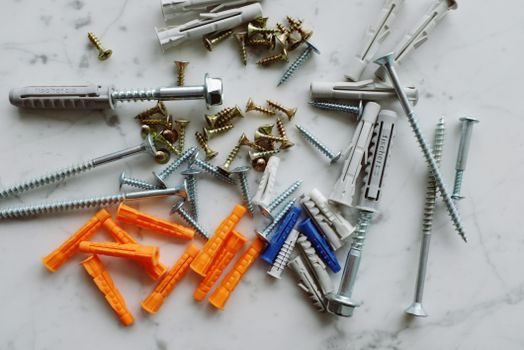
The substrate dictates more than the load. Solid concrete (non-cracked C12/15-C50/60) accepts every system; cracked concrete requires an ETA Option 1 system; solid brick is generally fine with injection systems; hollow brick requires a sleeve or anchor sleeve to give the resin a keying surface; cellular or aerated concrete needs low-pressure injection and a matched stud profile; natural stone and rebar starter bars are a separate specialty use case [S3][S6][S8].
Index datasheets list base materials in a fixed order: cellular concrete, concrete, stone, solid brick, reinforced concrete, hollow brick, and the installer must confirm the actual substrate matches the approval before drilling, because mixing substrates voids the design assumption [S6]. Ramset's anchor-studs literature makes the same point in plain language: chemical anchors do not impose expansion stress on the substrate, so they are the correct choice for close-to-edge fixings, close anchor spacings, and starter-bar splicing where mechanical anchors would crack the parent concrete [S8].
Field failures tracked back to the same three root causes: under-cured resin (wrong cure grade for the ambient temperature), over-filled or under-filled holes (injection systems), and stud-grade mismatch (carbon-steel stud in a corrosive environment). All three are eliminated by writing the cure grade, the resin name, the stud material, and the ETA option into the drawing notes rather than leaving them to the installer. A deeper treatment of how mechanical and chemical systems compare on the same jobs is laid out in our expansion-anchor installation field steps writeup.
Standards, approvals, and sourcing checkpoints
Third-party approvals are the dividing line between "fastener" and "structural fixing." The dominant schemes are the European Technical Assessment (ETA) issued under EAD 330499 for bonded anchors, ICC-ES AC308 for the North American market, and the UK Technical Assessment (UKTA) post-Brexit; on top of these, stud materials are governed by EN ISO 1461 for hot-dip galvanizing, ISO 3506 for stainless steel grades (A2/A4/HCR), and EN 1992-4 (Eurocode 2 Part 4) for design of post-installed fasteners in concrete. The MKT V system explicitly cites its ETA assessment for non-cracked concrete and its EN ISO 1461 >40 μm galvanizing, and exposes grade 8.8 as an on-demand upgrade [S3].
Sourcing checkpoints for procurement are the same four each time: (1) the resin system name and its current ETA or ICC-ES report number, with the approval option (cracked vs non-cracked, masonry, seismic); (2) the stud diameter, embedment depth, and drill diameter as a matched set, not as independent numbers; (3) the stud material grade and corrosion class matched to the environment, with the standard called out (e.g. A4-316 per ISO 3506); and (4) the cure grade and the substrate temperature window at the time of installation. Trackable signals worth watching into 2026 are the continuing shift of manufacturer catalogs from capsule systems toward injection systems for cracked-concrete and seismic approvals, the slow displacement of polyester by vinylester hybrid as the default mid-tier resin, and tighter ETA wording on recycled-aggregate concrete where bond-stress reduction factors are still under review.
The underlying component specifications are covered under chemical anchor, chemical reagent, and expansion anchor.