
A 2026 chemical-plant protective clothing programme is governed by CEN/TR 15419:2017, the European technical report that walks specifiers from hazard assessment through garment material selection, use, care, and maintenance of chemical protective clothing (CPC) [S2].
The same hazard-then-risk-then-garment logic is codified in GB/T 24536-2009 for Chinese plants, covering fully encapsulated and partial-body garments used in routine operations and emergency response [S3]. For US procurement, ASTM F1001-99a(2006) provides the standard challenge chemical list used to benchmark permeation data when comparing candidate suit materials [S5].
The Types 1-6 envelope: which suit for which plant task
EN 943-1 and the related Type standards define six CPC envelopes: Type 1 fully encapsulated (gas-tight), Type 1c with respirator on the outside, Type 2 positive-pressure non-gas-tight, Type 3 liquid-jet tight, Type 4 spray tight, Type 5 particulate tight, and Type 6 light spray limited [S2]. For a typical chemical plant, Type 3 or 4 coverall plus a Type 1 suit staged at the emergency shower is the common configuration; Type 1 is reserved for unknown atmospheres or IDLH entry where permeation data alone cannot justify a lower Type.
Selection starts with the chemical inventory, not the suit catalogue. CEN/TR 15419:2017 §4.2 (assessment of the nature of the hazard) requires the specifier to list the chemicals, their physical state, concentration, temperature, and contact mode (splash, jet, vapour) before any garment is shortlisted [S2]. Mapping the worst-case contact mode to the Type envelope prevents the common over-spec of Type 1 for routine sampling tasks that only need a Type 4 with the right face-seal.
For molten-metal work adjacent to reactors (casting, ladle transfer), the same hazard-then-garment flow is illustrated by HSE: a Level 3 incident with molten aluminium requires jacket and trousers marked D3 under EN ISO 11612, not a chemical Type 1 suit, because the dominant hazard is thermal, not permeation [S4]. Confusing thermal-protective and chemical-protective standards is one of the most common audit findings on multi-hazard plant PPE matrices.
Permeation, penetration, and the ASTM F1001 challenge list
Two failure modes drive chemical CPC rejection: permeation (molecular diffusion through the material at the nano-scale) and penetration (bulk flow through seams, closures, or pinholes). CEN/TR 15419:2017 §4.6.2 (chemical barrier properties) requires both breakthrough time and permeation rate data, normally tested to EN 374-3 or ASTM F739, and demands that the test chemical matches the in-service chemical, not a generic surrogate [S2].
ASTM F1001-99a(2006) defines the 15-chemical reference list (acetone, acetonitrile, ammonia, 1,3-butadiene, carbon disulfide, chlorine, dichloromethane, diethylamine, dimethyl formamide, ethyl acetate, ethylene oxide, hexane, methanol, methyl chloride, nitrobenzene, sodium hydroxide, sulfuric acid, tetrachloroethylene, tetrahydrofuran, toluene) used by US labs to rank candidate CPC materials when in-service data is unavailable [S5]. The list is explicitly a screening tool, not a definitive characterisation: the standard notes that test results are for material comparison only, and any in-service deployment requires testing against the actual plant chemical [S5].
Permeation data should be read as a three-number set: breakthrough time in minutes, permeation rate in microgram per square centimetre per minute, and the normalised breakthrough time. Reject any candidate whose breakthrough time on your worst-case chemical falls below the planned task duration plus a 6x safety margin, the conventional minimum used in EU plant procurement per the CEN/TR 15419 framework [S2].
Dexterity, heat stress, and the human-factors tax
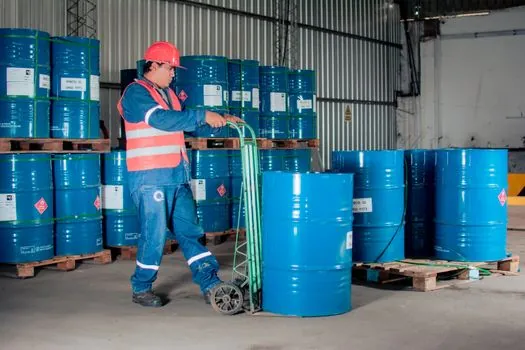
Protective clothing imposes a measurable dexterity and metabolic tax that the specifier must price in. The Springer 2020 manual-dexterity study (cited as the baseline human-factors data set in 2026 PPE reviews) reported bare-hand task completion at 45.97 ± 5.87 s, glove-only at 127.36 ± 45.45 s, and full CPC at 129.44 ± 48.77 s, a roughly 2.8x slowdown with no statistically significant difference between glove-only and full suit [S1]. For multi-hour sampling or valve-lineup work, that ratio translates directly into lost-unit-of-production cost.
The same study's practical finding: glove-only dexterity testing is a valid proxy for full-suit dexterity when ranking candidates, so laboratories do not need to run full-encapsulation trials just to compare fine-motor impact [S1]. For glove work specifically, where chemical permeation is the driver, see the food-processing glove selection guide for the polymer-comparison logic that also applies to chemical-plant gauntlets, and the warehouse safety glove reference for EN 388 / EN 511 mechanical and cold-rated selection when a single glove must satisfy both chemical and mechanical hazards.
Heat stress is the second tax. Encapsulated suits defeat convective cooling, and Type 1 work-rest cycles in plant procedures are normally capped using WBGT (wet-bulb globe temperature) rather than ambient temperature; CEN/TR 15419:2017 §5.4 (documentation) requires the specifier to record the work-rest regime alongside the garment choice, and any deviation needs a re-justified selection record [S2].
Decision matrix: matching plant task to Type and material family
A practical 2026 selection matrix for chemical-plant tasks lines four common scenarios against decision criteria (Type envelope, common material families, permeation test basis, dexterity cost):
Routine sampling of low-hazard liquids (caustic, dilute acid at ambient temperature): Type 6 coverall, single- or multi-layer SMS polypropylene or polyethylene-coated fabric, tested to EN 374-3 with the actual chemical, dexterity cost low (1.2-1.5x bare-hand baseline), suits staged at each sample point.
Open-batch chemical transfer with splash risk (solvents, intermediates): Type 4 coverall with sealed seams, fluoropolymer-coated or multi-layer laminate (e.g. Tyvek/Saranex-class laminates), tested to EN 374-3 plus ASTM F739 with the in-service solvent at operating temperature, dexterity cost moderate (2-2.5x baseline), with a Type 1 suit reserved at the boundary for escalation.
Emergency response to an unknown spill or gas release: Type 1a (gas-tight) fully encapsulated suit, multilayer barrier laminate (often chlorinated polyethylene or proprietary fluoroelastomer on a chemical barrier substrate), permeation data against the F1001 reference list as a minimum, dexterity cost high (2.8x or more), team-based with defined work-rest cycles.
Adjacent molten-metal hazard (e.g. reactor or furnace area): chemical Type 3/4 plus EN ISO 11612 D3 thermal layer for aluminium or E1 for iron, marking code verified on the label, garment change rules stricter because laundering degrades both the chemical barrier and the thermal layer simultaneously [S4]. For an oil-and-gas adjacent view of the same matrix, the protective clothing selection for oil and gas facilities reference applies the same Type logic to upstream hazardous-area zoning.
Use, decontamination, and the maintenance record

CEN/TR 15419:2017 §6 (Care) requires a written decontamination and cleaning procedure for every CPC model in service, with the cleaning agent verified compatible with the suit material (some fluoropolymer laminates are attacked by certain industrial degreasers) [S2]. Re-issue without a documented decon step is one of the most common REACH and OSHA audit findings; the specifier, not the laundry, owns the chemical compatibility statement.
Inspection (§7.2) is age-driven: thermal and UV ageing degrade barrier polymers, and CEN/TR 15419 lists ageing factors (storage temperature, light exposure, flexing) that the user must record on a per-garment log. A practical 2026 rule used by European operators is mandatory retirement after 5 years from manufacture for stored Type 1 suits, or sooner if the visual or pressure-hold test fails, even when the suit has never been deployed [S2].
Training (§5.3) and documentation (§5.4) close the loop: the user must demonstrate donning, doffing, and decon drills on the actual model, and the employer must retain the training record, the hazard assessment, the chemical inventory, the permeation data, and the cleaning log as a single auditable package. For deeper standards context on the chemical-resistant material families used in CPC, the chemical material reference and chemical reagent reference index the in-service chemicals the suit is rated against.
Failure modes and constraints the specifier must price in
Three failure modes recur across 2024-2026 plant PPE reviews and should be priced into the selection from the start, not discovered in the field. First, permeation at temperature: most published breakthrough times are at 23 °C, and a 40 °C process stream can cut breakthrough time by a factor of 4 or more for many barrier polymers; always request elevated-temperature permeation data when the in-service chemical is heated [S2]. Second, seam and closure bypass: Type 3 and Type 4 ratings depend on seam construction (welded, taped, or stitched with barrier thread), and the label marking alone does not prove the field-supplied garment uses the same seam; require lot-traceable seam data from the manufacturer. Third, gas-phase exposure below the LEL: organic vapours permeate many Type 4 laminates rapidly, so any task with vapour exposure above 10% of the LEL needs a Type 1 or Type 2 positive-pressure envelope, not a splash suit.
Standard watch-items: confirm that the cited standard is the current revision in force in your jurisdiction before procurement; CEN/TR 15419:2017 supersedes CEN/TR 15419:2006, and GB/T 24536-2009 remains the live Chinese national standard for selection, use, and maintenance of chemical protective clothing [S2][S3]. For the broader PPE spec frame that CPC sits inside, the protective clothing reference page indexes the Type system, the EN 943 / EN 14605 / EN ISO 13982 family, and the test methods a 2026 plant PPE matrix should reference.
Trackable signals for the next procurement cycle: (1) any revision activity around EN 943-1 or its companion standards under CEN/TC 162 WG 3, the working group responsible for the CPC family that CEN/TR 15419:2017 supports; (2) extension of ASTM F1001-style challenge lists to new chemical families, particularly the lithium-battery electrolyte surrogates now entering plant PPE matrices; (3) plant-level reporting of Type 1 suit retirement-age compliance, since 5-year stored-suit retirement is the most commonly missed maintenance gate. None of these signals are speculative; they are the routine 2026 audit and standardisation tracking points a chemical-plant PPE owner should already be logging.