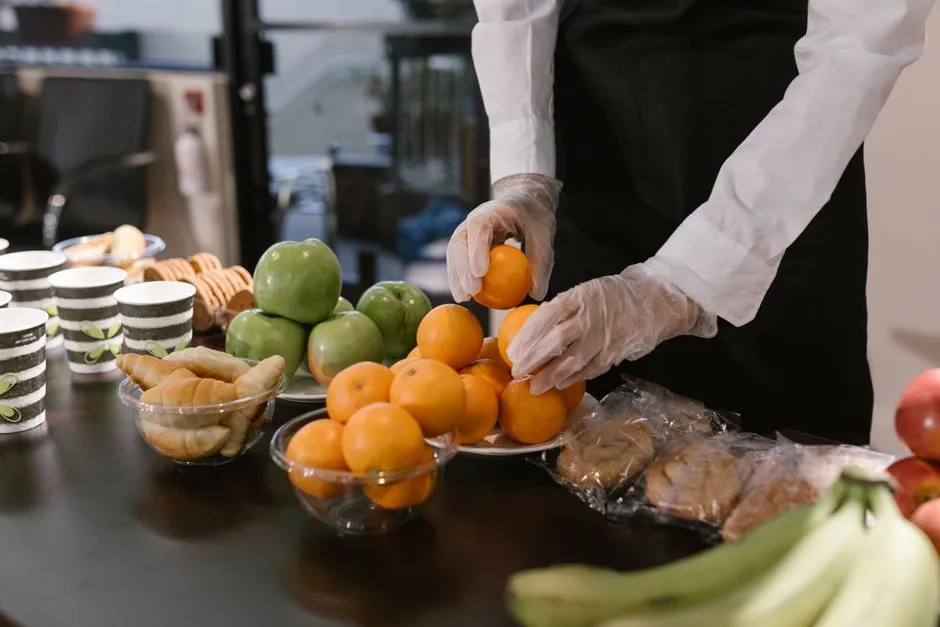
Food-contact glove selection in 2026 is dominated by four disposable polymers (nitrile, latex, vinyl, polyethylene), with nitrile increasingly the default for prep stations because it is latex-free, puncture-resistant, and tolerates longer wear [S6][S4]. Vinyl and polyethylene remain the cheap options for short tasks and frequent changeovers, while natural latex is being phased out of many operations over allergy concerns [S3][S5].
Selection is not a single SKU decision: prep, raw-to-ready transitions, hot sanitation, and sharp-edge deboning each carry different durability, fit, and migration-risk requirements, so most operations stock two or three glove types side by side [S4][S8]. Local jurisdictions adopt the FDA Food Code as model guidance, often with modifications, so glove choice must be paired with the local health-department rule and the plant's written change procedure [S4].
The four food-contact polymers and what each one actually does
Polyethylene (PE) is the cheapest food-safe disposable and is rated for light duty only: sandwich assembly, deli counter work, bakery finishing, and any task that needs very fast, very frequent changes; it is loose-fitting, transparent, and prone to rip under load, so it is not used for heavy prep [S3][S5].
Latex is natural-rubber, elastic, and tactile, with a strong pathogen barrier, but it carries a documented allergy risk to both worker and end consumer, and foodservice adoption is shrinking on that ground [S3][S4]. Vinyl (PVC) is latex-free, cheaper than nitrile, and adequate for short-duration, lower-risk handling, but the polymer may contain plasticizers that can migrate into food on contact and its pathogen barrier is weaker than nitrile or latex [S3].
Nitrile is a synthetic rubber, latex-free, available in multiple thicknesses and textures, with better puncture resistance than vinyl and PE, and is now the recommended all-rounder for prep, longer wear, and latex-sensitive teams [S4][S6][S3]. Neoprene is explicitly <em>not</em> a food-contact glove; it shows up only where hot water sanitization (three-compartment sink) demands a heat-resistant material separate from food handling [S3].
Selection criteria: match polymer to task, fit, and change frequency
The 2026 buyer checklist, repeated across glove guides, is consistent: map tasks first, then drive polymer choice by change frequency, allergy risk, fit range, and food-contact suitability [S4][S5]. Operators are advised to buy gloves specifically labelled for food handling, stock multiple sizes (poor fit causes slip, snag, and tear), and avoid a one-box-for-every-station approach because prep, serving, cleaning, and dishwashing each carry different contamination pressure [S4].
A practical task mapping that aligns with the 2026 guidance: nitrile for prep, longer wear, and any latex-free line; vinyl for short, low-risk handling where cost dominates; PE for high-churn, light-duty stations; latex only where the operation has screened for allergy and explicitly accepts the risk [S4]. Powdered gloves are prohibited by the FDA for food handling, so all stocked SKUs must be powder-free, and biodegradable plant-based nitrile and compostable PE are listed as FDA-compliant options for sustainability-driven buyers [S5].
Change rules and the contamination model behind them

A glove program fails at the change step, not the material step. Published guidance lists ten trigger events that force a glove change: after raw protein, before ready-to-eat, after cleaning or sanitizing, after touching face or hair, after phone or money, on station change, and on any tear or visible contamination [S4].
Disposable gloves are not to be washed, disinfected, reused, or shared; the FDA medical-glove prohibition on reuse is the same practical rule the 2026 foodservice guides apply to disposable food-contact gloves, and it is the rule auditors look for first [S4][S5]. A glove program is judged on whether workers actually change at the trigger, which is why the physical location of the glove box (next to the change-event station) matters as much as the SKU inside [S4].
Durability, cut, and heat: where disposable polymers hit their limits
For meat deboning, fillet lines, and any sharp-edge contact, 2026 industrial guidance says selection must add cut level, coating, gauge, and worker acceptance to the polymer list: a thin disposable nitrile will not survive blade contact, and a PE glove is wrong for that station on duty cycle alone [S8]. Nitrile disposable gloves are widely specified for their puncture resistance compared to vinyl and latex, but that is a relative statement about the disposable category, not a replacement for an ANSI/ISEA 105-rated cut glove on a deboning table [S6][S8].
For hot-water sanitation of three-compartment sinks, neoprene is the heat-tolerant option, but neoprene is not a food-contact material; the operation carries two glove types at the dish station, a neoprene over-glove for hot immersion and a PE or nitrile for handling cleaned items back into service [S3]. This dual-glove pattern is a recurring 2026 spec point for any plant that runs both prep and warewashing on the same line [S4].
Where nitrile is the right call, and where it is overkill
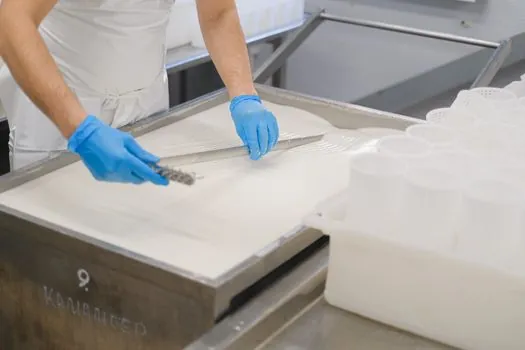
Nitrile is the right call for prep cooks running multi-hour stations, for any latex-sensitive operation, and for any task that demands a better puncture barrier than vinyl or PE at a moderate price premium [S6][S4]. Nitrile is overkill for a register-side sandwich assembler who changes every 90 seconds: PE does that job at lower unit cost, with a faster change motion, and a smaller waste stream per shift [S3][S5].
Latex remains a defensible choice only in operations that have screened workers and customers, controlled the protein-allergen risk, and explicitly accept that nitrile and vinyl now dominate buyer guides as the safer default [S3][S4]. Vinyl stays in the program for short, low-risk, low-budget stations, but 2026 guidance is moving toward reducing vinyl on chemical-migration and pathogen-barrier grounds, with nitrile absorbing the volume [S3][S6].
Buying gates and what to verify on the spec sheet
The non-negotiable spec-sheet checks for a 2026 food-processing glove purchase: FDA food-contact compliance statement on the box, powder-free labelling, polymer identification, available size run that matches the workforce, and an explicit food-handling rather than medical/exam designation if the use case is foodservice [S5][S4]. For cut or heat stations, the spec sheet must additionally carry an ANSI/ISEA 105 cut level and an indicated temperature or coating rating, matched to the station hazard inventory, not inferred from the disposable SKU [S8].
For related process lines, the same polymer-and-change discipline shows up in adjacent plant buying, including the chemical-plant glove gate covered in Chemical-Plant Safety Glove Selection: Polymer, Thickness, and EN 374 Gates and the food-grade mechanical spec gates covered in Linear bearing selection for food processing: 2026 spec gates; the latter is the cleanest cross-reference for any food-plant engineer building a single spec language across gloves and machine components. For the broader PPE context around hand protection in a plant, see safety gloves, and for the station-level hand-hygiene controls adjacent to glove use, see food safety and machine safety for the surrounding barrier and guarding decisions that interact with glove change discipline.
Trackable signals to watch over the next procurement cycle: vendor migration of foodservice SKUs from vinyl toward nitrile and biodegradable nitrile, expansion of FDA-cleared compostable PE offerings, and any local health-department amendment to the FDA Food Code that tightens or loosens the powder-free rule [S5][S4].