
China's LNG import strategy in 2026 is defined by a single number: Qatar supplied roughly 30% of Chinese LNG in 2025, and the 2026 Hormuz closure has forced Chinese buyers to retool their sourcing map on a cargo-by-cargo basis [S3]. That 30% is being backfilled by a wider seller set, with Canada and Nigeria among the named replacement origins, while spot price arbitrage is once again opening the seaborne import tap after the spring trough [S3].
For a procurement engineer the relevant questions are not abstract: which contract structures survive, which spot signals trigger reloads, and which Chinese terminals can flex receipt volumes. The data points below (weekly Hormuz flow, inventory buffer, Guangdong trucked-LNG premium, recovery in the 30-day moving average) come from the S2 and S3 reporting windows, March through May 2026.
Scope: What "China LNG Sourcing" Actually Means in 2026
Sourcing from China, in the 2026 context, covers two distinct flows: outbound Chinese equipment and engineering services into global LNG projects, and inbound LNG cargoes landing at Chinese terminals. This article concentrates on the inbound flow, where the 2026 Middle East shock has rewritten the buyer's checklist. The reference point is China as the world's largest LNG importer transiting Hormuz, with weekly Strait-bound volumes averaging 400,000 metric tons in March 2025, all sourced from Qatar, and representing approximately 24 percent of total weekly LNG exports through the channel [S2].
The 2025 inbound baseline was significant: Qatar alone held roughly 30% of Chinese LNG volume, a single-supplier exposure that became the focal risk once exports halted [S3]. The aggregate 2025 Chinese energy import basket was 642 million metric tons of crude, refined fuels, LNG, and LPG, of which 317 million tons, or 49.4%, came from Middle East-based suppliers [S4]. That concentration is the structural reason the 2026 shock hit LNG harder than other streams.
Selection Criteria: Which Cargo Structures Survive the 2026 Shock
Three criteria separate workable 2026 cargoes from unworkable ones, and each maps to a specific data point in the reporting. First, source diversification. Qatar, which accounted for around 30 per cent of China's LNG in 2025, has been forced to halt exports, with sellers from Canada to Nigeria explicitly named as replacement suppliers in the May 2026 reporting window [S3]. Second, delivery flexibility. Buyers who can divert cargoes between terminals and between provinces have a measurable edge, because Guangdong's trucked LNG benchmark jumped nearly 70% from March to May 2026, the highest since 2023, while overseas spot LNG landed below that domestic price, reopening the import arbitrage [S3]. Third, contract length versus spot exposure. Long-term offtake tied to a single origin proved the weakest structure in the Qatari disruption; the recovery in the 30-day moving-average import flow through May 2026 was driven by spot and short-term tenders, including cargoes bought by Guangdong Energy Group for May lifting and a Zhejiang Provincial Energy Group tender for June and July shipments [S3].
The same logic flows into long-lead LNG equipment procurement, where project teams now demand fabricator responses from Korea, China, Europe, and North America normalized onto common commercial terms, including currency provisions and shipping conventions [S5]. For a comparison of how regional fabricators stack up on multi-billion-dollar LNG packages, see the broader procurement reference at RFQ intelligence for liquefaction trains, storage tanks, and marine loading systems.
Who This Sourcing Map Is For, and Who It Is Not For

This is a buyer's playbook for the 2026 disruption window. It is for procurement and trading desks at Chinese utilities, provincial energy groups, and independent importers who need a decision framework right now, and it is for non-Chinese LNG sellers sizing the replacement-vessel opportunity. The shipping-route engineering community will also find the weekly Hormuz flow figure and the Qatar share useful as inputs to fleet-deployment models. The same 2026 reporting shows that Chinese buyers can fall back on domestic production, pipeline gas, coal, and renewables, which is a luxury most other Asian importers do not have [S3].
It is not for end consumers, residential gas users, or LNG equipment OEMs in non-LNG sectors. The 2026 shock is specifically a Qatari-origin, Hormuz-routed, seaborne-LNG problem; downstream city-gas distribution, pipeline interconnectors, and underground gas storage sit outside the scope of this sourcing map. Underground storage levels, while not quantified, are expected to exceed 2025 figures, which is part of the cushion but not a replacement cargo [S2].
Decision Map: Comparing 2026 Replacement Options Against Four Criteria
Four replacement paths are open to Chinese buyers in 2026, and they trade off against origin diversification, price, lead time, and infrastructure fit. The reference data is anchored in the 2026 reporting, not in generic industry chatter. [S3]
Long-term Qatari offtake renegotiated post-Hormuz: high origin concentration risk, contractually locked pricing, longest lead time, but best fit with existing terminal slots. Replacement spot and short-term tenders from Canada, Nigeria, and other non-Qatari sellers: high diversification, priced off the 2026 spot curve, lead time of 4 to 8 weeks, fits any regas terminal. Domestic production and pipeline gas: zero origin risk, regulated pricing, immediate availability, but capped by plateau output and pipeline capacity. Coal-to-gas switching and renewable dispatch: zero seaborne risk, dispatchable, useful for power-sector load shedding, but cannot cover industrial heat or residential gas demand.
The 2026 spot signals support option two over option one. Guangdong trucked LNG at Argus Media's May 2026 level is now above the overseas spot landed price, so import cargoes sold into the domestic market are again economic [S3]. That is the trigger that pulled Guangdong Energy Group and Zhejiang Provincial Energy Group back into the tender book in May 2026, and it is the same trigger that drove the 30-day moving-average import volume up to its highest level since February, although still below the five-year average [S3].
Inventory and Price Signals: The 2026 Buffer Numbers
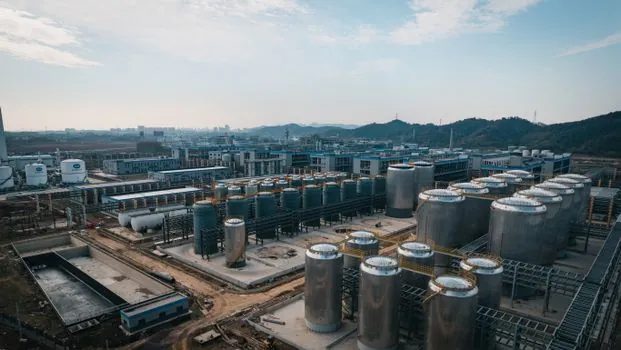
China entered the 2026 disruption with measurable cushion. End-of-February 2026 LNG inventories stood at approximately 6.8 million tons, roughly 200,000 tons above the already elevated 2025 level, and well above the seasonal low of 5.4 million tons recorded in summer 2025 [S2]. On a flow basis, that inventory equates to about three to four weeks of supply cover, with the warmer-than-average winter capping consumption and leaving the extra gas in the tank [S2]. The cushion is the reason BloombergNEF's March 2026 assessment rated a multi-month Hormuz closure as a low-probability scenario for China's overall supply chain, even as spot prices soared [S2].
On the price side, the May 2026 Guangdong trucked LNG benchmark is the cleanest leading indicator, up nearly 70% from March, the highest since 2023, and now trading above overseas spot landed LNG, which is what flipped the import arbitrage back on [S3]. Sourcing teams who locked term cargoes through the spring trough are now sitting on mark-to-market gains versus spot; teams who did not are paying replacement premium into the summer cooling-demand window, which the European Centre for Medium-Range Weather Forecasts flagged as above-normal across southern China through end-May 2026, with El Nino risk layered on for the back half of the year [S3].
Failure Modes and Sourcing Pitfalls in 2026
Three failure modes deserve explicit names. First, single-origin offtake: any 2026 contract that replicates the 30% Qatari concentration is a structured risk, regardless of price [S3]. Second, ignoring the inventory-to-spot arbitrage: buyers who held inventory through the spring and did not release into Guangdong's 70% benchmark spike left margin on the table [S3]. Third, leaning on Hormuz-routed term cargoes that bypass the Strait: Kpler-tracked flows show some LNG carriers avoiding the Strait entirely during the May 2026 reporting window, which extends voyage times and erodes the spot arbitrage [S2][S3].
The structural risk runs in the other direction too. The China National Petroleum Corp Economics and Technology Research Institute has publicly cautioned that an extended Hormuz closure would still trigger global market turbulence even if China's domestic supply chain held, a quote worth re-reading: while an extended closure "would undoubtedly trigger global market turbulence, it is improbable that it would significantly undermine China's overall supply chain or import consistency" [S2]. Sourcing teams should price that scenario, not dismiss it.
Standards, Sourcing Discipline, and Trackable 2026 Signals

No single ISO or API standard governs LNG cargo sourcing itself, but procurement discipline follows the same documentation pattern required for owner, lender, and regulator scrutiny on the equipment side, with assumption-driven pricing detection, long-lead equipment tracking, and global fabricator normalization treated as standard practice on multi-billion-dollar LNG packages [S5]. For Chinese utilities managing the 2026 replacement flow, the equivalent discipline is multi-origin qualification, contract-clause audit on force majeure and routing, and a standing spot-tender cadence tied to domestic price benchmarks like the Argus Guangdong trucked-LNG series [S3].
Two trackable signals will define the rest of 2026. First, the 30-day moving-average LNG import flow: if it crosses the five-year average before Q3 2026, the recovery is structural; if it stalls below, the import arbitrage has closed and domestic supply is doing the work [S3]. Sourcing teams should pin both numbers to their weekly review.
Spec-level background on the components involved: linear guide, crossed roller guide, and pressure transmitter.