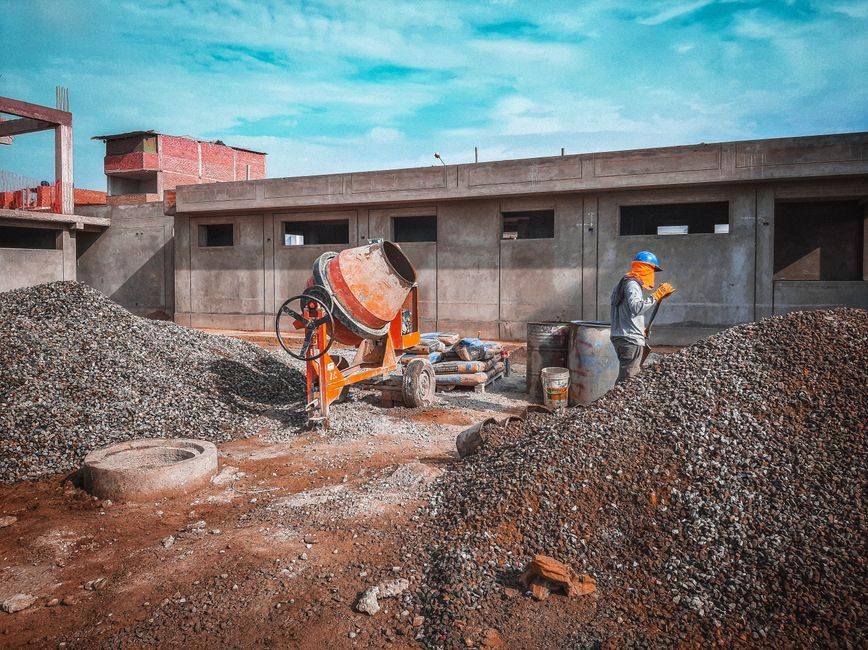
Concrete batching plant selection is driven by four interlocking spec bands — nominal hourly output (typically 25–180 m³/h for commercial units), mixer shaft configuration, aggregate feeding topology (skip hoist vs belt conveyor), and mobility class — all of which must be locked before any sourcing inquiry is issued [S3][S4].
The plant class on offer in 2026 spans small stationary HZS25 units (rated 25 m³/h) through HZS180 belt-conveyor configurations (180 m³/h), plus mobile YHZS25/35/60/75 trailer-mounted variants, with planetary, twin-shaft compulsory, and JZC/JZM rotary drum mixers covering the agitation side [S4][S6]. For buyers mapping a project to a specific model code, a working reference on concrete batching plant categories is the starting point, while downstream mix-quality decisions often hinge on the concrete admixture dosing interface built into the plant's weighing skid.
Capacity Bands and Project-Fit Logic
Chinese OEM line-ups published in 2026 cluster commercial stationary plants into four output tiers: HZS25 (~25 m³/h) for small precast yards and rural site batches; HZS60 (~60 m³/h) for medium commercial pours; HZS90 (~90 m³/h) for ready-mix depots serving residential blocks; and HZS180 (~180 m³/h) for highway, bridge and high-rise continuous-supply contracts [S3][S4]. The 90 m³/h belt-conveyor class is positioned as a balanced tier whose value is the full process chain — on-site deployment, continuous production, and long-term O&M — rather than the headline capacity number alone [S3].
Where output requirements are bursty, the mobile YHZS60 (~60 m³/h) and YHZS75 (~75 m³/h) trailer units allow redeployment between phases without foundation civil works [S4].
Mixer Selection: Twin-Shaft, Planetary, Rotary Drum
Three mixer families dominate the 2026 spec sheets: JS-series twin-shaft compulsory mixers (JS500, JS750 and larger) for high-intensity, short-cycle commercial output; MP-series planetary mixers (e.g. MP750) for dry-mortar, precast and high-homogeneity applications; and JZC/JZM rotary-drum mixers for low-cost, low-throughput site work [S4][S5][S6]. The planetary MP750 covers the entire mixing region through several groups of mixing arms arranged on a central gearbox, which is the structural feature that makes it preferred for self-levelling screed and special-mortar production [S6].
Twin-shaft units such as the JS750 typically carry a 750-litre input per batch and are the default on HZS60 and HZS90 mainframes [S4]. For specialty mortar lines — tile adhesive, self-levelling underlayment, thermal-insulation render — single-shaft paddle and double-shaft non-gravity dry-mortar mixers are specified instead of the concrete-drum family, because the lower water content and binder-rich recipes punish drum-style agitation [S5]. Buyers should pin the mixer model code on the quote; "JS750" or "MP750" tells the engineer the batch volume, the lining wear-parts family, and the maximum aggregate size the gearbox can swallow.
Aggregate Feeding: Skip Hoist vs Belt Conveyor
Aggregate transport from the bin tower to the weigh hopper is the single biggest driver of plant height, foundation cost and cycle time. Skip-hoist plants (most YHZS mobile units and smaller HZS models) lift aggregates in a tipping bucket up the side of the plant, which keeps the structural footprint narrow but caps practical output near the 60–75 m³/h band due to single-bucket cycle limits [S4]. Belt-conveyor plants use an inclined or enclosed belt to feed aggregates and scale cleanly into the 90 m³/h, 120 m³/h and 180 m³/h classes where the skip cycle becomes the bottleneck [S3].
Site geometry often decides this before capacity does. A skip-hoist plant fits inside a 12 m × 6 m compound and needs only a flat stone-base pad; a belt-conveyor HZS180 typically needs 18 m × 14 m of level ground plus clearance for the inclined conveyor, which on confined urban ready-mix yards is frequently the deciding constraint. The 90 m³/h belt-conveyor OEM literature for 2026 explicitly markets the conveyor variant on deployment adaptability rather than raw throughput, which is a signal that civil-work cost — not capacity — is where these two topologies diverge commercially [S3].
Stationary vs Mobile: When Each Pays Back
Stationary HZS-series plants assume a multi-year fixed-site deployment and amortise the civil foundation, aggregate bins and conveyor structure over thousands of hours; they are the correct pick for ready-mix suppliers, precast factories and large infrastructure projects with a defined two-to-five-year horizon [S3][S4]. Mobile YHZS-series plants are trailer-mounted with folding conveyors or integrated skip hoists, require no permanent foundation, and can be commissioned in 24–48 hours on a hardstand — they suit short-cycle highway, wind-farm and remote-area pours where redeployment frequency exceeds 12 months [S4].
For capacity-anchored side-by-side comparison across the four most common 2026 commercial models, the following applies: HZS25 (25 m³/h, stationary, single-shaft/small twin-shaft mixer, skip hoist) suits <0.2 M m³ annual programmes; HZS60 (60 m³/h, stationary, JS750 twin-shaft, skip hoist) suits 0.1–0.4 M m³; HZS90 (90 m³/h, stationary, twin-shaft, belt conveyor) suits 0.3–0.6 M m³; YHZS60 (60 m³/h, mobile, twin-shaft, skip hoist) suits projects of 0.05–0.2 M m³ on rotating sites [S3][S4]. Below 25 m³/h, buyers should evaluate a concrete vibrator-anchored site-mix workflow instead of a fixed plant.
Weighing, Batching Accuracy and Additive Dosing

Mix-design conformity is set by the load-cell cluster on the aggregate, cement, water and admixture weigh hoppers. Commercial 2026 plants quote aggregate weighing accuracy typically within ±2% and cement/water weighing within ±1%, with admixture metering through a separate volumetric or gravimetric pump skid controlled from the same PLC as the aggregate cycle [S2]. The batching sequence — aggregate loaded via conveyor or skip, weighed in sequence, discharged into the mixer, cement and water injected mid-cycle, admixture dosed at the tail — is a closed timed loop on every commercial OEM line published in the 2026 catalogues [S2][S3].
The admixture interface is the dimension most often under-specified. Plants destined for ready-mix delivery or freeze-thaw-exposed structural concrete must support at least two admixture lines (a water-reducer and either a retarder or accelerator) with separate calibration, because a single shared dosing pump cannot meter two chemistries without cross-contamination. Buyers sourcing for high-durability mixes — bridge decks, marine substructures, SCC — should also confirm that the moisture probe on the sand bin is wired into the batching PLC, since sand moisture can swing 2–6% by mass and silently push the effective water/cement ratio above the mix-design target.
Power, Dust and Water-Recycle Constraints
A HZS90 twin-shaft plant typically draws 120–180 kW of installed power depending on the silo and conveyor options, with the mixer gearbox, aggregate conveyor and cement screw conveyors as the dominant loads; the generator or grid feed must be sized with a 25–30% headroom for inrush on the screw conveyors during silo refill [S3]. Dust collection at the cement silo, aggregate bin loading zone and mixer discharge hood is mandatory under most urban-jobsite permitting — pulse-jet bag filters with 99.9% capture on PM10 are standard on 2026 OEM builds [S3].
Water-recycle systems — settling tanks plus a clarified-water buffer feeding the mix-water line — are increasingly built into the plant skid rather than retrofitted, because the ready-mix market now treats wash-water recovery as a baseline cost-of-entry on urban sites. For projects where surface finish is critical (architectural concrete, white-cement facades, polished overlays), a chilled-water dosing loop and a concrete curing compound spray bar downstream of the placement line are typically scoped into the same supply contract — see the 2026 OEM line-up pages for the optional skid builds.
Sourcing Levers: Lead Time, MOQ, Spare-Parts Path

Lead time on a 2026 HZS-class stationary plant is typically 30–45 working days ex-works Zhengzhou for the standard catalogue, plus 20–30 days for sea freight to a European, Middle Eastern or African port; mobile YHZS units ship faster because the pre-assembly is higher and the foundation is omitted [S4]. Wholesale channels list concrete machinery with no formal MOQ on the plant itself, but pricing tiers typically step at one, two and four-unit thresholds, with the four-unit level unlocking OEM-direct container loads [S2].
For buyers comparing 2026 sourcing options, the most concrete lever is the spare-parts path: planetary gearbox seals, twin-shaft mixer liner plates, screw-conveyor hanger bearings, and load cells must all be stocked regionally or the plant will sit idle for weeks. A useful adjacent reference for matching ancillary equipment to plant capacity is the 2026 guide to truck-mounted concrete pump sizing, since the pump's m³/h rating has to be sized against — not above — the plant's rated output to avoid truck queuing at the mixer discharge. Verify on the quote that the OEM's after-sales desk has English-speaking technical staff, that the electrical schematic is delivered in IEC-compliant symbols, and that the warranty explicitly covers the mixer gearbox and weighing load cells — these three signals separate a buildable 2026 contract from a parts-bin write-off.