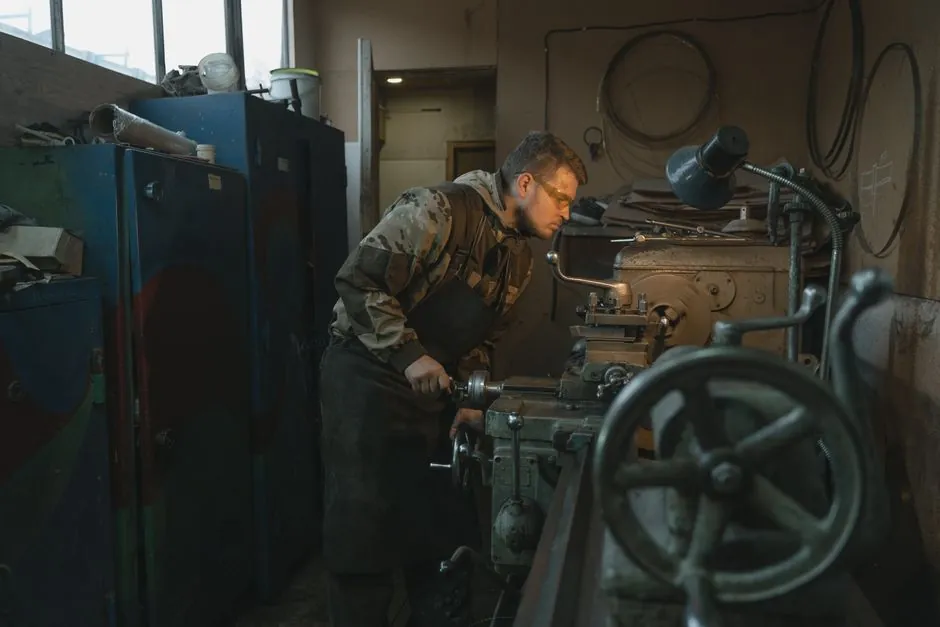
OEE at the bottleneck directly governs line output, while whole-line OEE measures good parts at the line exit against the constraint’s reference rate.
Bottleneck OEE diagnoses the machine that limits throughput; whole-line OEE evaluates the production system without averaging machine percentages.
Two OEE Levels Serve Different Decisions
Machine OEE is calculated from Availability, Performance, and Quality. Its operating meaning depends on machine role: improving the constraint can release more line output, whereas improving a non-constraint may create work-in-process without increasing shipments [S1][S2].
Whole-line OEE compares good parts leaving the final station with the output possible at the bottleneck rate. It is neither the arithmetic average nor the product of individual machine OEE values [S4]. A practical dashboard therefore needs both levels: line OEE for the business result and machine OEE for cause isolation.
The distinction is especially important in linked machining, assembly, filling, and packaging lines, where one station can run well while remaining idle because its upstream supplier is starved or its downstream destination is blocked [S4]. A detailed treatment of line OEE versus machine OEE is useful when the measurement definitions need formal alignment.
Choose Bottleneck OEE for Throughput Decisions
An hour lost at the constraint is an hour of output lost for the whole line, whereas an hour lost at a non-constraint machine is frequently absorbed by a buffer and costs nothing. Bottleneck OEE is therefore the preferred measure for capacity-release decisions, constraint-reduction projects, and prioritisation of maintenance or changeover work.
The illustrative case of five serial processes shows why indiscriminately maximising OEE is unsafe. A high OEE upstream of process C can jam material before the constraint, while a downstream machine cannot sustain high OEE if process C limits feed [S2]. In that configuration, improvement at process C is the intervention that raises system output [S2].
Bottleneck OEE is not suitable for judging total asset utilisation by itself. It omits whether quality losses, starvation, blocking, buffers, or another station constrain good output elsewhere. A low bottleneck OEE can also reflect excessive planned time that requires a schedule decision rather than a maintenance action.
Choose Whole-Line OEE for Output Performance

Whole-line OEE is appropriate when the required result is good finished units per available production time relative to the constraint’s reference rate [S4]. This definition links the KPI to physical output and avoids the averaging problem that makes a plant-level number difficult to interpret.
Line OEE is neither the average nor the product of machine OEE.
Whole-line OEE is the better selection for executive reporting, customer-service review, and comparing complete production systems. Its weakness is diagnostic resolution: it can reveal that output is below the reference rate, but it cannot by itself identify the responsible loss. Machine-level data remains necessary for root-cause analysis [S4].
Compare the Metrics Against Four Criteria
On throughput impact, bottleneck OEE has the direct causal relationship because the constraint sets the achievable line rate, while whole-line OEE captures the result after all interacting losses [S1][S4]. On diagnostic detail, machine OEE identifies breakdown, adjustment, changeover, micro-stop, speed, and quality losses at a station, whereas whole-line OEE identifies the net output gap [S4].
On comparability, whole-line OEE uses one line-level definition and an agreed bottleneck reference rate, while bottleneck OEE changes meaning if the constraint moves. The measured bottleneck must be confirmed over several weeks because nominal capacity does not always represent real capacity, and constraints can shift with product, format, or crew [S4].
On management use, bottleneck OEE supports constraint improvement, while whole-line OEE supports performance assessment and system balancing. The recommended operating model is to publish one line OEE, monitor the active bottleneck, and measure the bottleneck plus at least its immediate neighbours for action planning [S4].
Identify the Constraint from Measured Line Behaviour
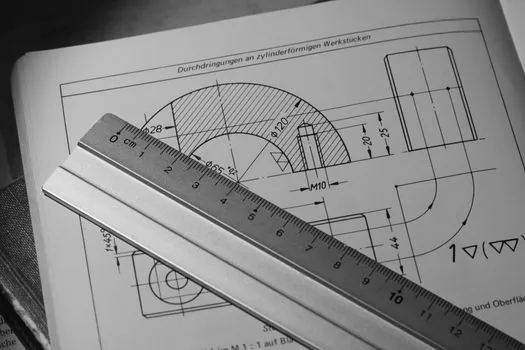
Three operational signals identify a likely bottleneck: the longest per-unit cycle time against nameplate capacity, the fullest upstream buffer, and downstream stations frequently waiting [S1]. The bottleneck sets the reference rate and is confirmed by measurement.
The nominal slowest machine is not automatically the real constraint. A faster station that stops frequently may produce less usable capacity, so stop measurements across several weeks are required [S4]. The active constraint should also be reassessed for each product family and format because the reference rate can move.
Machine states must be coded separately to avoid charging a station for induced waiting. An “own stop” covers breakdown, adjustment, changeover, and micro-stop; “starved” means the machine is ready but upstream supplies nothing; “blocked” means finished parts cannot leave because downstream is full; and “running” means the station is producing [S4].
Protect Measurement Integrity and Failure Modes
Availability, Performance, and Quality must use fixed definitions across shifts, products, and operators, because OEE is easily distorted when planned production time, micro-stops, or quality losses are counted inconsistently [S2]. Buffers must also be included in operating logic: a buffer that is too small propagates stops, while a buffer that is too large conceals stoppages and ties up work-in-process [S4].
Do not use high OEE as an objective when customer demand does not support the output. Lean guidance states, “Produce only what is needed, when it is needed and in the amount needed” [S2]. Raising non-constraint OEE can therefore create excess work-in-process, while improving the constraint can expose a second constraint, requiring the reference rate and action plan to be recalculated.
Whole-line OEE also needs a controlled counting boundary. The numerator is good parts leaving the line, and the denominator is the agreed available time and constraint reference rate; undocumented exclusions can turn the KPI into an administrative target rather than an engineering measure [S4].
Implement a Two-Layer OEE Control System
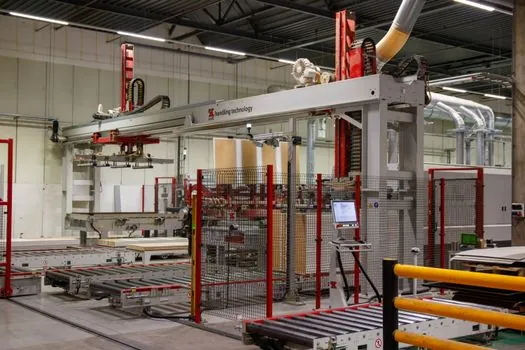
Start by validating the constraint through cycle-rate data, buffer occupancy, starvation, blocking, and a controlled stop test over multiple weeks [S1][S4]. Then define bottleneck OEE with its own Availability, Performance, and Quality loss codes, while defining whole-line OEE from good line output against the same validated reference rate.
Track the bottleneck and its immediate neighbours even when every station cannot be measured continuously. The active constraint, its OEE, line OEE, good-unit output, and top six loss codes form a compact control set with direct action ownership [S4]. Reconfirm the constraint whenever the product mix, format, crew, or major equipment configuration changes, because the line reference rate must remain physically valid.