
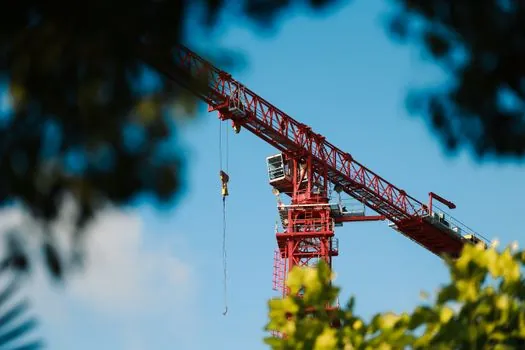
A hammerhead tower crane is identified on site by its horizontal jib and overhead counterjib forming a T-silhouette, while a luffing jib tower crane replaces that fixed arm with a lattice jib that pivots up and down from the tower top [S1][S6].
For project planners, the practical split is open high-volume sites favouring hammerhead units and confined urban or multi-crane sites favouring luffers, with cost, slewing clearance, and operator skill separating the two [S2][S3][S5].
Defining the Two Crane Geometries
A hammerhead, also called a saddle jib or topkit crane, carries a fixed horizontal jib with a counterjib and counterweight; the trolley travels radially out and back along the jib while the entire upper works slews 360° [S1][S8]. The lattice A-frame and cat-head above the slewing table give the silhouette its name.
A luffing jib tower crane keeps the same vertical mast and slewing table, but the jib is mounted on a luffing cylinder or pendant system that lets it pivot between a near-horizontal working angle and a near-vertical parked angle [S6][S8]. The motion is called luffing, and the geometry is what enables the jib to stand up vertically when idle or to clear an adjacent structure mid-swing.
Working Radius, Slewing Footprint, and Coverage
Hammerhead cranes offer long horizontal jibs (commonly 50–80 m on commercial high-rise units) and full 360° slewing, which makes them efficient for wide rectangular sites and material yards where the trolley can place a load at any radius on the jib [S1][S2].
Luffing jib cranes keep a smaller effective slewing radius because the raised jib angle pulls the load line inward, and the boom can be parked nearly vertical to swing over or under neighbouring towers without striking them [S3][S5][S8]. On tight urban plots where two or three cranes must overlap, this reduced tip-clearance envelope is often the deciding factor [S4][S7].
Lifting Capacity and How the Loads Are Carried
Capacity at radius depends on jib length, reeving, and counterweight package, but the consistent trend in vendor literature is that luffing jib units carry more at short radius relative to their own weight because the load is transferred along the inclined jib into the tower rather than creating a bending moment on a horizontal arm [S4]. BQ-Cranes states a luffing unit can out-lift a hammerhead of comparable class, with example ratings reaching 10 t and above at useful working radii on standard builds [S4].
Hammerhead units still lead on absolute jib-tip reach and on trolley speed, since horizontal traverse along a fixed jib is mechanically simpler than raising a luffing boom under load [S2][S3]. A general spec rule cited across multiple sources: choose hammerhead for reach and cycle speed, choose luffing for tip capacity at short radius in a tight envelope [S2][S3][S7].
Cost, Cycle Time, and Operator Skill
Both [S2] and [S7] report that luffing jib tower cranes cost more to buy, rent, and maintain because the luffing mechanism (cylinder, luffing winch, reeving, anti-two-block logic for a moving boom) is more complex than a fixed jib plus trolley. Cycle times are also slower: a trolley radial move on a hammerhead is faster than luffing a jib up and down under load [S2].
Operator skill requirements scale with the same axis, since luffing under load demands precise coordination of hoist, luff, and slewing, and sources note that a less experienced operator is more at risk on a luffing unit [S2]. Mechanic familiarity, parts commonality, and the size of the local hammerhead fleet are practical reasons why a hammerhead is often the cheaper, easier-to-staff choice on open sites [S1][S2].
Site Fit: Open Yards vs Congested Urban Cores

Open, spacious sites such as stadium, power-plant, refinery, and large low-rise commercial builds suit hammerhead units: full 360° coverage, long jibs, and multiple cranes can be planned on a simple radial grid [S1][S2]. Mazzella, Plant & Equipment, and Maxim all converge on this site-type recommendation [S1][S2][S6][S7].
Congested urban high-rise sites, sites with adjacent existing buildings, or sites where multiple tower cranes must overlap in the same airspace are the canonical luffing case [S3][S5][S7]. BQ-Cranes specifically notes luffing units allow two or more cranes to share a footprint because the slewing radius collapses when the jib is raised [S4]. JustDial summarises the rule: luffing for tight urban high-rise, hammerhead for open spacious projects [S5].
Setup, Transport, and Foundation
Both crane types share a vertical mast that bolts to a foundation anchor or climbs inside a structure, but the luffing jib folds to a shorter, steeper envelope, which often reduces the number of transport loads and the clear height needed during erection over an existing slab [S1][S6]. Hammerhead jibs ship in full-length sections and require clear overhead airspace to erect, which is part of why flat-top designs exist as a transport-friendly variant [S1].
Mobile self-erecting tower cranes are a third category that trades capacity for short setup, but they are outside the hammerhead vs luffing comparison and are only worth specifying on shorter-duration or relocating work [S1]. For a more general look at how slewing and pinning choices play out on a different crane family, the truck-crane boom trade-offs are mapped in this pinned vs full-power telescoping boom comparison.
Comparison Matrix for Spec Writing

Across the research, the four decision criteria that consistently separate the two types are: (1) site envelope, hammerhead needs wide radial clearance while luffing accepts tight urban footprints [S2][S3][S5]; (2) lifting profile, luffing carries heavier loads at short radius, hammerhead carries lighter loads at long radius [S3][S4][S7]; (3) cycle and cost, hammerhead is faster per lift and cheaper to rent or maintain, luffing is slower and more expensive [S2][S7]; (4) multi-crane overlap, luffing is the safe pick when two or more cranes share a site [S4][S7].
A direct quote from BQ-Cranes captures the capacity logic: "The Luffing Tower Crane also has a higher lifting capacity because the weight is transferred from the crane's jib much more effectively" [S4]. For wider context on how crane classes sit inside the broader lifting ecosystem, the tower crane encyclopedia entry and the crawler crane reference cover the structural and foundation assumptions that any tower-crane spec should respect.
Limitations, Failure Modes, and Common Mis-specs
Specifying a hammerhead on a tight urban site usually fails at the slewing-clearance review, because the horizontal jib sweeps over neighbouring property lines or live traffic [S2][S3]. Specifying a luffing unit on an open site usually fails on budget and cycle time, paying a luffing premium for a constraint the site does not impose [S2][S7].
Operationally, luffing units require more attention to wind on the raised boom, anti-two-block logic on a moving jib, and operator certification for variable-radius lifts, while hammerhead units mostly fail through trolley travel limits and two-block events at the jib tip [S2][S3]. Foundation loads also differ: luffing cranes concentrate higher vertical and moment loads at the base because the raised jib changes the overturning moment, which is a foundation-engineering check that should not be skipped [S4][S6].
Selection Checklist and Sourcing Notes
Use a hammerhead when the site has open airspace, long reach is needed, cycle speed matters, and budget is constrained; use a luffing jib when the site is urban, multiple cranes overlap, heavy short-radius lifts dominate, and a higher rental and operator-skill budget is acceptable [S1][S2][S5][S7]. The decision should be reviewed against local codes for crane safety, operator licensing, and anti-collision systems, which is also where any gantry crane or mobile crane supplement would be specified on the same project.
Trackable signals to monitor over the next planning cycle: city-crane airspace permits in dense metros, manufacturer announcements on luffing-jib modularity (BQ-Cranes, Potain, Liebherr, Comedil), and updates to OSHA 1926.1400-series operator-certification and anti-two-block requirements that affect both crane types. The research material in [S1] through [S8] is dated between November 2021 and June 2026 and should be cross-checked against the latest OEM load charts before any procurement commitment.