
Pharmaceutical batch weighing fails for three reasons: wrong capacity class, inadequate hygienic sealing, or weak overload margin. The correct starting point is the process node: a capsule filler needs a 1-10 kg single-point or S-beam cell, while a 5,000 L bioreactor vessel needs a compression cell with 30-300% safe overload [S3][S8].
Stainless-steel (typically 1.4404 / 316L) hermetically sealed construction is the non-negotiable baseline for any pharmaceutical wetted-side application, with surface finish ≤0.8 µm Ra to survive CIP/SIP cycles [S3][S4]. Capacities span 0-100,000 kg on compression platforms, with 1,000% overload tolerance a published figure on Alfa Laval's capacitive design [S3].
Pharmaceutical-Specific Operating Envelope
Pharmaceutical load cells must tolerate repeated exposure to aggressive cleaning agents (caustic, nitric, peracetic acid), steam at 121-134 °C, and full vacuum during SIP. Hermetically sealed stainless construction with welded diaphragms, no moving seals, and IP68/IP69K rating is the published requirement across hygienic weighing lines [S3][S4]. Minebea Intec's Novego and Contego families target exactly this envelope, with compact footprints suited to skid-mounted reactors [S4].
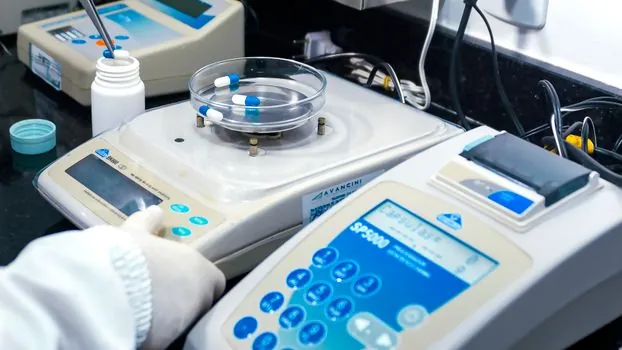
Resolution matters: tablet press and capsule filling demand ≥0.01% accuracy over the weighing range, while bulk API dispensing typically accepts 0.05-0.1%. The Alfa Laval capacitive platform cites plug-and-play ASIC calibration that removes time-consuming onsite adjustment, a concrete reduction of commissioning hours per vessel [S3]. For a deeper look at how single-point and compression cells differ, the load cell module reference covers the platform-to-vessel mechanical interface.
Selection Criteria: Match the Cell to the Process Node
Single-point load cells fit bench scales, checkweighers, and capsule fillers where the load is applied centrally and capacities stay in the 0.5-100 kg band. S-beam (Z-beam, S-type) cells handle tension or compression in hanging-weigh or in-line force applications, with female threads for mechanical mounting [S6]. Compression cells dominate tank, vessel, and silo weighing from 30 kg up to 100 t, and accept the heaviest mechanical abuse [S3][S4].
Minebea Intec offers Pendeo Process as a digital vessel-weighing line for SCADA-ready plants [S4].
Comparison of Common Load Cell Types for Pharma

Single-point cells offer the best accuracy-to-cost ratio for compact, low-capacity bench equipment, with capacities typically 0.5-100 kg and C3-C6 accuracy classes, but limited overload margin. S-beam cells add force-direction flexibility for inline compression/tension rigs but require careful alignment and anti-rotation hardware [S6].
Compression cells deliver the highest capacity range (0-100,000 kg) and the strongest overload tolerance (up to 1,000% on capacitive designs), at the cost of larger footprint and tank-leg mounting kits [S3]. Hygienic compression cells in stainless with capacitive ASIC calibration minimise mechanical mounting parts, removing stay rods and overload protectors that complicate CIP [S3]. For batch control loops downstream of the cell, a pressure transmitter often shares the same 4-20 mA or HART backplane.
Failure Modes and Field Constraints
The most common pharmaceutical load-cell failure is seal breach: moisture ingress through a cable entry or weld after repeated thermal cycling, producing zero drift within weeks. Hermetically sealed designs with potted cable exits and welded diaphragms are the documented mitigation [S3]. Side-load and torsion on a poorly aligned compression cell destroy the sensing element in agitated reactors; capacitive non-contact designs are largely unaffected by these forces because there is no mechanical contact between sensor and load body [S3].
Overload from washdown (water hammer, chemical slugging) is the second failure pattern. Standard strain-gauge cells fail at 150-200% of rated load; the Alfa Laval capacitive platform cites tolerance up to 1,000% as a published design figure [S3]. For medical and laboratory scales where calibration integrity must hold over years, Interface specifies a generous safe-overload rating as the core design margin [S2].
Standards, Calibration, and Compliance Mapping
No single global standard governs pharmaceutical load-cell selection, but the layered stack is consistent: OIML R60 (or NTEP for the US) sets accuracy classes, ATEX 2014/34/EU and IECEx govern hazardous-area builds, and 3-A / EHEDG cover hygienic cleanability for wetted-side hardware [S3][S4]. ATEX/IECEx versions of the Alfa Laval compression cell are published special models for explosive-area use [S3].
Factory pre-calibration with plug-and-play ASIC chip exchange is now standard on capacitive hygienic platforms, eliminating the corner-load adjustment ritual that older load cells required during commissioning [S3]. Traceability with OIML R76 indicators and PR 5220 / PR 5230 weight transmitters from Minebea Intec supports legal-for-trade batch documentation [S4]. For flow-based batch recipes that share a hygienic line with weight-controlled dosing, a flow meter often runs on the same fieldbus.
Vendor Shortlist and What Each One Actually Wins On
METTLER TOLEDO covers the broadest pharmaceutical weighing portfolio, from IND360/IND400/IND700 automation indicators down to single-point bench cells, with deep documentation for cGMP batch records [S1]. Minebea Intec differentiates on hygienic vessel weighing, with Novego, Contego, and Pendeo Process covering pharma-grade tank and skid builds up to 520 t [S4]. Sartorius (formerly GWT) is a long-standing specialist for in-process tank and hopper weighing, including agitated vessels [S5].
Alfa Laval focuses on hygienic fluid-handling integration, with compression cells engineered for clean-in-place and steam-in-place cycles in food, dairy, brewery, and pharmaceutical skids [S3]. Interface and FUTEK handle the medical-scale and OEM force-measurement niches, including gram-class gram load cells used in pill counting, powder dispensing, and capsule filling machines [S2][S8]. Sensomatic and Transducer Techniques cover small-capacity precision cells for life-saving medical and neonatal applications [S7][S8]. Cross-reference against an electronic load for bench testing the cell before field installation.
Trackable Signals for 2026 Spec Updates

Two specific things to watch over the next two quarters: the next METTLER TOLEDO IND360 firmware revision that bundles Pendeo-compatible digital protocols, and any ATEX/IECEx certificate refresh for the Alfa Laval capacitive compression cell line that would expand its Ex-zone rating [S1][S3]. For projects where measurement accuracy directly drives regulatory exposure, cross-checking the load switch reference clarifies how electromechanical limit protection stacks with the load cell's own overload margin.
Background reading: OEM vs ODM for measuring instruments: where the spec actually breaks.